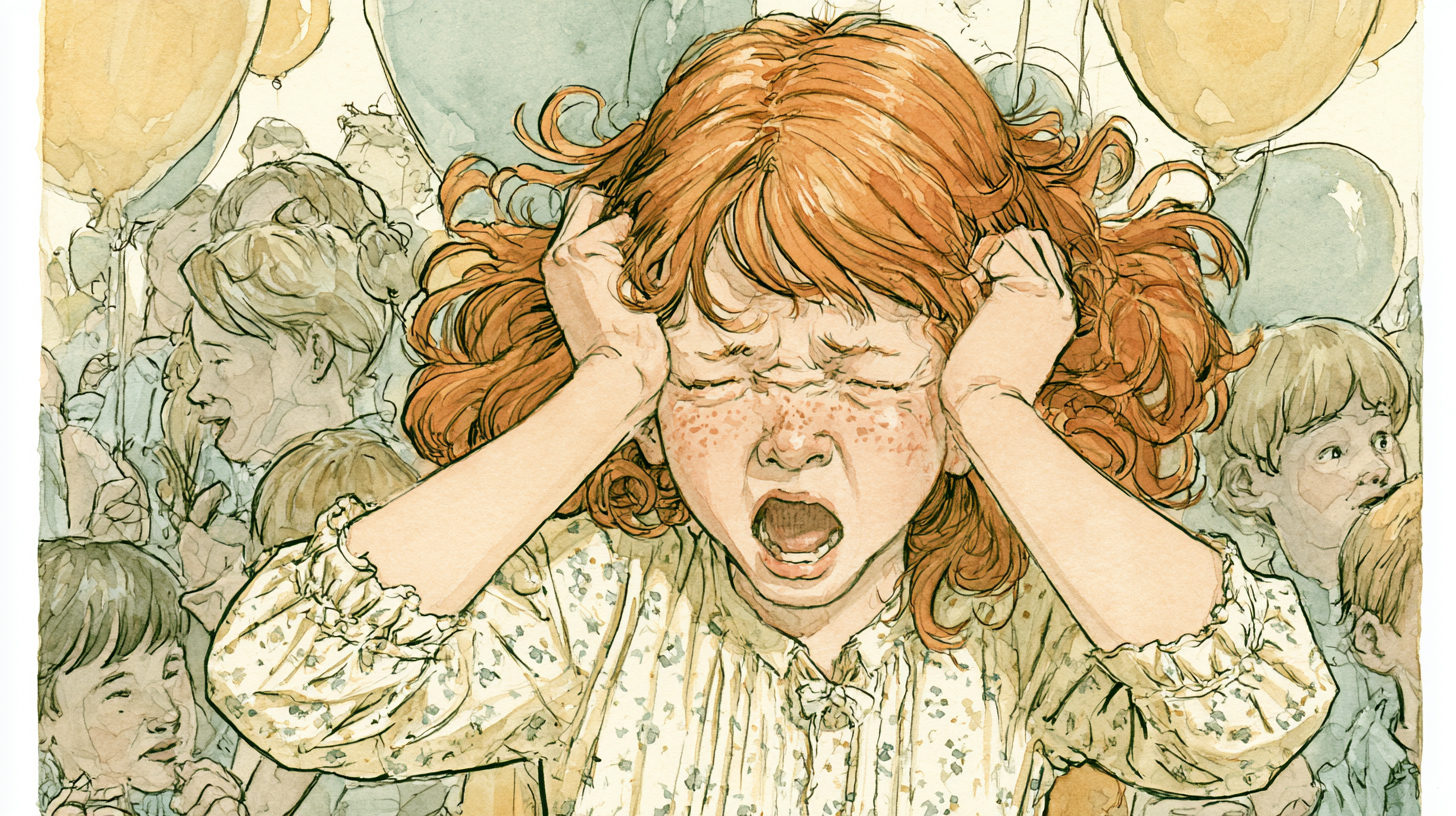
A tantrum has a goal and a sensory overload does not. A tantrum is a bid to get something, and it eases when that changes. Overload is a nervous system flooded past its limit, so it needs less noise and fewer demands, not a consequence.
From across the room, they look the same. A child on the floor, crying, screaming, inconsolable. Same volume, same tears, same impossible-to-reach quality. And because they look the same, we tend to respond to them the same way — and that is where the trouble starts.
Because a tantrum and a sensory overload are not the same thing. They come from different places, they need different responses, and the response that helps one can actively deepen the other. Learning to tell them apart is one of the most practically useful skills a parent can develop.
What a Tantrum Actually Is
A tantrum, in the truest sense, is goal-directed. It has a purpose. The child wants something — the toy, the candy, to not leave the park — and the tantrum is, at some level, a strategy for getting it. It is an emotional storm, yes, but it is a storm with an aim.
You can often see the goal-directedness if you look. A child in a true tantrum tends to keep some awareness of their audience. They may check to see if it's working. The intensity may flex depending on whether anyone is watching or whether the desired thing seems reachable. There is, underneath the upset, a thread of connection to the outcome they want.
None of this makes a tantrum bad or manipulative in a cynical sense. It is a young child using the tools they have to pursue a want. But it is fundamentally a communication aimed at a goal — and that matters for how you respond.
What a Sensory Overload Actually Is
A sensory overload is not goal-directed. It has no aim. It is not a strategy for getting anything. It is a nervous system that has taken in more input than it can process and has tipped into a state of overwhelm it cannot control.
The child in sensory overload is not trying to get something from you. They are not checking to see if it's working, because there is no "it." They have been flooded — by noise, light, crowding, texture, the accumulated sensory load of a too-much environment — and their system has reached its limit. What you are seeing is not a pursuit. It is an overflow.
This is closer to a meltdown than a tantrum, and the distinction is everything. A meltdown is a loss of control, not a bid for control. The child is not driving it. It is happening to them.
A tantrum is a storm with a destination. A sensory overload is a flood with no steering.
How Can You Tell a Tantrum From Sensory Overload?
You won't always know for certain, but there are reliable clues.
Is there a clear goal? If the upset began the instant a specific want was denied and would likely stop the instant that want was granted, you are probably looking at a tantrum. If there is no obvious want — or if giving the child what they "seem" to want doesn't help at all — you are likely looking at overload.
Is the child aware of you? A child in a tantrum usually retains some connection to their audience and their goal. A child in sensory overload is often somewhere else entirely — past the point of taking in your words, your face, or your offers. The lights-are-on-but-no-one's-reachable quality is a strong signal of overload.
What came before it? Context is one of your best clues. A tantrum tends to follow a thwarted want. An overload tends to follow accumulation — a long, loud, bright, crowded, demanding stretch of time. If your child has been holding it together through a sensory gauntlet and then erupts over something tiny, the tiny thing was the last straw, not the cause.
Does attention change it? A tantrum is often somewhat responsive to audience and outcome. An overload generally is not — it has to run its course regardless of what anyone does, because it is a physiological state, not a negotiation.
While you're here, take the guide
What's Underneath is free: the three body-state triggers under most meltdowns, what to say in the minute before it tips over, and how to reset afterward.
You'll get the guide instantly, plus five free articles in your inbox every week. Real challenges (meltdowns, school mornings, picky eating, big feelings) and how to actually handle them. Unsubscribe anytime.
Why the Response Has to Be Different
Here is why getting this right matters so much: the responses are nearly opposite.
For a tantrum, the general guidance many parents have absorbed is reasonable — stay calm, hold the boundary, don't reward the storm by handing over the thing, and let the child learn that the strategy doesn't achieve the goal. The child has the capacity, in a tantrum, to learn from how you respond.
For a sensory overload, that same approach is not just unhelpful — it can prolong and worsen the state. A flooded nervous system cannot learn a lesson, cannot be reasoned with, and cannot be "held accountable" mid-overflow, because the thinking brain is offline. Holding a firm boundary against a sensory overload is like trying to discipline a fever. What the child needs is not a lesson. It is a reduction in input and a calm presence while their system comes back down.
Treat an overload like a tantrum, and you add demand and threat to an already-flooded system. Treat a tantrum like an overload, and you may inadvertently reinforce that storms get results. The cost of mixing them up runs in both directions.
What Should You Do During a Sensory Overload?
Reduce the input. This is the first and most important move. Less noise, less light, fewer people, less talking. Get the child to a quieter, dimmer, calmer space if you can. You are trying to lower the flood.
Drop the demands. Now is not the moment for instructions, questions, or consequences. The system has no capacity for any of it. Demands are more input, and input is the problem.
Offer calm, not correction. Your steady presence — quiet, unhurried, not requiring anything — gives the child's system something to borrow regulation from. You are the calm they can't generate yet.
Wait it out. An overload runs a physiological course. It will come down, but on its own timeline, and the attempts to rush it tend to extend it.
The Shift Worth Making
The question is not "how do I stop this behavior" but "what is this behavior actually made of." A tantrum and an overload can look identical from the outside and require opposite things from you. Learning to read which one is in front of you — through the goal, the awareness, the context, and the response to attention — is what lets you give your child what they actually need rather than what the behavior superficially looks like it's asking for.
Same floor, same tears, two completely different children to meet.
Every behavior is a clue.
If you're trying to sort out which of your child's big moments are tantrums and which are overload, LightMap can help you track what precedes each — the sensory load, the context, what helps — so the pattern beneath them becomes easier to see. Explore LightMap at birchandlight.com/lightmap.
For your child: The Little Porcupine by the Road is about a porcupine whose quills are always up, brought to a noisy place, whose body slowly stops needing to be on alert without the place ever getting quieter.
Sources: Potegal and Davidson, "Temper Tantrums in Young Children: Behavioral Composition," Journal of Developmental and Behavioral Pediatrics (2003); peer-reviewed research distinguishing goal-directed tantrums from sensory-driven meltdowns (PMC); STAR Institute for Sensory Processing; Ross Greene, Collaborative and Proactive Solutions, on lagging skills versus motivation; American Academy of Pediatrics guidance on temper tantrums in young children.
Primary sources: Belden AC, Thomson NR, Luby JL, "Temper tantrums in healthy versus depressed and disruptive preschoolers: Defining tantrum behaviors associated with clinical problems," The Journal of Pediatrics, 2008, 152, 117-122. Potegal M, Davidson RJ, "Temper tantrums in young children: 1. Behavioral composition," Journal of Developmental and Behavioral Pediatrics, 2003.
For education and reflection, not medical advice. Our terms
See what's underneath
Find the input before it becomes a meltdown
LightMap reads your hard days together and gives you answers. Start with one moment today.
Start with 3 moments Not sure where to start? Ask me.Message Tara on WhatsApp. It really is me, I read everything and will personally respond.Click here to message Tara →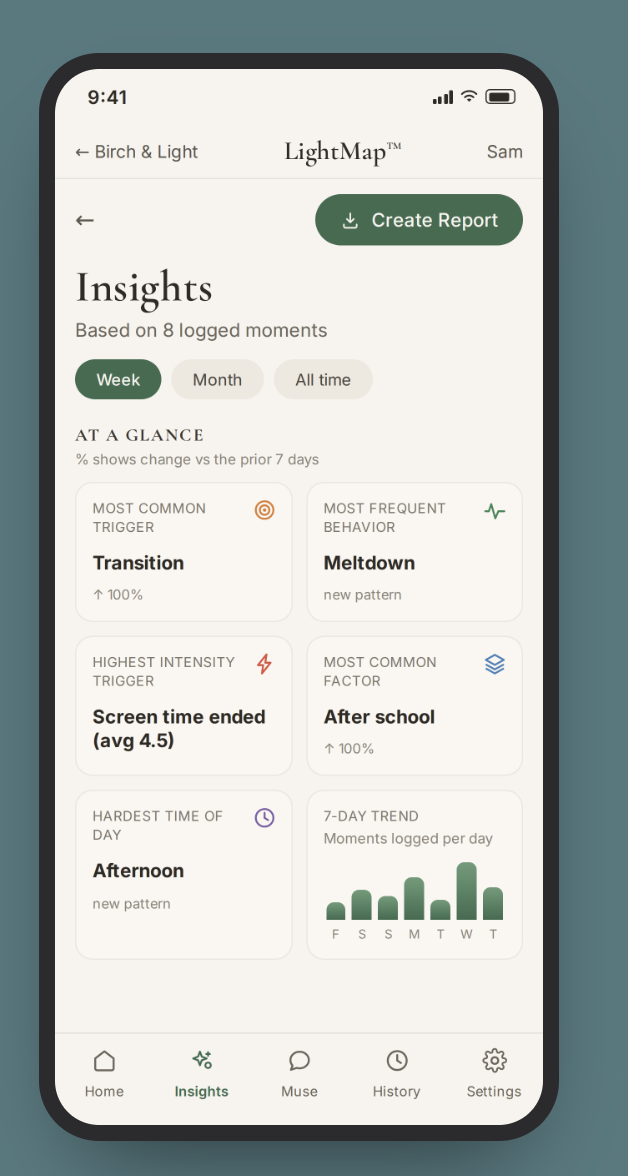

Part of the award-winning Birch & Light Method, honored with the Mom's Choice Gold Award for excellence in family resources.
A story to read together
Sometimes the easiest way in is a story you read side by side.
 Taste Bud 17
Taste Bud 17 feels everything more — and learns that big sensory feelings deserve the same care as everyone else’s.
Read the story Otto Filled Everything
Otto can't stop filling things with water. His family doesn't understand — until Grandma Willow helps them listen to what his body is actually asking for.
Read the story
If today was one of those days
A few more from the library, free to read.
Researched and drafted with AI assistance, reviewed before publication. Editorial standards