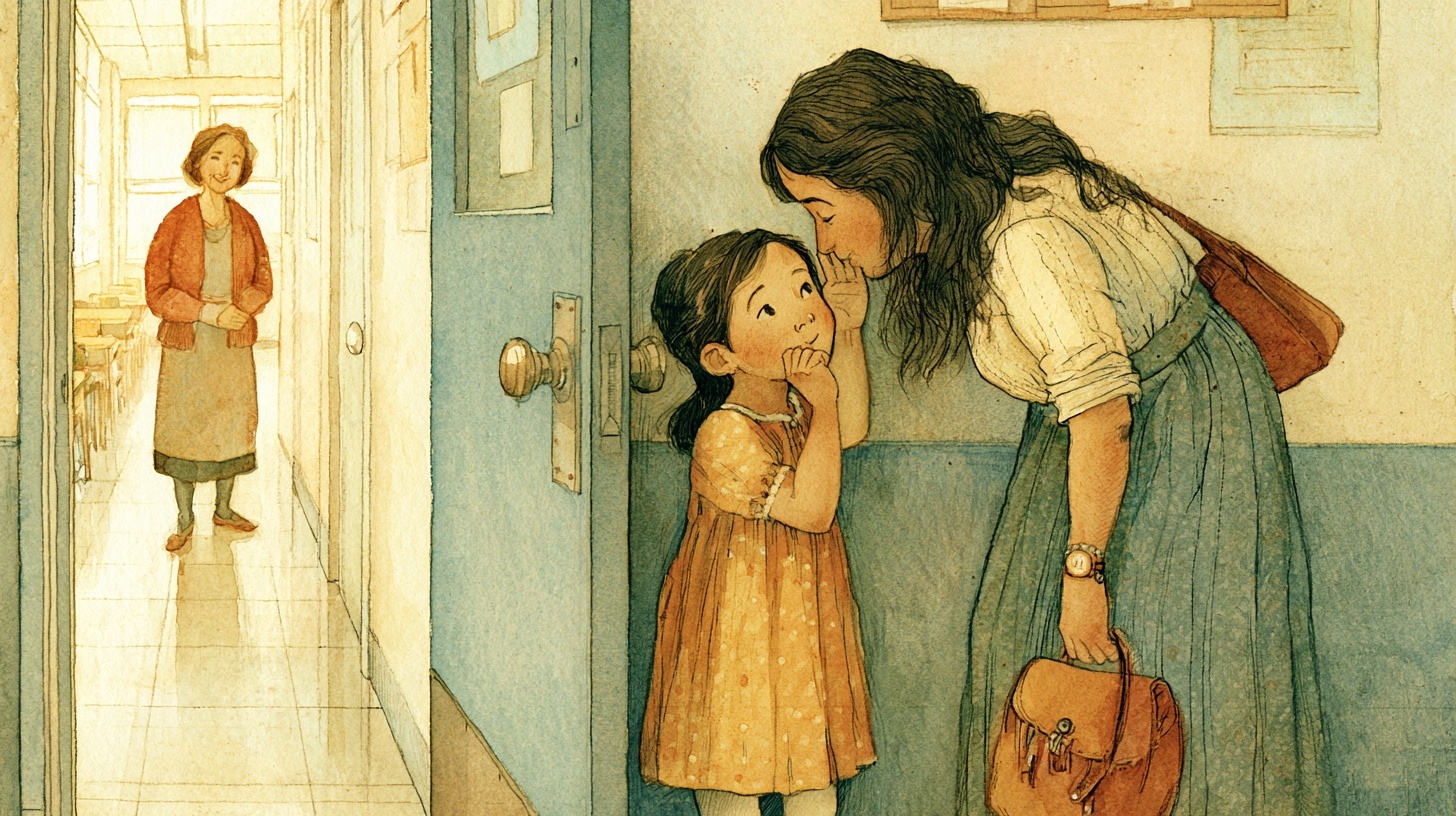
At home she talks constantly. Full sentences, jokes, opinions about everything, a running commentary you sometimes wish had a pause button.
At school she has not spoken a word since September.
Her teacher thinks she is shy and will warm up. Someone else has suggested she is being stubborn, or manipulative, or that she must be getting something out of it. And you know neither of those is right, because you have watched her want to answer and watched something stop her.
It is not refusal. It is anxiety with a physical lock on it.
Selective mutism is an anxiety disorder. That is its actual classification, not a soft framing of a behavior problem. The child is not deciding not to speak. In specific settings, the anxiety response is strong enough that speech becomes physically unavailable to them.
Parents describe it as a freeze, and that is close to what is happening. The threat response is doing what it does, and speech is one of the functions that goes offline. The child usually knows the answer. They often desperately want to give it. The words are there and the route out is closed.
The word selective causes endless trouble, because it sounds like choosing. It is not describing choice, it is describing the fact that the silence is situation-specific rather than global. Situational mutism is the clearer term and a lot of clinicians and autistic adults now prefer it.
Why the at-home version confuses everyone
The single most misleading feature of this condition is that the child speaks fluently in the settings where they feel safe. Which means the people who see the silence never see the talking, and the people who see the talking cannot picture the silence.
That is how you end up with a teacher who thinks the problem is mild, a relative who thinks the child is playing you, and a parent stuck holding evidence that nobody else has seen. It is also why the same accusation surfaces again and again: she can talk, so she is choosing not to. She can talk where the threat is low. She cannot where it is high. Both facts are real at once.
Speech is often not the only thing that locks. Many children also cannot eat in front of others, use a school bathroom, raise a hand, or move naturally when watched. Some appear frozen or expressionless in the setting where they are silent.
What it commonly gets mistaken for
Shyness. A shy child warms up over weeks. A child with selective mutism can go an entire school year without speaking, and often longer, without the situation resolving on its own.
Autism. The overlap is real and it runs both ways. A child who is silent, still, and hard to read in a classroom can look autistic to an observer who only sees that setting. Selective mutism also genuinely co-occurs with autism at rates well above chance. It is worth getting this properly assessed rather than assumed either way, because the supports differ.
Defiance or ODD. This is the most damaging misreading, because it leads to consequences. An adult asks a question, gets no answer, reads it as insolence, and applies a sanction. The sanction raises the anxiety, which tightens the lock, which produces more silence, which looks like escalating defiance.
A speech or language disorder. Sometimes there is one alongside, and that raises the stakes, because a child who already finds language effortful has more reason to fear being asked to produce it publicly.
Trauma. Where a child has had frightening experiences with school or with adults in authority, the silence can be tightly bound to that history. The mechanism is the same threat response; the trigger is more specific and often more entrenched.
The thing that makes it worse
Pressure to speak.
Every version of it. Waiting expectantly. Repeating the question more gently. Offering a reward for one word. Holding up an activity until she answers. Telling her the other children manage it. Praising her loudly on the rare occasion a word escapes, which guarantees the next one will not.
The reason is straightforward. Anxiety is driving the silence, so anything that raises the anxiety around speaking tightens the lock. Well-meaning adults produce most of the pressure in a typical day, and they produce it precisely because they can see the child wants to answer.
There is a second cost. A child under constant speech pressure starts avoiding the settings entirely, and this is one of the routes into school refusal.
While you're here, take the guide
What's Underneath is free: the three body-state triggers under most meltdowns, what to say in the minute before it tips over, and how to reset afterward.

You'll get the guide instantly, plus five free articles in your inbox every week. Real challenges (meltdowns, school mornings, picky eating, big feelings) and how to actually handle them. Unsubscribe anytime.
What actually helps
Take speech off the table first. Not forever. First. The child needs to learn that being in the room does not mean being asked to perform. Comment rather than question. Say things that do not require an answer at all.
Then build back in small graded steps. The evidence-based approach is a graded exposure ladder, done deliberately, usually with a therapist or a school team who knows the method. A typical progression runs something like: comfortable in the room, nonverbal participation, whispering to one trusted person with no audience, one word to that person, that person plus one other, and outward from there.
Use the brave-talking helper. Sliding-in is the standard technique. The child talks to the person they can already speak to, in the setting where they cannot, while a new person joins so gradually that the child barely registers the shift.
Let nonverbal count as participation. Pointing, writing, a thumbs up, a card on the desk, a recorded voice note. This is not giving up on speech. It is keeping the child included and engaged while the anxiety comes down, and reducing the accumulating experience of failure.
Give five seconds and then move on. If a question does get asked, a short unpressured pause with no expectant face, then a graceful exit, teaches the child that the moment will not be held open painfully.
Do not announce progress. When she does speak, respond exactly as you would to any other child speaking. Delighted commentary makes speech feel enormous and observed, which is what she is already afraid of.
Get it treated early. Length of time matters here. Silence that has held for years becomes part of a child's identity and part of how a whole school perceives them, and it gets harder to shift. Early, structured intervention has good outcomes, and this is not usually a condition children simply outgrow without help.
What to ask school for
Ask for a plan rather than sympathy. Specifically: that no adult requires a spoken answer for now, that nonverbal responses are accepted for register, requests, and classroom participation, that one consistent key adult is identified, that she has a guaranteed route to the bathroom without asking aloud, and that any assessment relying on spoken responses is understood to measure her anxiety rather than her knowledge.
Put it in writing. Silence is easy for a busy school to accommodate badly, because a quiet child is not disrupting anything and the plan quietly lapses.
If the mutism is tied to fear of adult authority or to specific experiences at school, say that plainly, because the plan has to account for it. A key adult chosen for convenience rather than safety will not work.
For the wider question of how school demands and anxiety interact, when anxiety looks exactly like defiance covers the same misreading in a different form, and understanding masking in school covers why the version you see at home can be so different from the one the school describes.
Who to ask for
A speech and language therapist or pathologist with specific selective mutism experience, or a child psychologist who works with childhood anxiety, is the usual starting point. Ask directly whether they have treated it before, because general anxiety experience is not the same thing and the graded approach has specific mechanics.
Where there is a co-occurring language difficulty, both need addressing. Where there is autism alongside, the mutism still gets treated as anxiety rather than absorbed into the autism diagnosis and left alone.
Which settings, which people, which days, what happened just before the silence closed in: log the specifics in LightMap as they happen. The pattern of where speech is possible is exactly what a therapist builds the ladder from, and it is almost impossible to reconstruct from memory months later.
Your child is not being difficult, and you are not imagining the gap between who she is at home and who the school describes. Both children are her. One of them is currently under a load she cannot speak through.
Sources: DSM-5-TR diagnostic criteria for selective mutism as an anxiety disorder; Selective Mutism Association clinical guidance; SMiRA (Selective Mutism Information and Research Association) resources for families and schools; peer-reviewed research on graded exposure, stimulus fading, and the sliding-in technique in the treatment of selective mutism (PMC; Journal of Anxiety Disorders); research on the co-occurrence of selective mutism with autism and with speech and language disorders (PMC); research on duration of symptoms and treatment outcomes in selective mutism (PMC).
For education and reflection, not medical advice. Our terms
See what's underneath
Find the trigger instead of chasing the fear
LightMap reads your hard days together and gives you answers. Start with one moment today.
Start with 3 moments Not sure where to start? Ask me.Message Tara on WhatsApp. It really is me, I read everything and will personally respond.Click here to message Tara →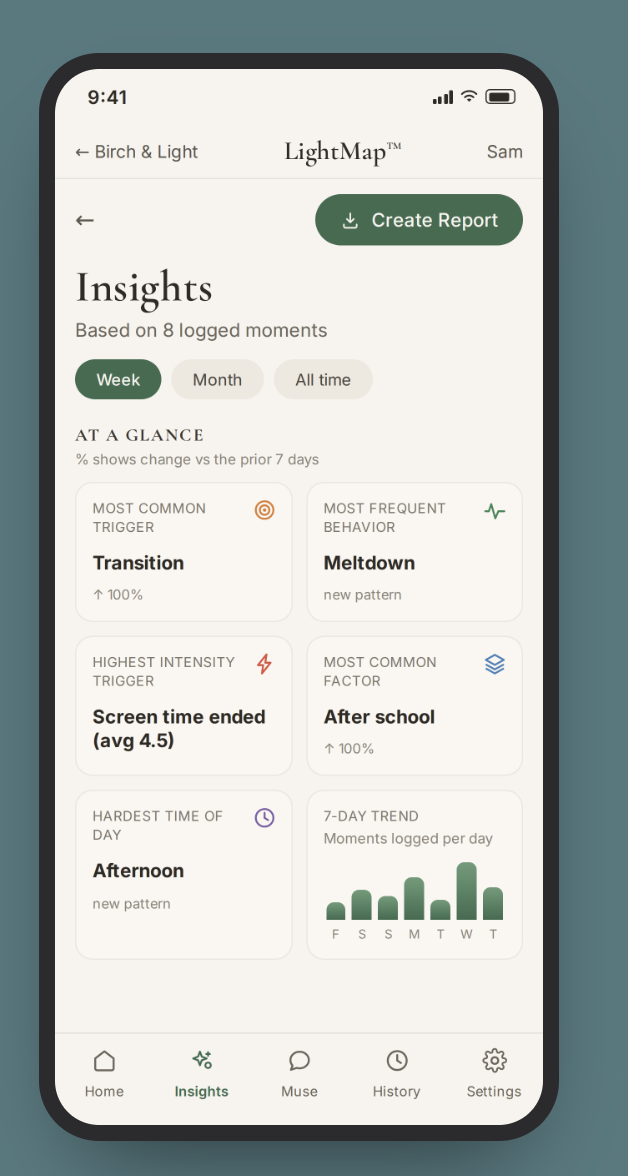

Part of the award-winning Birch & Light Method, honored with the Mom's Choice Gold Award for excellence in family resources.
A story to read together
Sometimes the easiest way in is a story you read side by side.
 HT the Hot Dog
A nervous hot dog learns that worrying about imagined disasters keeps stealing today’s joy.
Read the story Little Bird
Little Bird used to fly everywhere. Then the forest started to feel too big — and a wise voice helps her see that her wings remember more than her worries do.
Read the story
If today was one of those days
A few more from the library, free to read.
Researched and drafted with AI assistance, reviewed before publication. Editorial standards