
Most parents of intense, sensitive children have at least one story they do not tell people.
Something their child said at three or four that they cannot account for. A question answered that was never asked out loud. A thought repeated back word for word. Usually it happened once or twice, it stopped by school age, and the parent has quietly filed it under "that was strange" ever since, because saying it aloud sounds like something you would be embarrassed to have said.
If that is you, this article is written for you. Not to convince you of anything, and not to explain it away.
What parents actually describe
The reports are remarkably consistent, which is the first interesting thing about them.
They cluster around ages two to five. They almost always involve a primary caregiver rather than a sibling, a grandparent, or a stranger. They involve silent, internal, specific thoughts rather than moods or general states. They happen a handful of times rather than continuously. And they fade, usually between five and seven, often abruptly.
Parents also describe them in a particular way: not as a party trick their child could perform, but as something that happened to them, unbidden, and often at ordinary moments. Making dinner. Driving somewhere. Sitting on the sofa.
We are calling this intuitive telepathy, not as a claim about mechanism, but because the experience needs a name. Parents who have lived it recognize it instantly, and having no words for something makes it much harder to say out loud.
What science can explain
A great deal of it, honestly.
Human beings leak information constantly. Before you speak, your body has begun preparing to speak. Breathing shifts. The muscles around the eyes change. Your gaze flicks toward the thing you are about to mention. Your posture drops or tightens. Most of this is far too fast and small for you to notice yourself doing, but it is not hidden. It is simply subtle.
Young children who are sensory sensitive, anxious, or unusually attuned read this at a resolution most adults never access. They have strong reasons to. Before language is fluent, reading the adults around you is most of the information available, and for a child whose own nervous system swings hard in response to other people's states, early detection is genuinely useful.
Add shared context. You have been standing outside the ice cream shop before. Your child knows what you tend to say about spending money and what your tired face means at eight in the evening. A guess that lands is not a guess when the person guessing has thousands of hours of data on you.
Add memory. We remember the hit and forget the fifty misses. That is not a character flaw, it is how memory works for everyone, and it is why single striking incidents are almost impossible to evaluate years later.
Between those three things, most of these stories have a plausible ordinary reading. Not a dismissive one. Reading a parent that accurately is genuinely remarkable, it is just remarkable in a way that does not require anything new in physics.
What science cannot explain
Some of these stories do not reduce cleanly, and it is worth being honest about that rather than forcing them.
The ones that resist explanation tend to involve specific verbal content, not mood. A pre-reading child saying aloud two unusual words a parent had just silently read. A child repeating a full sentence a parent had thought in another room. Micro-expression reading, however sophisticated, does not transmit vocabulary.
Parents who have had one of these tend to know the difference. They are not confused about which of their stories are impressive and which are eerie.
While you're here, take the guide
What's Underneath is free: the three body-state triggers under most meltdowns, what to say in the minute before it tips over, and how to reset afterward.

You'll get the guide instantly, plus five free articles in your inbox every week. Real challenges (meltdowns, school mornings, picky eating, big feelings) and how to actually handle them. Unsubscribe anytime.
What the research actually says
There is a real scientific literature here, and it is genuinely unresolved rather than either proven or debunked.
The most studied protocol places a receiver in sensory isolation and a sender in another room, with four possible targets, so chance performance is twenty five percent. Across more than a hundred studies since the 1970s, hit rates have averaged around thirty to thirty three percent. A 1994 meta-analysis in a mainstream psychology journal concluded there was a replicable anomalous effect. A 1999 analysis of tighter studies in the same journal found none. In 2005 a group of researchers who publicly disbelieved in the phenomenon attempted a replication and reported a significant result, to their own evident discomfort. A registered report meta-analysis published in 2024 still finds a small effect.
The pattern over fifty years is that the effect shrinks as controls tighten, but has not gone away. Reasonable scientists disagree about what that means.
What does not exist is rigorous research on parent and child specifically. The studies use adult strangers in laboratories, which is close to the opposite of the conditions parents describe. That is a genuine gap, not evidence either way.
One caution if you go reading further. There is a great deal of material in this space, some of it built on communication methods that have been rejected by speech and language professional bodies because the evidence indicates the facilitator, rather than the child, is producing the messages. Be careful about what you accept as documentation, particularly where nonspeaking children are involved. The stakes there are high, and families deserve better than wishful reporting.
Why it might fade
The most common explanation is that language outcompetes it. A child without much vocabulary has to read the room. As language and abstract reasoning develop, they start relying on what people say rather than what people's bodies do. The perceptual channel does not necessarily disappear, it just stops being the primary one.
Some of it is likely socialized away too. Children learn quickly that announcing what they have noticed about adults makes adults uncomfortable, so they stop announcing it. The noticing may well continue in silence, which is worth sitting with.
What this means for your child now
Here is the part that matters more than the mystery.
Whatever was happening, a child who could do that is a child with very little filter between your state and theirs. That does not go away when the striking incidents stop.
It is why your hard day becomes their hard evening. Why they escalate when you are barely holding it together, even though you were sure you hid it. Why they seem to fall apart for no reason on the exact day you got bad news and said nothing.
It also explains the combination parents find confusing: a child who is strikingly perceptive and kind about other people's feelings, and who also comes apart over small things. Those are the same trait. High sensitivity to signal is not selective.
So the practical work is the same whether you believe something extraordinary happened or not. Name your own state briefly rather than denying it, because a child who can see you are upset and hears you say you are fine learns to distrust their own perception. Regulate yourself first and genuinely, because they are reading your body and your body is not fooled by your tone. And give them somewhere to put what they absorb, because children who take on this much of other people need a way to set it down.
If you have one of these stories
You are not the only family. These accounts turn up across cultures and across generations, told in almost identical terms, by people who have never met.
You are also not obliged to resolve it. It is entirely possible to hold something as unexplained without either explaining it away or building a belief system on it. Most parents who have lived this seem to land there naturally, which is probably the healthiest place to be.
What is worth keeping is the underlying observation. You have a child who perceives more than most people do. That is true regardless of what happened when they were three, and it is the thing that will shape the next ten years.
This is general information for parents, not medical or psychological advice.
If you want to see how much of your child's hard week tracks your own, LightMap is built for that. Log the difficult moments as they happen, and the pattern underneath starts to show. A lot of parents are surprised by what lines up.
Sources: Bem and Honorton, Psychological Bulletin (1994); Milton and Wiseman, Psychological Bulletin (1999); Storm, Tressoldi and Di Risio, Psychological Bulletin (2010); Tressoldi and Storm, F1000Research registered report meta-analysis (2024); Schmidt et al., British Journal of Psychology (2004); American Speech-Language-Hearing Association position statement on Rapid Prompting Method and Facilitated Communication.
For education and reflection, not medical advice. Our terms
See what's underneath
Next time, you will know what set it off
LightMap turns scattered hard days into a pattern you can see. Start by logging one moment tonight.
Log today's hard moment, no account needed Not sure where to start? Ask me.Message Tara on WhatsApp. It really is me, I read everything and will personally respond.Click here to message Tara →

Part of the award-winning Birch & Light Method, honored with the Mom's Choice Gold Award for excellence in family resources.
A story to read together
Sometimes the easiest way in is a story you read side by side.
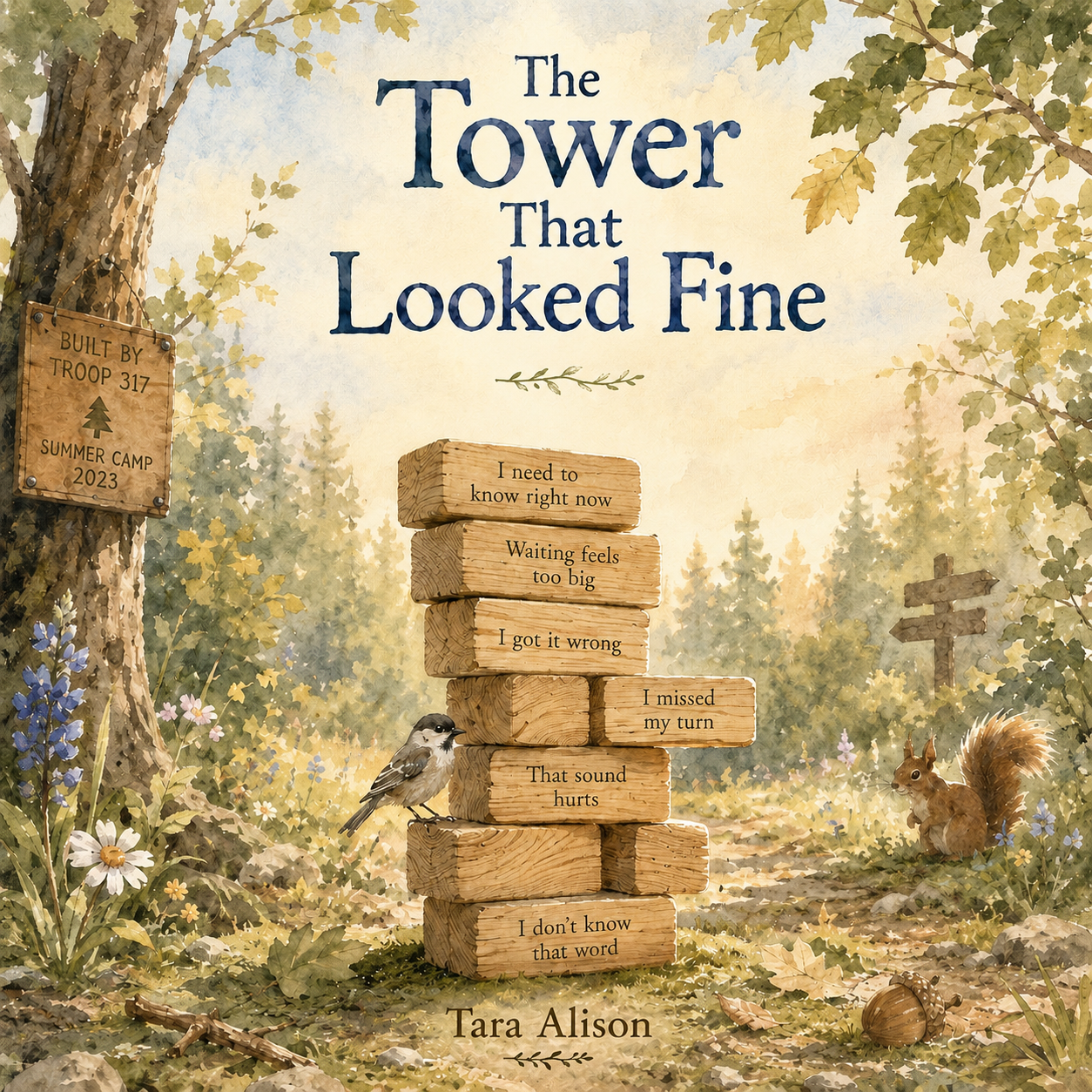 The Tower That Looked Fine
A tower in a quiet clearing tries to stay steady through every small thing nobody else seems to notice — until one tiny breath of wind causes her to fall, and a gentle hand begins to gather the blocks back.
Read the story The Princess and the Witch Inside
Esme is loved, but a fast protective part keeps rushing in before she gets a turn. A quiet visitor helps her meet the witch inside — not as an enemy, but as a worried protector — and find her way back to the people she wanted to be with all along.
Read the story
Researched and drafted with AI assistance, reviewed before publication. Editorial standards