
With a screen, your child is a different person. Settled. Quiet. Absorbed. Easy to be around. And then the screen goes away, and within minutes the tension is back — the short fuse, the big reactions, the way the smallest thing now sets them off. The contrast is so sharp it can feel like whiplash.
From there, the conclusion seems obvious: the screen is the problem. It is winding them up, frying their patience, making them worse. Less screen, calmer kid. It is the most natural inference in the world, and for some children it may even be partly true.
But for a great many kids, the pattern is pointing at something almost opposite — and missing it leads parents to do the one thing that makes everything harder. If a child is genuinely calm with a screen and falls apart without one, the screen may be doing real regulatory work. And the explosion when it's gone may not be the screen's damage showing up. It may be everything the screen was holding at bay, suddenly visible.
The Screen as a Regulator
For some children, a screen functions less like entertainment and more like scaffolding — external support for a nervous system that struggles to hold itself steady on its own. It is absorbing enough to quiet a busy, racing mind. It is predictable enough to feel safe. It delivers stimulation in a controlled, steady, manageable stream rather than the chaotic flood of the real world.
For a child whose system is easily overwhelmed, that combination can be the thing that keeps them inside their window of tolerance — psychiatrist Dr. Dan Siegel's term for the zone where they can cope, think, and stay regulated. It is not indulgence. It is, functionally, a coping tool that happens to come in the shape of a tablet.
Which leads to an uncomfortable but important reframe: the calm you see on the screen may not be your child's baseline. It may be a borrowed calm — a regulated state the screen is helping to produce. And when the borrowing ends, you don't see their true steady self emerge. You see what the screen was covering.
Why "Off Them" Gets Explosive
If the screen was doing regulatory work, then taking it away predictably produces dysregulation — and it helps to understand exactly why, because each reason points toward a different kind of support.
The support is gone, but the load isn't. Whatever was overwhelming your child before they picked up the screen — the exhausting school day, the sensory overload, the accumulated stress, the simple depletion of a hard afternoon — is all still there. The screen didn't resolve it. It paused it. Remove the screen and the full, un-dealt-with load comes rushing back into a child who now has no buffer against it.
The contrast itself is a shock. Going from a steady, absorbing, low-demand state straight into an unstructured, high-demand world is a jarring transition for any nervous system, and a genuinely hard landing for a depleted one. The explosion is often the sound of that landing.
There may be nothing left underneath. If the screen was the last bit of regulation your child had access to at the end of a long day, then removing it doesn't just remove a privilege. It removes their final coping resource — and a child with no resources left is a child who melts down.
The explosion off the screen isn't proof the screen ruined them. It's often a window into how much they were already carrying — and how little was left to manage it.
While you're here, take the guide
What's Underneath is free: the three body-state triggers under most meltdowns, what to say in the minute before it tips over, and how to reset afterward.

You'll get the guide instantly, plus five free articles in your inbox every week. Real challenges (meltdowns, school mornings, picky eating, big feelings) and how to actually handle them. Unsubscribe anytime.
The Trap Worth Avoiding
Here is where good intentions backfire. The intuitive response — cut the screens, and the calm will return — frequently produces the exact opposite. If the screen was providing regulation your child cannot yet generate on their own, then removing it without replacing that support doesn't restore calm. It removes the one thing that was creating calm, and you get more dysregulation, not less.
This is the crucial distinction: the goal is not to rip away the scaffolding and hope the child stands on their own. The goal is to understand what the scaffolding was holding up — and to build other supports alongside it, so that the screen is no longer the only thing keeping your child regulated. You reduce the reliance by adding alternatives, not by subtracting the one thing that works and leaving a vacuum.
What Tends to Help
Look at the whole day, not just the screen. If the explosions reliably cluster after school, before meals, when they're tired, or at the end of overstimulating days, that is your evidence: the screen is not the cause. It is the thing that was masking an already-full system. The real work is upstream of the device.
Add support before you subtract the screen. Movement, food, water, quiet, connection, downtime — forms of regulation your child can access without a device — need to be built up first. When other supports are genuinely in place, removing the screen stops being a freefall, because it's no longer the only thing holding them.
Soften the transition out. The exit from screen time is where the dysregulation shows itself, so that is where to intervene. A heads-up before it ends. A bridge into the next thing rather than a cliff. Something concrete and not-too-demanding to land in, rather than an empty, high-pressure void.
Track the pattern. Pay attention to when the off-screen child is hardest. The timing almost always reveals the underlying load the screen was quietly covering — and once you can see that load, you can start addressing it directly.
The Shift Worth Making
"Calm on, explosive off" is not a verdict on screen time. It is a clue about regulation — how much your child has, where they currently get it, and what is left when it's gone. Read that way, it stops being evidence that the screen is the villain and becomes a map of where your child needs more support.
Once you see the screen as one support among several rather than the enemy, the whole project changes. The work is no longer about taking something away. It is about building enough underneath your child that the screen stops being the only thing holding them up.
If the explosions are intense or frequent and you're feeling stretched thin, this is also exactly the kind of pattern worth exploring with a professional who can look closely alongside you.
Every behavior is a clue.
If your child is steady with a screen and falls apart without one, LightMap can help you track what's happening around those moments — what was building before, what's left after — so the pattern beneath them becomes easier to see. Explore LightMap at birchandlight.com/lightmap.
Sources: Dan Siegel, MD, "The Developing Mind" and interpersonal neurobiology framework on the window of tolerance.
For education and reflection, not medical advice. Our terms
See what's underneath
Next time, you will know what set it off
LightMap reads your hard days together and gives you answers. Start with one moment today.
Start with 3 moments Not sure where to start? Ask me.Message Tara on WhatsApp. It really is me, I read everything and will personally respond.Click here to message Tara →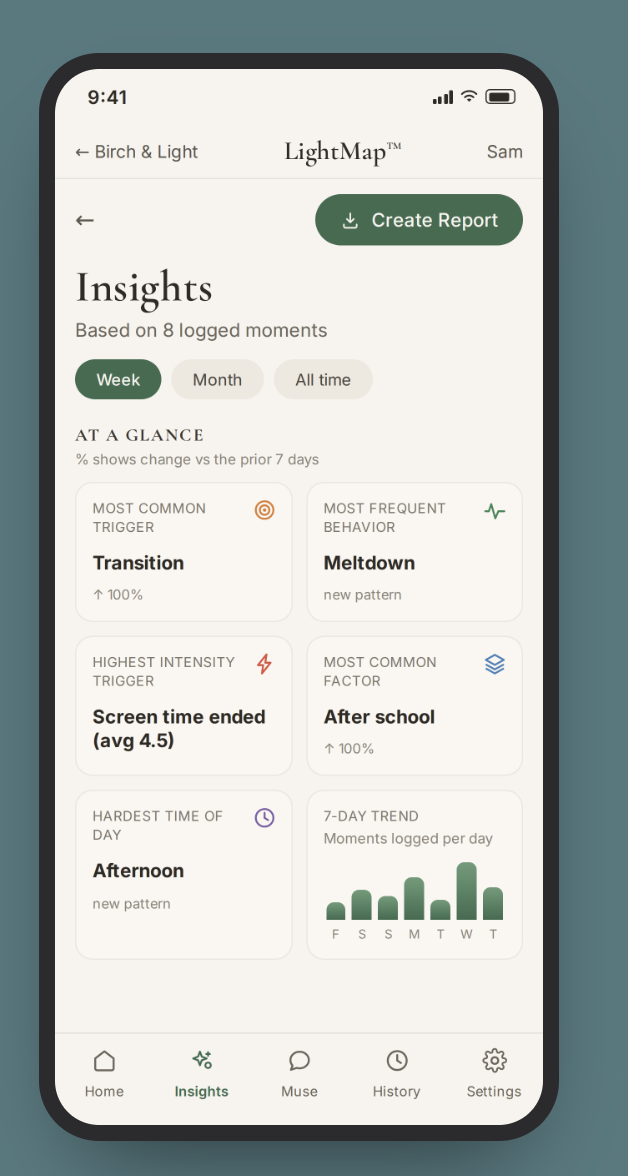

Part of the award-winning Birch & Light Method, honored with the Mom's Choice Gold Award for excellence in family resources.
A story to read together
Sometimes the easiest way in is a story you read side by side.
 But I Said “Okay”
Owen always says okay. He means it every time. But his attention is still inside the bridge, the dragon, the cave, the music — until Mom realizes that helping him leave one thing matters more than asking him to start the next.
Read the story When Wildflower Day Ended for Gus
Gus loves Wildflower Day so much he can't bear for it to end — and learns that beautiful moments don't have to disappear when we leave them.
Read the story
If today was one of those days
A few more from the library, free to read.
Researched and drafted with AI assistance, reviewed before publication. Editorial standards