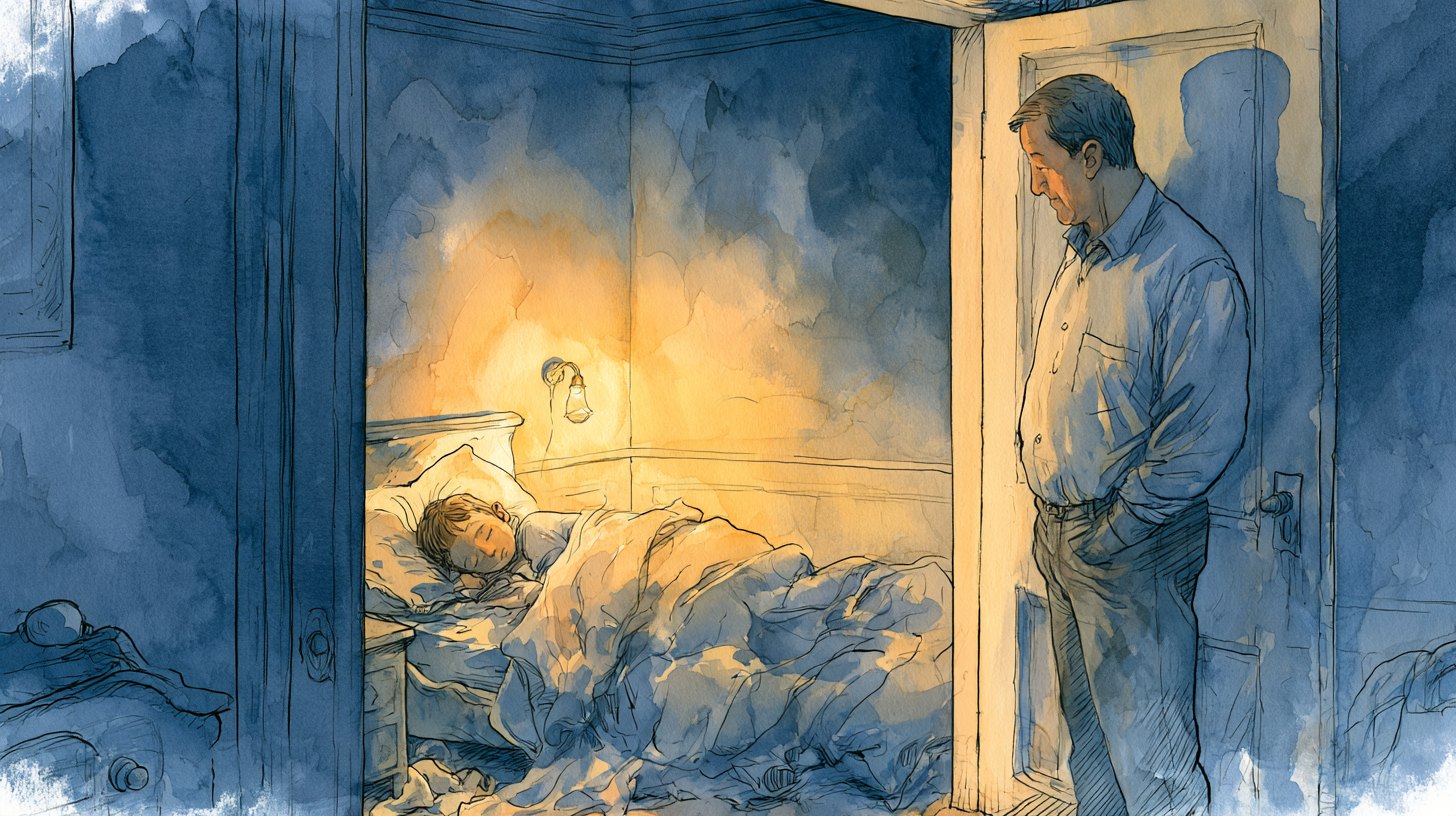
A night terror is an incomplete awakening from deep sleep: your child screams and thrashes, cannot hear or recognize you, and remembers nothing in the morning. It is harmless to her, so keep her safe and do not try to wake her. Frequent episodes can signal disrupted sleep, such as snoring or restless legs, so raise them with a doctor.
One of mine started when she was around five. She would sit bolt upright in the dark, screaming, kicking, thrashing, her eyes wide open. We would say her name. We would say it louder. We would put our hands on her and try to hold her still, and none of it landed, because she could not hear us.
That is the part nobody prepares you for. You are standing in front of your own child, in your own house, saying her name, and there is no way in.
In the morning she had no memory of it. None at all. She came down for breakfast the way she came down every other day, and we were the ones still shaking.
What follows is what I know now and did not know then. Some of it has changed since those nights on the edge of her bed, and the part that has changed most is what a doctor should do about it.
What is happening in her brain?
Night terrors, called sleep terrors in the medical literature, belong to a family of sleep events called NREM parasomnias, or disorders of arousal. The others in that family are sleepwalking and confusional arousals, and a child who has one often has another.
Sleep is not a single state. It moves in cycles, and the deepest part, slow-wave sleep, is heaviest in the first few hours after a child falls asleep. Children have far more slow-wave sleep than adults do, which is one reason these events belong to childhood. During slow-wave sleep the brain is at its least responsive to the outside world.
A night terror is an incomplete awakening out of that state. Part of the brain surfaces and part of it stays deeply asleep. The systems that produce movement, vocalization and the physical alarm response come online. The systems that produce awareness, recognition and memory do not.
Researchers describe this as sleep and wake happening simultaneously in different regions of the same brain. The direct evidence comes from a small number of patients who happened to have electrodes placed inside the brain for epilepsy surgery and had an episode recorded. Studies published in Sleep in 2009 and 2018, and in the Journal of Sleep Research in 2012, documented motor and cingulate areas producing wake-like activity while frontal and parietal association areas stayed in deep sleep during the same episode. Those recordings captured confusional arousals rather than full sleep terrors, and they were adults rather than children, so this is the mechanism as best it is currently understood rather than a settled account.
That single mechanism explains every confusing thing about the event:
- Why she does not respond to you. The parts of her brain that recognize faces and process language are still asleep. Your voice is arriving at a closed door
- Why comfort does not work. There is nobody there to comfort
- Why she looks terrified. Her autonomic nervous system has fired, so her heart is racing, she may be sweating, her pupils may be dilated. The physical signature of terror is present without the experience of it
- Why she remembers nothing. Memory encoding is offline. There is no experience being recorded to recall
- Why she is fine the next day. As far as she is concerned, nothing happened
The distress in that room is real, and almost all of it is yours.
Night terrors are not nightmares, and the difference is diagnostic
The two get used interchangeably in ordinary speech and they are different events, arising from different stages of sleep, with different implications.
Nightmares come out of REM sleep, the dreaming stage, which dominates the second half of the night. The child wakes fully. She knows where she is and who you are. She is frightened, she wants you, comfort works, and in the morning she can usually tell you something about the dream. Nightmares become more common as children get older, not less.
Night terrors come out of slow-wave sleep, usually in the first third of the night, often within one to three hours of falling asleep. The child does not wake. Comfort does not reach her. The event ends on its own, frequently very abruptly, and she drops straight back into sleep. In the morning there is nothing.
You can run the diagnostic test at breakfast. Ask her, lightly, without loading the question. If she has no idea what you are talking about, that is your answer, and it is a more reliable indicator than anything you will read.
One caveat on timing. Most night terrors happen early in the night, but not all of them do, and a child who is significantly sleep deprived can have slow-wave sleep pushed later. Timing is a strong clue rather than a rule.
How common are night terrors?
Common enough that if it is happening in your house, it is happening in several houses on your street.
Estimates vary widely depending on how the question is asked, and the published range is genuinely wide. Studies asking whether a child has ever had a sleep terror return figures anywhere from about one percent to eighteen percent, depending on the population and the definition used. Studies asking about recurrent episodes cluster lower, around one to six percent. The International Classification of Sleep Disorders puts the working estimate at roughly six percent of children. Anyone quoting you a single confident number is rounding off a real disagreement.
Peak age sits between five and seven, which is when my daughter's started. Around half of affected children have stopped having them by age eight, and the large majority stop by adolescence, as the amount of slow-wave sleep drops during the teenage years. Persistence into adulthood happens but is uncommon, at roughly one to two percent.
Family history matters more than most parents realize. Positive family history is reported in a large majority of cases, often cited at around eighty percent. If you or your partner sleepwalked as a child, or had these yourself, you have probably found the biggest single reason.
What has changed since I was going through this
When my daughter's were happening, the standard advice was straightforward: they are harmless, they are developmental, most children grow out of them, keep her safe and wait. That advice is still broadly correct, and it is now incomplete.
What has shifted is the recognition that frequent or persistent night terrors are often a symptom of something else that is fragmenting a child's sleep, and that the something else is frequently treatable.
The landmark work here came out of the Stanford sleep clinic. A study published in Pediatrics in 2003 examined eighty-four children with recurrent sleepwalking or sleep terrors. Fifty-one of them, around sixty-one percent, turned out to have an additional sleep disorder. Forty-nine had sleep-disordered breathing. Two had restless legs syndrome.
The children who were treated for the underlying condition, mostly with tonsil and adenoid surgery, had their parasomnias resolve. The small group who went untreated continued to have them.
Sixty-one percent is not a footnote. It means that for a child with frequent episodes, the odds are better than even that there is a driver underneath, and that finding it does more than waiting will.
The mechanism makes sense once you see it. A child whose breathing is partially obstructed during sleep, or whose legs are uncomfortable, surfaces repeatedly toward lighter sleep all night. Every one of those partial arousals is an opportunity for an incomplete awakening. The parasomnia is not the disease. It is what the fragmentation looks like from the outside.
This is the piece I would want a parent to know now that I did not know then. Not because most children need surgery, because most do not, but because the question "is anything disrupting her sleep" is a better first question than "how do we stop the terrors."
What to do while it is happening
Less than every instinct in your body is telling you to do.
Do not try to wake her. You will likely find you cannot, because the arousal threshold in slow-wave sleep is extremely high, and many children simply cannot be roused mid-episode no matter how loudly their name is said. When waking does work, pulling a child out of slow-wave sleep produces a disoriented, frightened, genuinely upset child who now has something real to be scared of, and the episode often restarts. Do not restrain her unless she is at risk of injury, because physical restraint tends to escalate the thrashing.
What helps:
- Stay in the room. Close enough to stop her hitting a headboard, a wall or the floor
- Keep the lights low and the room quiet
- Say very little. Whatever you say is not being received, and a stream of anxious talk from you raises the noise level in a room that needs less of it
- Let it run. Most episodes last a few minutes, but do not let that number set your expectations, because some run forty-five minutes or longer, which is exhausting and not more dangerous
- Do not discuss it with her in the morning in a way that alarms her. She has nothing to remember and telling her she screamed for forty minutes can create a fear of sleep that was not there before
If she has ever gotten out of bed during one, treat this as a safety issue now rather than after something happens. A gate at the top of the stairs, a chime or alarm on her bedroom door, nothing breakable or sharp within reach, windows secured, and any outside door locked in a way she cannot operate half asleep. Injury during these events is the one genuine risk, and it is a preventable one.
While you're here, take the guide
What's Underneath is free: the three body-state triggers under most meltdowns, what to say in the minute before it tips over, and how to reset afterward.

You'll get the guide instantly, plus five free articles in your inbox every week. Real challenges (meltdowns, school mornings, picky eating, big feelings) and how to actually handle them. Unsubscribe anytime.
The triggers, and why they are counterintuitive
Almost everything that increases night terrors does so by deepening slow-wave sleep or fragmenting it. That produces advice that sounds backwards.
- Overtiredness. The most common trigger by a distance. A late night, a dropped nap, a busy week, a vacation. An overtired child produces more and deeper slow-wave sleep to compensate, and more slow-wave sleep means more opportunity for these events
- Irregular bedtimes, for the same reason. Consistency does more here than any single early night
- Illness and fever
- A full bladder. Simple, common, and easy to test by adjusting evening fluids and offering the bathroom before you go to bed yourself
- Noise or touch during deep sleep. A sibling coming in, a door, a dog
- Stress and major transitions. Real, and usually secondary to the others rather than the whole story
- Some medications, including certain sedatives and, in some children, stimulants. If terrors started within weeks of a medication change, that belongs in the conversation with the prescriber
The practical consequence surprises most parents: an earlier bedtime usually reduces night terrors. If you have been pushing bedtime later hoping she will sleep more soundly, try the opposite consistently for two weeks and watch what happens.
When should I see a doctor, and what should I ask for?
Most children need reassurance and a safe bedroom rather than investigation. Take it further if any of the following are true.
She snores, mouth breathes, or seems to pause or gasp in her sleep. This is the single most useful thing you can report, and the one most likely to change the outcome. Ask directly about sleep-disordered breathing and whether an ENT assessment or a sleep study is appropriate. Recent longitudinal work continues to find that treating the obstruction reduces parasomnia symptoms.
She is restless in bed, kicks a lot, or complains of aching or "funny" legs, or you have a family history of restless legs. Ask for a serum ferritin, not a standard iron panel, because ferritin measures storage and it can be low while everything else reads normal. This is where a lot of parents get told the bloods are fine. In pediatric sleep medicine the treatment thresholds discussed are far higher than the laboratory's abnormal flag, with figures in the range of fifty micrograms per liter used in adults and lower thresholds debated for children. Case series and clinic reports describe parasomnias improving or resolving with iron repletion in children who have restless sleep, though the evidence base here is smaller than for the breathing question and iron should only be given on a doctor's advice after testing.
Episodes are frequent, injurious, or happening several times a night.
They started suddenly in an older child who never had them, or arrived alongside other new symptoms.
They happen late in the night, or she remembers them. That points away from night terrors and toward something else that deserves its own answer.
One further note for parents in our world. Nocturnal seizures can occasionally look like a parasomnia. Features that argue for a medical review rather than reassurance include episodes that are very stereotyped, meaning near identical every time, very brief and very frequent in one night, involving stiffening or rhythmic jerking, or occurring in the second half of the night. Bring a phone video if you can. A thirty second clip will tell a sleep physician more than a page of description.
Scheduled awakening, the technique that sounds wrong
For a child with frequent episodes at a fairly predictable time, there is a behavioral intervention with real support behind it, and it is counterintuitive enough that most parents have never heard of it.
It works like this. Track her timing for a week or two, until you know roughly when the episodes tend to happen.
Then, about fifteen to thirty minutes before that time, go in and rouse her lightly. Not a full waking. Enough that she stirs, mumbles, shifts, opens her eyes briefly. Then let her settle back down. Do this every night for two to four weeks, and once the episodes have stopped, fade it out gradually.
The rationale is that you are interrupting the approach into the deepest part of the cycle at the moment the incomplete arousal would otherwise occur. One proposed mechanism is that the child gradually learns to surface on her own just before an episode would happen.
The evidence is case series rather than large trials. A 1997 study in the Journal of Pediatric Psychology used scheduled awakenings with three children who had persistent sleepwalking and eliminated it in all three, with the effect holding at three and six months. A separate case series in three boys with a multi-year history of sleep terrors reported the same, sustained at twelve months. Reviews of behavioral treatment for NREM parasomnias describe scheduled awakening as the evidence-based behavioral option, while noting honestly that it is demanding for parents to keep up. Small numbers, consistent results, and no large randomized trial behind it.
Two practical notes. The technique depends entirely on knowing her actual timing, which is why the tracking comes first rather than the intervention. And if you accidentally trigger an episode by going in, published guidance is to leave it alone rather than intervening, and to move your awakening time fifteen minutes earlier the following night.
Medication is rarely used in children for this and is generally reserved for cases that are frequent, dangerous, or unresponsive to everything else. That is a conversation with a sleep specialist rather than a first step.
Why do night terrors turn up more in neurodivergent children?
If your child is autistic, has ADHD, or is somewhere in the wider group of kids whose nervous systems run differently, the odds go up.
A systematic review published in 2024 examining NREM parasomnias and psychopathology found a higher incidence of these events in children with neurodevelopmental conditions, particularly ADHD, and found anxiety and depression to be the most commonly co-occurring symptoms across ages. A polysomnography study of autistic children found significantly more NREM parasomnias than in matched comparison children, and notably that finding did not appear to be explained by medication, other conditions, or sleep-disordered breathing.
Sleep problems in general cluster heavily here. Estimates for sleep difficulties in autistic children run between fifty and eighty percent, against roughly a quarter of children generally. Around a quarter to a half of children with ADHD have significant sleep problems.
There are several plausible reasons, and they are not mutually exclusive. A child who spends the day managing sensory input, holding herself together at school, or running an anxious nervous system at a higher baseline arrives at bedtime carrying more sleep debt. Anatomical and airway differences increase the risk of disrupted breathing in some groups. Iron status is more often low in children with ADHD. And the underlying regulation of arousal, which is the thing not working smoothly during a night terror, is arguably the same system under strain during the day.
None of this means a night terror is a sign of something wrong with your child. It means the conditions that produce them accumulate more easily in a child who is already working harder than everyone else.
The part that is actually about you
Your child will not remember any of this. You will remember all of it.
There is something specific about being unable to reach your own child. Sitting on the edge of her bed, saying her name into a room where it does not arrive, is a particular kind of helplessness, and it stays with you far longer than the episode does. It is entirely reasonable to still find it frightening after somebody competent has told you it is harmless.
Harmless for her is true. Harmless for you is a different question. If you are lying awake afterward waiting for the next one, or listening through the wall at the hour it usually happens, that is not you overreacting. It is the ordinary cost of watching something you cannot fix, in a child you would fix anything for.
It helps, slightly, to hold onto the mechanism. She was not frightened. She was not calling for you and being ignored. Her body ran an alarm with nobody home to feel it, and by morning it had left no trace on her at all.
What to track, and why it decides everything
Every useful decision in this article depends on a pattern, and a pattern is close to impossible to reconstruct from memory in a fifteen minute appointment months later.
What matters:
- The clock time the episode started, and how long it lasted
- How many hours after she fell asleep it began
- What the day before looked like. Late night, missed nap, unusually busy, unwell
- Whether she snored, sweated, or was restless before it
- What ended it, and whether she settled straight back
- How many episodes this week and this month
That record answers the questions nobody can answer from impression alone. Whether the terrors cluster after short nights, which is your strongest argument for an earlier bedtime. Whether they are consistent enough in timing to make scheduled awakening viable. Whether they are genuinely increasing or you are simply more worn down. And whether the timing is early, which fits a night terror, or late, which does not.
It is also the difference between arriving at an appointment with a feeling and arriving with evidence. A parent who says she has a bad night sometimes gets reassurance. A parent who can show eleven episodes in four weeks, all within ninety minutes of sleep onset, all following days she was short on sleep, and who mentions that she snores, gets a referral.
Capturing it in the moment rather than trying to remember it in the morning is what LightMap is built for.
Sources: Allen RP, Picchietti DL, Auerbach M, et al. Evidence-based and consensus clinical practice guidelines for the iron treatment of restless legs syndrome/Willis-Ekbom disease in adults and children: an IRLSSG task force report. Sleep Medicine, 2018, volume 41, pages 27 to 44, for the serum ferritin target of 50 micrograms per liter. Malhi N, Weiss M, Waxmonsky J, Baweja R. World Journal of Clinical Pediatrics, 2025, volume 14, issue 4, article 110612, on the two way relationship between ADHD and sleep problems.
For education and reflection, not medical advice. Our terms
See what's underneath
Walk into the next appointment with answers
A record of when they happen and what came before is what turns reassurance into a referral.
Start with 3 moments Not sure where to start? Ask me.Message Tara on WhatsApp. It really is me, I read everything and will personally respond.Click here to message Tara →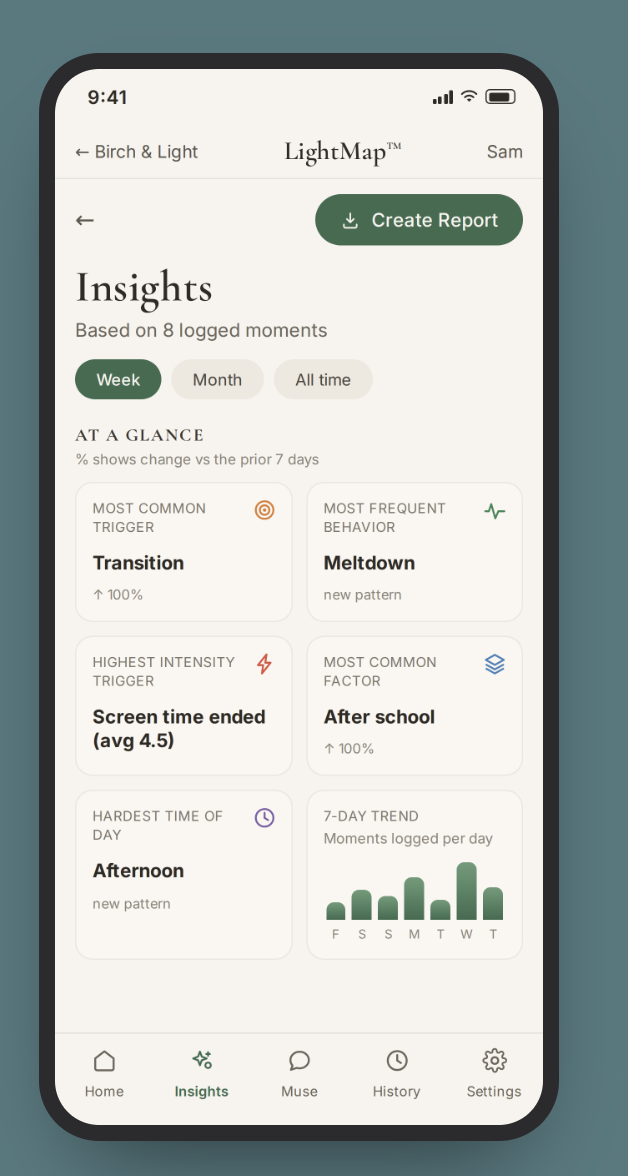

Part of the award-winning Birch & Light Method, honored with the Mom's Choice Gold Award for excellence in family resources.
If today was one of those days
A few more from the library, free to read.
Researched and drafted with AI assistance, reviewed before publication. Editorial standards