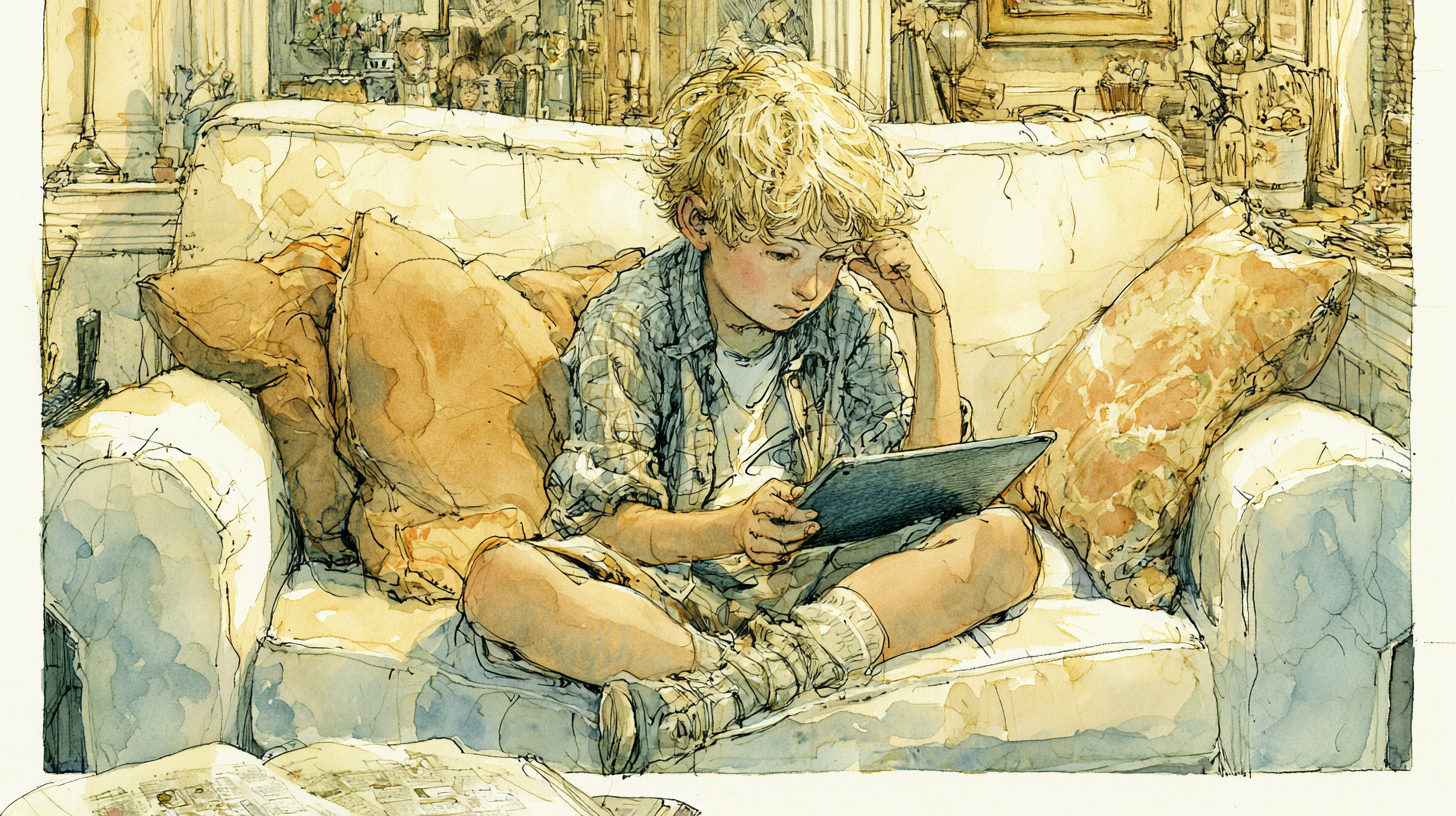
Summer screen-time battles get intense because summer removes the school-year structure that kept screens in proportion and leaves long stretches of open time that many kids find hard. The screen becomes the easiest relief from boredom and the easiest way to feel steady, so taking it away removes a coping tool, not just a game.
During the school year, screens had natural edges. The day was full, the hours were accounted for, and the device lived in the margins. Then summer arrived, the structure dissolved, and somehow the screen expanded to fill the whole horizon — and every attempt to limit it became a battle that consumes the day.
You set the timer. They negotiate. You hold the line. They melt down. You give in a little, feel bad, tighten up the next day, and the whole exhausting cycle resets. By August you're wondering whether you've lost the thread entirely.
Before you conclude that you need a stricter rule or a stronger will, it's worth understanding why summer specifically turns screens into a war — because the reason points to a very different fix than just clamping down harder.
Why Summer Makes It Worse
The screen battle isn't new in summer; it's amplified by summer. Several things the season removes were quietly doing the work that kept screens in proportion.
The structure that bounded it is gone. During the school year, the day's shape limited screen time without anyone having to fight about it. School, activities, homework, and routine left only small windows. Summer removes those walls, and now the only thing standing between your child and unlimited screen time is you, in real time, all day. The boundary went from being built into the day to being a thing you personally have to enforce, over and over.
The open time the screen fills is uncomfortable. For a child who struggles with unstructured time, the screen isn't just fun — it's the most reliable escape from the discomfort of an empty afternoon. So the pull toward it in summer isn't only the screen's appeal; it's the push of boredom and the demand of self-structuring that the screen instantly resolves. You're not competing with a game. You're competing with relief.
The screen is doing regulatory work. For many children a screen is a regulated, predictable, absorbing state — and summer, with its loss of routine, leaves them more dysregulated and therefore reaching for that regulation more often. The increased pull is partly a bid to feel steady in a season that took their steadiness away.
In summer you're not just competing with the screen's appeal. You're competing with the boredom it relieves and the regulation it provides.
Why Does the Battle Itself Escalate?
Understanding why the conflict gets so heated matters as much as understanding the pull, because the escalation has its own logic.
When the screen is meeting a real need — relief from boredom, escape from the demand of empty time, a route to regulation — then removing it doesn't just deny a want. It removes the strategy your child was using to feel okay, with nothing in its place. That's why the meltdown over the timer can be so out of proportion to "a game getting turned off." You haven't ended an activity; you've removed their coping tool and handed back the discomfort it was solving.
And because summer days are long and unstructured, the void the screen leaves is bigger. Turning it off during the school year dropped a child into a scheduled next-thing. Turning it off in summer drops them into the exact open time they find hard — so the resistance is fiercer, because what waits on the other side is worse.
While you're here, take the guide
What's Underneath is free: the three body-state triggers under most meltdowns, what to say in the minute before it tips over, and how to reset afterward.

You'll get the guide instantly, plus five free articles in your inbox every week. Real challenges (meltdowns, school mornings, picky eating, big feelings) and how to actually handle them. Unsubscribe anytime.
What the Research Shows
The pattern parents see at home shows up in the data. The Structured Days Hypothesis, proposed by Brazendale and colleagues in 2017, holds that summer days look more like unstructured weekend days than school days, and that school days regulate behaviors such as screen time through segmented, pre-planned routines. In their review of 190 studies, about 80 percent found that elementary-aged children's behaviors were less favorable on weekend days than on weekdays.
The American Academy of Pediatrics gives parents a matching starting point. Its guidance for families says that younger children do better with consistent and predictable media routines and time limits. It also recommends screen-free times and places in the home, and a family media plan that balances time with and without devices.
What Helps When the Timer Goes Off?
Rebuild structure so the screen isn't the only thing in the day. The most effective lever isn't a tighter screen rule — it's a day with enough shape that screens have natural edges again. When the afternoon has a rough rhythm and a few anchors, the device stops being the only thing filling the void, and the limits enforce themselves more than you do.
Address the boredom, not just the screen. If the screen is winning because the alternative is uncomfortable open time, then making the non-screen parts of the day more doable — narrowed choices, help getting started, things genuinely worth doing — reduces the pull at its source. You lower screen demand by raising the appeal and accessibility of everything else.
Make limits structural, not moment-to-moment. Constant real-time negotiation is exhausting and turns you into the enemy. Predictable, consistent screen windows — same shape each day, decided in advance — move the boundary out of the heat of the moment and into the structure, where it's far easier to hold.
Soften the transition off. The end of screen time is the flashpoint, so scaffold it: warning, a natural stopping point where possible, and — crucially in summer — something to land in that isn't an empty hour. A screen that ends into a next-thing is far easier than one that ends into a void.
Stay regulated through the conflict. Your calm during the battle is the thing that keeps it from escalating. Matching their intensity raises the ceiling; staying steady lowers it. This is hard, especially in August, but it's the single most stabilizing thing you bring.
The Shift Worth Making
The summer screen war isn't evidence that your child lacks willpower or that you lack firmness. It's evidence that summer removed the structure that used to bound screens, left behind open time your child finds hard, and turned the device into the easiest way to relieve and regulate that — so the pull went up and the fight got bigger.
The fix that lasts isn't a stricter rule enforced by sheer will. It's rebuilding enough shape in the day, and enough appeal outside the screen, that the device returns to proportion on its own. You're not trying to win the battle. You're trying to make it a smaller battle by changing what surrounds it.
Every behavior is a clue.
If summer screen limits have become a daily war, LightMap can help you track when the battles spike and what surrounds them — the boredom, the transitions, the open time — so the pattern beneath them becomes easier to see. Explore LightMap at birchandlight.com/lightmap.
Sources: Dan Siegel, MD, "The Developing Mind" and interpersonal neurobiology framework on the window of tolerance. Brazendale K, Beets MW, Weaver RG, Pate RR, Turner-McGrievy GM, Kaczynski AT, Chandler JL, Bohnert A, von Hippel PT, "Understanding differences between summer vs. school obesogenic behaviors of children: the structured days hypothesis," International Journal of Behavioral Nutrition and Physical Activity, 2017, volume 14. American Academy of Pediatrics, "Kids & Tech: 12 Tips for Parents in the Digital Age," HealthyChildren.org.
For education and reflection, not medical advice. Our terms
See what's underneath
Next time, you will know what set it off
LightMap reads your hard days together and gives you answers. Start with one moment today.
Start with 3 moments Not sure where to start? Ask me.Message Tara on WhatsApp. It really is me, I read everything and will personally respond.Click here to message Tara →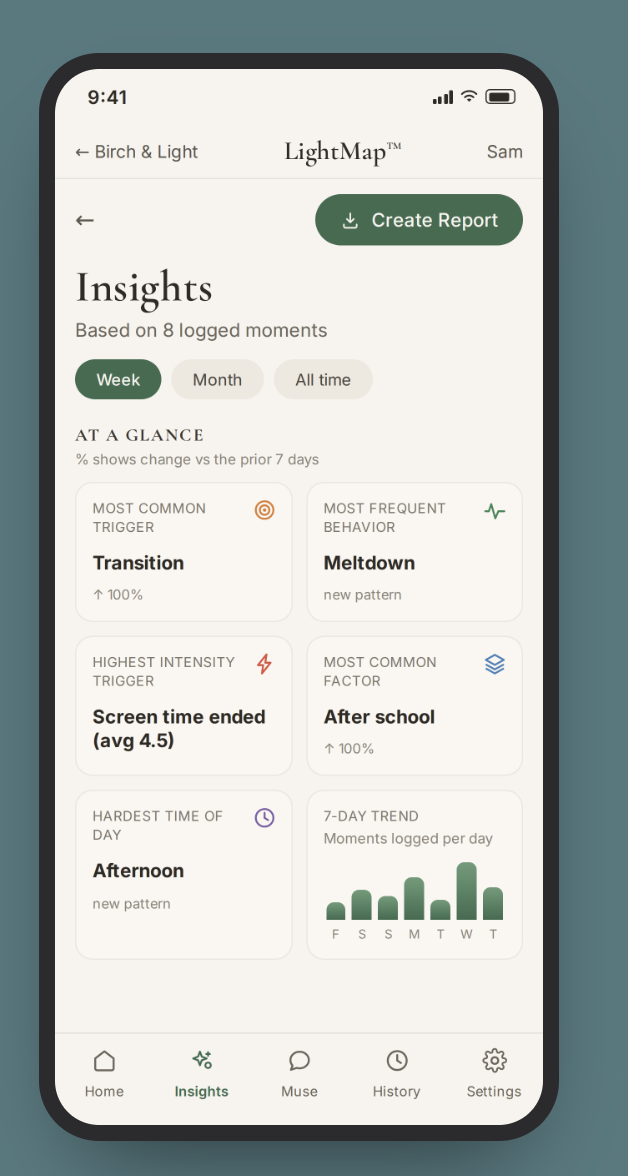

Part of the award-winning Birch & Light Method, honored with the Mom's Choice Gold Award for excellence in family resources.
A story to read together
Sometimes the easiest way in is a story you read side by side.
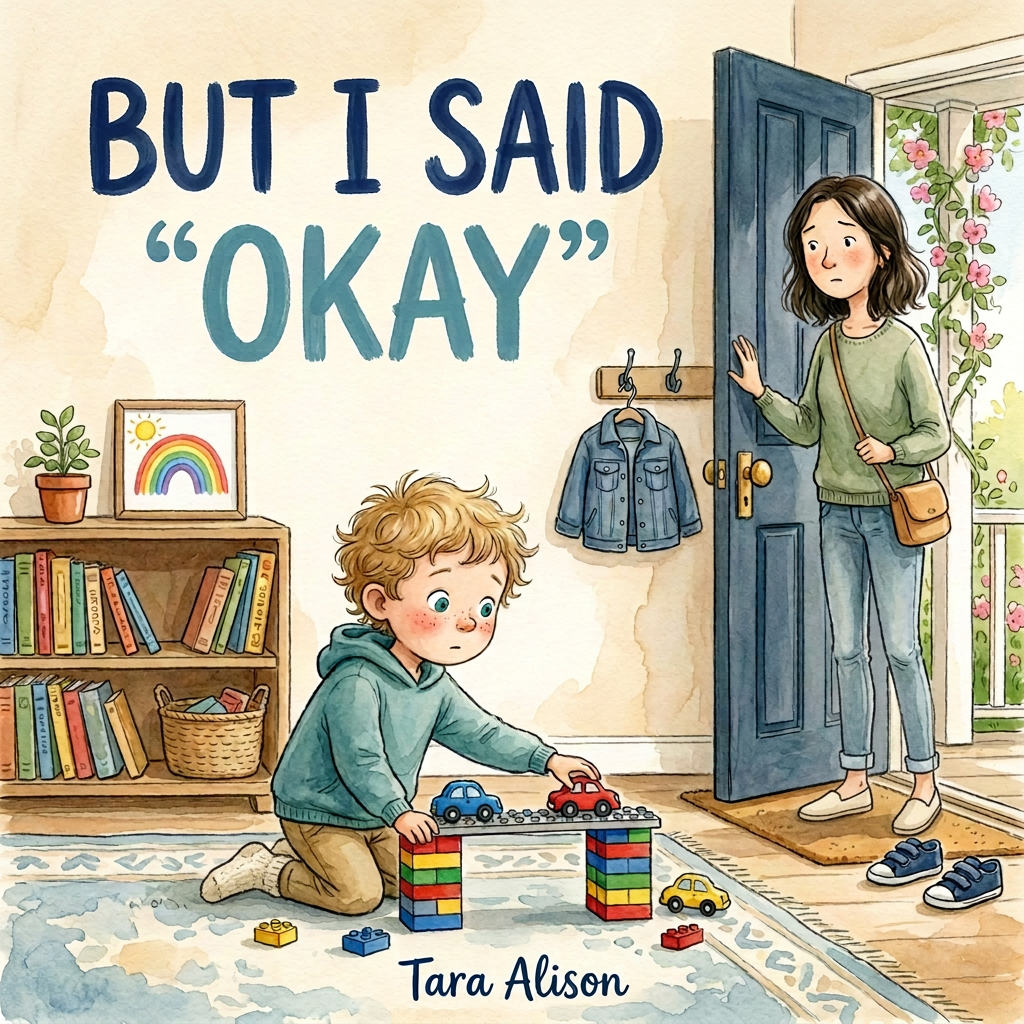 But I Said “Okay”
Owen always says okay. He means it every time. But his attention is still inside the bridge, the dragon, the cave, the music — until Mom realizes that helping him leave one thing matters more than asking him to start the next.
Read the story When Wildflower Day Ended for Gus
Gus loves Wildflower Day so much he can't bear for it to end — and learns that beautiful moments don't have to disappear when we leave them.
Read the story
If today was one of those days
A few more from the library, free to read.
Researched and drafted with AI assistance, reviewed before publication. Editorial standards