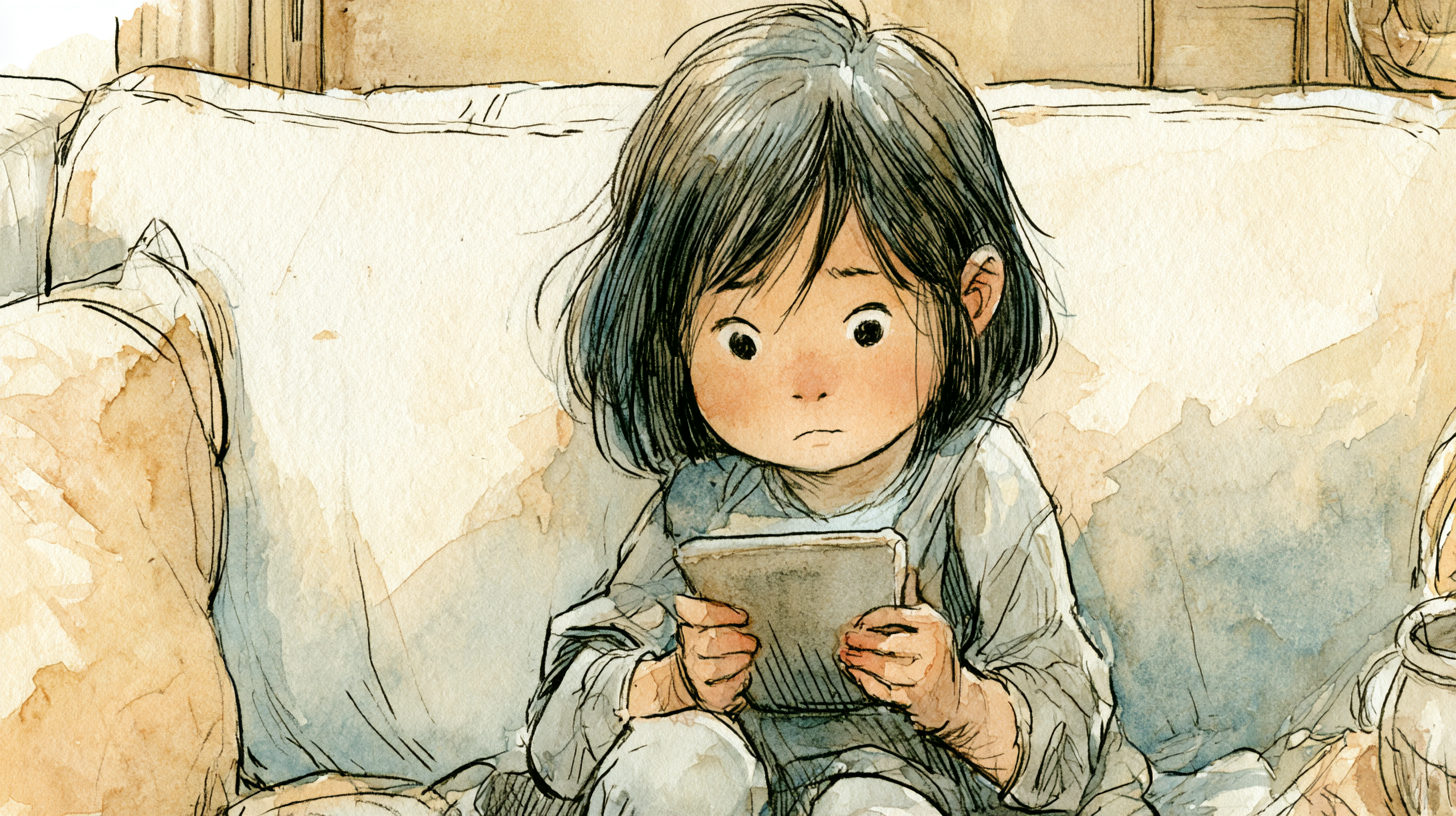
"Two more minutes." You said it kindly. You gave the warning. You were doing everything the advice says to do. And still, when the two minutes were up and the screen went dark, it was as though you had detonated something. The size of the reaction made no sense against the smallness of what you asked.
It makes more sense once you understand that turning off a screen is not one action. It looks like one — a finger on a button, a device set down. But for your child's nervous system, that single moment contains a whole transition, and transitions are some of the hardest work a developing brain does. The button is small. What it sets in motion is not.
Why Transitions Are Genuinely Hard
We tend to think of stopping one thing and starting another as trivial — a non-event, a hinge between the real activities on either side. But for the brain, a transition is its own task, and for some children a demanding one.
Shifting from one state to another requires disengaging attention from where it is, holding the new expectation in mind, reorganizing toward it, and physically beginning to move in a new direction. For a child with executive-function differences, or one whose attention locks deeply onto things, each of those steps takes real effort. The transition is not the space between the work. For these children, the transition is the work — and it's often the hardest part of their day.
A screen makes this dramatically harder for a specific reason: it is unusually good at capturing and holding attention. The more absorbing the activity, the more effortful it is to pull attention off it. Turning off an iPad is not asking a child to stop a neutral activity. It is asking them to tear their attention away from one of the most attention-capturing things ever designed.
What's Packed Inside That One Moment
When you ask a child to turn off a screen, you are — without meaning to — asking for several distinct things at once.
Disengage from total absorption. They are not lightly watching. They are inside it. Pulling out of that absorbed state is a real neurological shift, not a casual glance away.
Leave something unfinished. Games and shows rarely end on clean boundaries. Stopping usually means abandoning a level mid-play, a build half-done, a moment they were seconds from reaching. That is a genuine loss, and the protest over it is not manufactured.
Reorganize toward something less compelling. Whatever comes next — dinner, bath, bed, a chore — almost certainly asks more and rewards less than the screen did. The child is being asked to trade a high-engagement state for a lower one, and to generate the motivation for that trade themselves.
Do all of it on someone else's timing. The transition isn't chosen; it's imposed, on a schedule that has nothing to do with where they are in the activity. Being yanked out of an absorbed state by an external clock is harder than choosing to stop.
You asked for one small thing. Their nervous system received four hard ones, all at once.
While you're here, take the guide
What's Underneath is free: the three body-state triggers under most meltdowns, what to say in the minute before it tips over, and how to reset afterward.

You'll get the guide instantly, plus five free articles in your inbox every week. Real challenges (meltdowns, school mornings, picky eating, big feelings) and how to actually handle them. Unsubscribe anytime.
Why "Two More Minutes" Often Doesn't Help
The standard advice — give a warning — is sound, and it does help some children. But it's worth understanding why it sometimes fails, because the failure isn't the parent doing it wrong.
A warning helps if the difficulty is being surprised. But if the difficulty is the transition itself — the disengaging, the leaving-unfinished, the reorganizing — then knowing it's coming doesn't remove the hard part. It just means the child sees the hard thing approaching. For some children, the warning even adds a layer of dread to the time that remains. The work of the transition is still all there waiting; the heads-up didn't shrink it.
What Tends to Help
Build a bridge out, not a hard stop. Instead of screen-then-nothing, create a soft landing — a next activity that's appealing enough to move toward, so the child is transitioning to something rather than just being torn from something. The pull of a good next thing does some of the work the child can't do alone.
Let them reach a natural stopping point where you can. "Finish the level, then we're done" respects the unfinished-business problem in a way "off right now" doesn't. It won't always be possible, but when it is, it removes one of the four hard things entirely.
Co-regulate through the transition. Your calm, steady presence during the switch — rather than issuing the command from across the room and waiting for compliance — gives the child something to lean on through the hardest moment. Transitions are easier with a regulated adult alongside.
Make the transition itself predictable. The same end-of-screen routine every time — the same sequence, the same next thing — turns the transition from a fresh negotiation each time into a known path. Predictability lowers the demand.
Expect that it's hard, and stop reading it as defiance. Perhaps the most useful shift is internal: once you see the meltdown as the cost of a genuinely difficult transition rather than a child being manipulative, your own response softens — and your softened response makes the transition easier, not harder.
The Shift Worth Making
The reaction to "turn off the iPad" stops being baffling once you can see what you were actually asking. Not one small thing, but a demanding transition compressed into a single moment — disengaging from absorption, accepting a loss, reorganizing toward less, on someone else's clock.
When you scaffold the transition instead of just issuing the command, the same moment that used to detonate the evening can become something your child can actually do. The button is still small. But now you're helping them carry what's behind it.
Every behavior is a clue.
If turning off the screen reliably ends in a meltdown, LightMap can help you track the transitions around it — what makes them harder, what helps them go smoother — so the pattern beneath them becomes easier to see. Explore LightMap at birchandlight.com/lightmap.
For your child: But I Said "Okay" is about Owen, who means it every time he agrees to stop, and still cannot pull himself off what he is doing.
For education and reflection, not medical advice. Our terms
See what's underneath
Next time, you will know what set it off
LightMap reads your hard days together and gives you answers. Start with one moment today.
Start with 3 moments Not sure where to start? Ask me.Message Tara on WhatsApp. It really is me, I read everything and will personally respond.Click here to message Tara →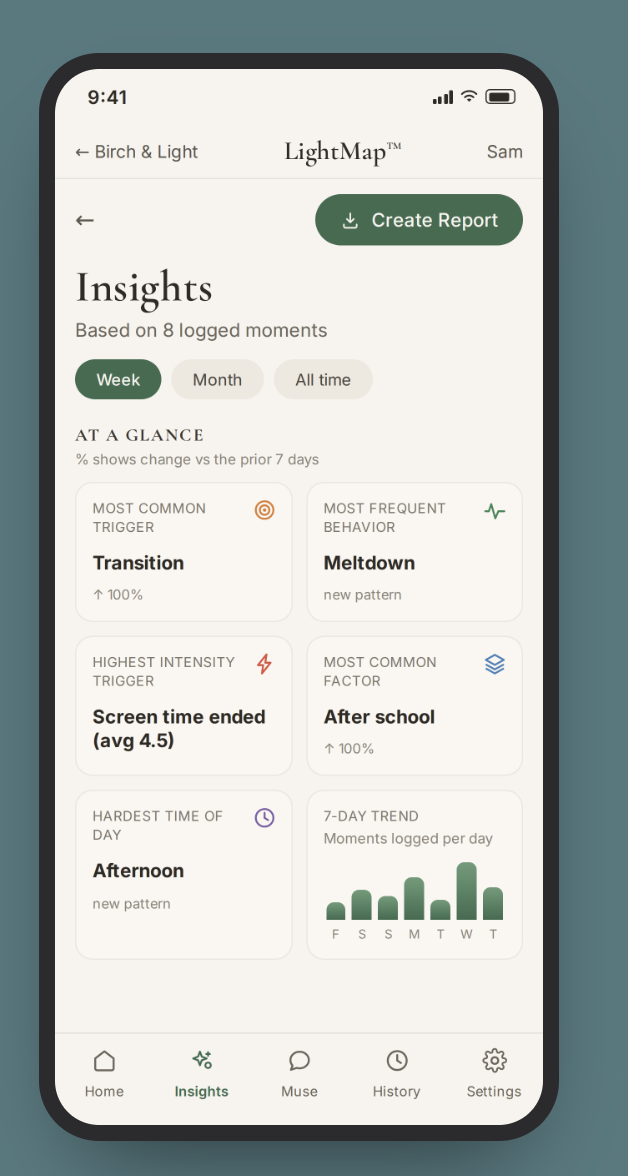

Part of the award-winning Birch & Light Method, honored with the Mom's Choice Gold Award for excellence in family resources.
A story to read together
Sometimes the easiest way in is a story you read side by side.
 When Wildflower Day Ended for Gus
Gus loves Wildflower Day so much he can't bear for it to end — and learns that beautiful moments don't have to disappear when we leave them.
Read the story The Tower That Looked Fine
A tower in a quiet clearing tries to stay steady through every small thing nobody else seems to notice — until one tiny breath of wind causes her to fall, and a gentle hand begins to gather the blocks back.
Read the story
If today was one of those days
A few more from the library, free to read.
Researched and drafted with AI assistance, reviewed before publication. Editorial standards