
You asked for something at the meeting. A different classroom. An aide. More support. And the team said no, and gave you a reason that sounded official, and you left the building without a document and without knowing what happens next.
Here is what most parents do at that point, which is go back to the same meeting and argue harder. Here is what changes the outcome instead.
First, understand which direction the ladder runs
A great many placement arguments are lost because the parent and the district are using the word restrictive to mean opposite things.
Federal regulation requires districts to keep a continuum of placements available, and it lists them: instruction in regular classes, special classes, special schools, home instruction, and instruction in hospitals and institutions. Least restrictive is the general education classroom with typically developing peers. Every step away from that room, in the direction of smaller settings and more specialized staff, is a step toward more restrictive.
So a co-taught or integrated class with a one to one aide is more restrictive than general education, not less. If your child is currently in a general education class and you are asking for that, the district is describing the continuum correctly when it uses the word.
This matters enormously to how you argue. Go in insisting they have the definition backwards and the meeting becomes a debate about vocabulary that you will lose, and you will never reach the point you actually came to make.
Second, know what the standard actually is
The law does not say children must be in general education. It says removal from the regular educational environment happens only when the nature or severity of the disability is such that education in regular classes, with the use of supplementary aids and services, cannot be achieved satisfactorily.
Read that clause again, because it contains your entire case.
The question is not whether your child would do better somewhere else. It is whether the current setting, with supports actually in place, is working. If the supports written into the IEP have been tried and have not been enough, that is the argument for moving. If they have never been tried, or have been written but not delivered, the district has a strong position and you have a different problem to solve first.
A few other requirements sit alongside it. Placement is decided by a group that includes you. Your child is educated in the school he would attend if he did not have a disability unless the IEP requires otherwise. The team has to consider any potential harmful effect on him. And he cannot be removed from an age-appropriate regular classroom solely because he needs modifications to the curriculum.
Third, get the refusal in writing
This is the step almost nobody takes and it changes everything.
When a district refuses to change a child's identification, evaluation, placement, or the provision of a free appropriate public education, it is required to give you prior written notice. Not only when it proposes something. When it refuses something too.
And the required contents are specific. The notice must describe what was refused. It must explain why. It must describe every evaluation procedure, assessment, record, or report the district used as the basis for saying no. It must tell you that you have procedural safeguards and how to get a copy. It must give you sources of help in understanding your rights. It must describe the other options the team considered and why each one was rejected. And it must describe any other relevant factors.
Sit with what that list means in practice. A team can say no in a meeting on the strength of a general impression. A team cannot write down which specific records supported the refusal, and which alternatives were considered and rejected and why, unless that thinking actually happened.
So the sentence to send, by email, the day after the meeting: I am requesting prior written notice of the committee's refusal of my request, including all elements required under 34 CFR 300.503(b).
Sometimes what comes back is thin or contradicts what was said out loud. That is information you did not have before, and it is the first thing an advocate or a hearing officer will read.
While you're here, take the guide
What's Underneath is free: the three body-state triggers under most meltdowns, what to say in the minute before it tips over, and how to reset afterward.

You'll get the guide instantly, plus five free articles in your inbox every week. Real challenges (meltdowns, school mornings, picky eating, big feelings) and how to actually handle them. Unsubscribe anytime.
Fourth, look at whose evaluation this rests on
Most refusals rest on the district's own evaluation. If you disagree with that evaluation, the federal regulations provide for an independent educational evaluation at public expense.
The mechanics are more favorable than parents realize. Under the regulation, a district that receives such a request either funds the independent evaluation or files for a due process hearing to show its own evaluation was appropriate, and it is expected to do one or the other without unnecessary delay rather than simply declining.
It may ask why you disagree. It cannot require you to answer, and it cannot use your refusal to explain as a reason to delay.
The regulation provides for one publicly funded independent evaluation each time the district conducts one you disagree with. The evaluator has to meet the same criteria the district applies to its own evaluations, including location and qualifications, and beyond those criteria the district cannot impose extra conditions or timelines.
Ask in writing. Use the phrase independent educational evaluation at public expense, because that is the language that starts the obligation.
What order to do this in
Request the prior written notice first, because it is free, it takes one email, and it tells you what you are actually fighting. Then request the independent evaluation if the refusal rests on assessment data you think is wrong.
Only then consider mediation or a due process complaint, and by that point you will have a documented refusal and independent data, which is a completely different starting position than a parent who is upset about a meeting.
Every state also has a federally funded Parent Training and Information Center, staffed by people who do this daily and cost you nothing. Use yours before you pay an attorney.
The thing to hold onto
You are not being difficult. The system is built on the assumption that parents will accept what they are told in a meeting, and most do, because the meeting is designed to feel final.
It is not final. It is one step in a process with written requirements attached to it, and the written requirements are where a parent gets traction.
Our research says this is how the process works, based on our reading of the federal special education regulations as of August 2026. It is not legal advice. Rules get amended, states add their own layers on top, and your district may operate differently. Check it directly before you act on it. The regulations are public and free at ecfr.gov under Title 34, Part 300, and your state's Parent Training and Information Center will confirm how it works where you live at no cost.
Sources: 34 CFR 300.114, 300.115, 300.116, 300.502, 300.503.
For education and reflection, not medical advice. Our terms
See what's underneath
Walk into the next meeting with answers
LightMap reads your hard days together and gives you answers. Start with one moment today.
Start with 3 moments Not sure where to start? Ask me.Message Tara on WhatsApp. It really is me, I read everything and will personally respond.Click here to message Tara →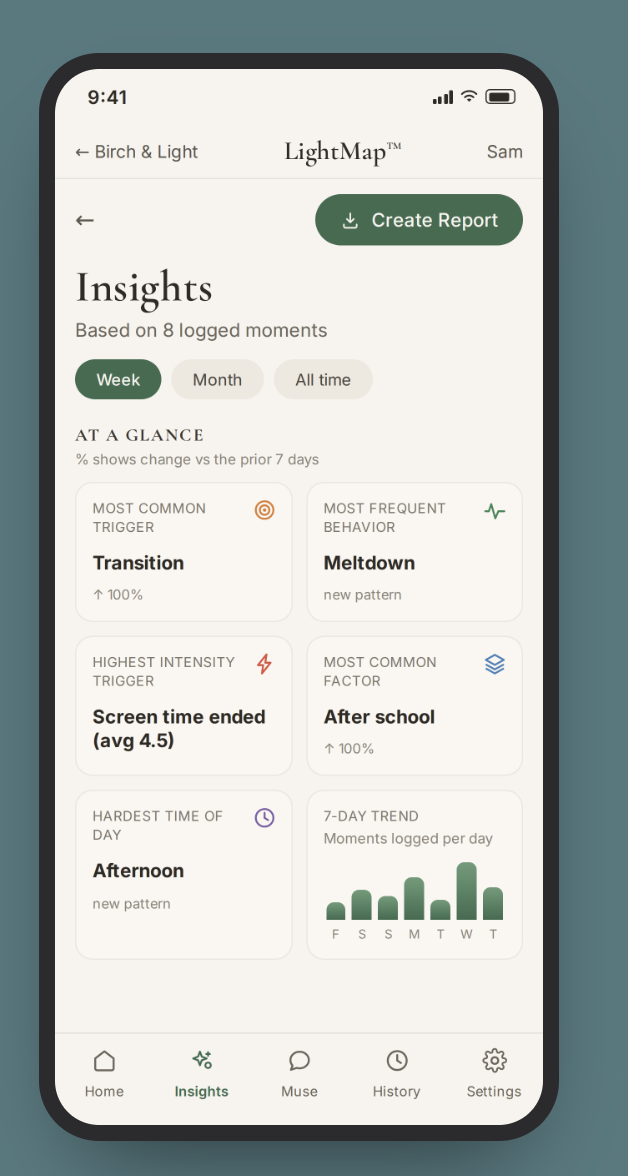

Part of the award-winning Birch & Light Method, honored with the Mom's Choice Gold Award for excellence in family resources.
If today was one of those days
A few more from the library, free to read.
Researched and drafted with AI assistance, reviewed before publication. Editorial standards