
You have searched. Probably more than once, probably over years. Respite care near me, in-home support for special needs, someone, anyone, who could hold this for four hours so you could sleep or shower or sit in a parked car. Or for a night, so you are not the person awake at three in the morning again. Or for a week, so two parents could leave together and remember who they were before this, which for some families has not happened in five years or ten. What comes back is agencies that do not take your child, waitlists that never move, private pay rates you cannot sustain, or nothing at all.
Here is the thing almost nobody tells parents: for most families, searching for respite providers directly is the wrong search. Not because the services do not exist, but because in most states they are gated behind a door you cannot see from the outside. This article is about finding that door.
Why the direct search fails
Publicly funded respite is rarely something you request as a service. It is usually something you become eligible for, and eligibility runs through an assessment process that has nothing to do with calling providers. A family can spend years contacting agencies that would happily serve their child, and be turned away every time, simply because they arrived without the authorization that unlocks the funding.
So the question to start with is not who provides respite near me. It is what determines whether my child qualifies, and who makes that determination.
The pattern almost every state shares
- There is usually a single point of entry. Most states funnel children's behavioral health and developmental disability services through one contracted access point rather than letting families apply service by service. Find that entity and you have found the door. It is often not the agency whose name you would guess.
- Respite is usually gated behind care coordination. Rather than being directly requestable, respite tends to sit inside a broader package that becomes available once a child is enrolled in care management or found eligible under a disability determination. This is the step most families miss entirely.
- There is usually a Medicaid pathway where your income does not count. More on this below, because it is the single most consequential thing in this article.
- Waitlists are real and vary enormously. Some states have deep service arrays and short waits. Others have thin offerings and multi-year queues for the same programs. This is not something a parent can fix by being more persistent, and it is not a reflection of how much your family needs help.
Respite is not one thing, and asking for the wrong tier gets you nothing
Much of the frustration here comes from respite being treated as a single service when it is actually several, authorized differently and staffed by different people. Naming the one you need changes the answer you get.
- Hourly in-home respite. Someone comes to the house for a few hours. This is what most people picture and what most directories list.
- Overnight respite. A distinct option that frequently exists but is rarely volunteered. ARCH advises families directly to ask whether overnight is available rather than assuming, because it often is not mentioned unless raised.
- Out-of-home respite. Your child stays somewhere licensed, commonly authorized in blocks of one to fourteen days. This is the category that makes an actual trip possible, and it is the one families almost never know to ask for. Depending on the state it may be delivered in a licensed respite facility, a provider's licensed home, a nursing facility, or a camp setting.
- Camp-based respite. Some states fund specialized camp specifically as a respite benefit, which can cover a week at a stretch.
If your child is medically complex, ask for skilled respite by name
This distinction matters enormously and gets missed constantly. Many states separate ordinary respite from skilled or specialized respite, which must be provided by a registered nurse, licensed practical nurse, or similarly credentialed staff, and is reimbursed at a higher rate. Some states additionally require that specialized respite staff have around the clock access to a nurse for consultation.
If your child has a condition requiring medical management, insulin dosing and glucose monitoring, seizure protocols, tube feeding, oxygen, a request for general respite will be matched against a workforce that cannot legally or safely take her, and you will be told no repeatedly without ever being told why. Ask specifically whether your state offers skilled or specialized respite, and make sure the assessment documents the nursing tasks involved rather than only the behavioral picture.
Worth knowing too: respite and private duty nursing are different services with different authorizations. Private duty nursing provides ongoing skilled care for the child's daily medical needs; respite exists to relieve the caregiver. Some families need both, and being approved for one does not mean the other has been considered.
You may be able to hire someone you already trust
Many state programs include a consumer-directed or self-directed option, which lets a family recruit their own respite worker and have that person paid through the program, generally with lighter training requirements than agency-employed staff. In a number of states this can include a relative who does not live in the home.
For families whose child cannot tolerate a stranger, and for families in areas where no agency has staff, this is often the only workable route. It rarely appears in the initial explanation of benefits, so ask whether self-direction is available and who is eligible to be hired.
The income assumption that stops families before they start
This is the part worth reading twice. Many parents never apply for disability-based Medicaid because they know their household income is too high. For the pathways that matter most here, that reasoning does not hold.
Under the Katie Beckett provision, also called TEFRA after the 1982 law that created it, states may disregard parental income and resources entirely when determining Medicaid eligibility for a child with significant disabilities living at home. Qualification is based on the child's level of care need, meaning care comparable to what would be provided in an institutional setting, not on a diagnosis list and not on what the family earns. A household earning well into six figures can have a child who qualifies.
Two practical cautions. First, roughly eighteen states plus the District of Columbia have adopted this as a state plan option, so it is not universally available, and states that skip it often run similar access through 1915(c) home and community based services waivers instead. Second, and this trips up an enormous number of families, you generally have to ask for it by name. Apply for children's Medicaid generically and the agency evaluates you under the standard income-based category and denies you on income, without ever considering the disregard. Say Katie Beckett or TEFRA explicitly, and if your state does not use those terms, ask which pathway disregards parental income for a disabled child.
One more distinction worth knowing: the TEFRA state plan option extends regular Medicaid coverage but does not itself add respite. HCBS waivers are typically where respite, home modifications, and family supports actually live. Many families benefit from pursuing both at once, and getting onto a waiver waitlist early matters even if another pathway is already providing coverage.
While you're here, take the guide
What's Underneath is free: the three body-state triggers under most meltdowns, what to say in the minute before it tips over, and how to reset afterward.

You'll get the guide instantly, plus five free articles in your inbox every week. Real challenges (meltdowns, school mornings, picky eating, big feelings) and how to actually handle them. Unsubscribe anytime.
A worked example: how it runs in New Jersey
Every state differs, so here is one walked through concretely to show the shape of it.
New Jersey routes all children's behavioral health, developmental disability, and substance use services through a single contracted access point called PerformCare, reachable at 1-877-652-7624, staffed around the clock, serving anyone under twenty-one. Families call directly. No referral from a doctor or school is required.
From that one call, several things become possible. Mobile Response and Stabilization Services will dispatch to the home, often within an hour, and the state defines crisis by what the family says it is rather than by a clinical threshold, noting explicitly that a crisis for one family may not be a crisis for another. Care Management Organizations provide ongoing coordination for complex cases. Family Support Organizations offer peer support from parents who have lived it.
Respite itself sits under Family Support Services, allotted at ninety hours per ninety-day authorization for in-home respite when approved, whether the family hires through an agency or self-directs. Note the gating: Family Support Services generally requires either a developmental disability eligibility determination or existing enrollment in care management or mobile response. That is precisely why calling respite agencies directly produces nothing. The authorization comes from somewhere else entirely.
Access requires a Medicaid or NJ FamilyCare application, but families are frequently found eligible for Medicaid as secondary insurance, or the child is approved for state funds that supplement private coverage. The application is completed with a care manager rather than by a parent working alone.
How to find your own state's version
- Start with your state Lifespan Respite Program or State Respite Coalition. These exist to coordinate respite access at the state level and are the most direct route to what is actually funded where you live.
- Use the ARCH National Respite Network. Their National Respite Locator lists respite providers nationally, and ARCH itself recommends checking your state program first, noting frankly that the locator is not a complete list of every program or funding source.
- Search for your state's children's system of care or single point of entry. The name varies widely. What you are looking for is the entity that authorizes services rather than delivers them.
- Ask your state Medicaid office which waivers serve children with your child's profile, and where the waitlists stand. Get on lists early, even if you are not sure you will use the service.
- Contact your state's Parent Training and Information Center or Family Voices affiliate. These organizations navigate exactly these applications routinely and can advise on documentation and appeals.
What to expect, honestly
None of this is fast and none of it is guaranteed. Applications get denied and need appealing. Waitlists in some states run for years. Approved hours are often fewer than a family needs, and finding an actual worker to fill approved hours is its own separate problem, particularly for a child with complex behavioral or medical needs. Programs also require annual reapplication in many states, so approval once is not approval permanently.
That reality needs naming, because parents who go looking for help and find a maze often conclude they must be doing it wrong. Mostly they are not. The system is genuinely fragmented, underfunded in many states, and difficult to navigate by design rather than by accident. Knowing where the door is does not make the queue behind it shorter. It does mean the years of searching were not a failure of effort.
Where LightMap helps
Every one of these applications turns on documentation, specifically on demonstrating level of need rather than describing it. Eligibility determinations, waiver applications, and appeals all ask what actually happens at home, how often, and how severely, and a general description carries far less weight than a dated record.
A log of incidents, intensity, triggers, and what a typical week actually contains is the difference between a reviewer reading that a parent is struggling and a reviewer seeing the pattern for themselves. If you are heading into an eligibility assessment, arrive with months of it rather than memory.
Every behavior is a clue.
Eligibility runs on evidence, and evidence has to be gathered before you need it. Explore LightMap at birchandlight.com/lightmap.
Frequently asked questions
We make too much money to qualify for anything. Is that true?
Often not, and this assumption stops more families than any other single factor. Katie Beckett and TEFRA pathways, and many HCBS waivers, disregard parental income entirely and qualify a child on their level of care need. You have to request that pathway by name, because a generic Medicaid application will be assessed on household income and denied.
Why do respite agencies keep turning us away?
Usually because the funding authorization has to come from somewhere else first. Many agencies would serve your child but can only bill through a program your family has not been enrolled in yet. Finding the authorizing body rather than the provider is the step that changes this.
What if my state has a multi-year waitlist?
Get on it anyway, today, and ask whether there is a separate crisis or emergency pathway that moves faster. Also ask your state respite coalition about voucher programs, faith community respite programs, and disability-specific nonprofits, which sometimes operate outside the waiver system entirely and are not listed in official directories.
We have not had a night away in years. Is extended respite actually a real thing?
Yes. Out-of-home respite is commonly authorized in blocks of one to fourteen days, and some states fund specialized camp as a respite benefit. It is rarely offered up front, so ask about overnight and out-of-home respite specifically rather than asking about respite generally. If your child is medically complex, pair that with a request for skilled respite so the authorization matches staff who can actually provide the care.
Does my child need a developmental disability diagnosis to qualify?
Not necessarily. Many state systems serve children with behavioral health diagnoses as well as developmental ones, sometimes through different tracks within the same access point. Ask which track fits your child rather than assuming exclusion, and ask the question of the access point rather than of a provider.
Sources: ARCH National Respite Network and Resource Center; Administration for Community Living Lifespan Respite Care Program; National Academy for State Health Policy on state Medicaid respite approaches; 42 CFR 435.225 and the TEFRA Katie Beckett provision; New Jersey Children's System of Care and PerformCare; Kids Waivers.
For education and reflection, not medical advice. Our terms
See what's underneath
Stop guessing what set it off
LightMap reads your hard days together and gives you answers. Start with one moment today.
Start with 3 moments Not sure where to start? Ask me.Message Tara on WhatsApp. It really is me, I read everything and will personally respond.Click here to message Tara →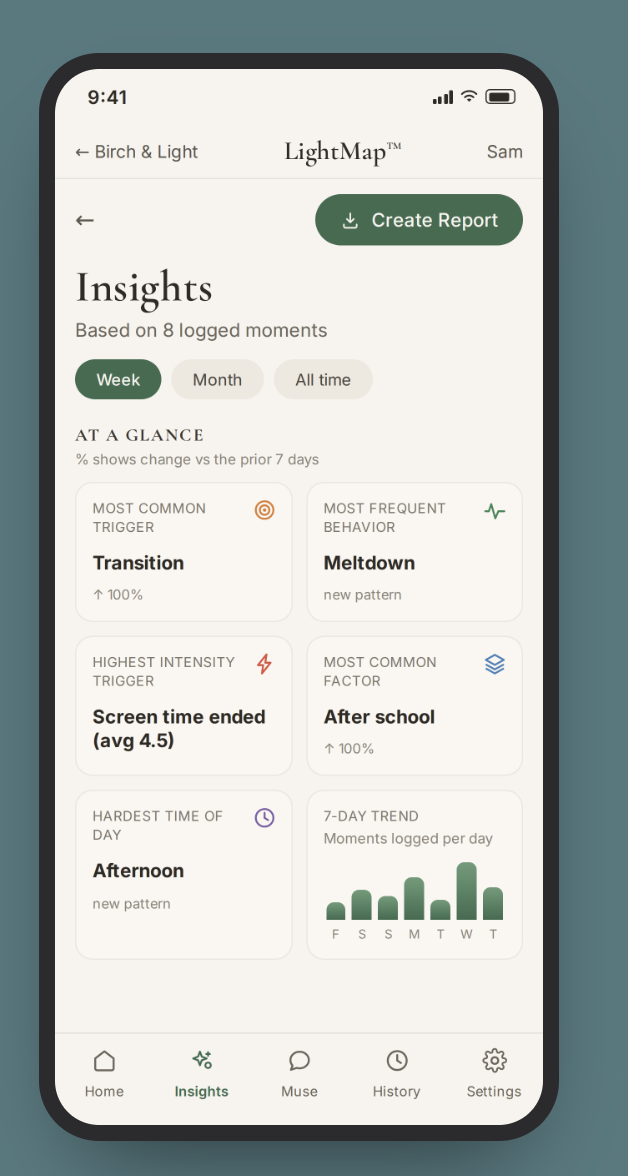

Part of the award-winning Birch & Light Method, honored with the Mom's Choice Gold Award for excellence in family resources.
A story to read together
Sometimes the easiest way in is a story you read side by side.
 The Tower That Looked Fine
A tower in a quiet clearing tries to stay steady through every small thing nobody else seems to notice — until one tiny breath of wind causes her to fall, and a gentle hand begins to gather the blocks back.
Read the story The Boy at the Edge
A boy finds calm by watching the world move from a window. When his stillness is mistaken for defiance, the moment escalates — and he learns that being calm doesn’t always protect you from being told no.
Read the story
If today was one of those days
A few more from the library, free to read.
Researched and drafted with AI assistance, reviewed before publication. Editorial standards