
Someone in your feed has posted a photo of a golden retriever resting its head on a sleeping child's chest, and the caption says this dog saved her life last night. You are sitting there at 2am having just treated a low you caught yourself, and you are wondering whether you are failing your kid by not having one.
Here is the fuller picture.
What they actually do
Diabetes alert dogs are trained to detect changes in blood glucose by scent, most likely volatile organic compounds released through breath and skin, and to alert their handler by pawing, nudging, or fetching a supply kit.
They are legitimate service animals under the ADA when individually trained to perform this task, which means access rights to schools, restaurants, and public buildings.
What the research shows
The honest summary is that the evidence is mixed, thinner than the marketing suggests, and better on quality of life than on accuracy.
They can detect real events. Multiple studies confirm dogs can identify hypoglycemia by scent at rates well above chance. The ability is real, not folklore.
Accuracy varies enormously, and CGMs generally outperform them. Head-to-head studies have found continuous glucose monitors detect hypoglycemic episodes faster and more reliably than trained alert dogs. Sensitivity across studies ranges widely between individual dogs and between programs, and performance drops when the dog is asleep, distracted, at a distance, or in a busy environment.
False alerts are common. Dogs alert on things that are not lows, including stress, exercise, and their own learned expectation that alerting produces a reward. Families report a real burden in learning to distinguish a genuine alert from a hopeful one.
The strongest findings are psychological. Where the research is most consistent is on reduced fear of hypoglycemia, better sleep for parents, increased confidence and independence for the child, and reduced ambulance callouts in some cohorts. Those outcomes are not trivial. Fear of hypoglycemia is one of the largest drivers of poor quality of life in families managing type 1, and it drives the running-high behavior that damages long-term control.
So your endocrinologist is right on the clinical question. A CGM does the detection job better. That does not make the dog worthless, it makes it a different kind of intervention.
The lag, and why the dog sometimes wins anyway
There is one piece of physiology worth understanding, because it explains the stories that seem to contradict everything above: the nights a dog alerts while the CGM still reads normal.
A finger stick measures glucose in blood. A CGM measures glucose in interstitial fluid, the fluid just under the skin, and that fluid trails blood by roughly five to fifteen minutes. The gap is smallest when glucose is stable and widest exactly when it is moving fast, which is precisely when a low matters most. So a screen can honestly read 102 while the blood underneath is already at 63 and falling. The sensor is not broken. It is showing you where your child was, not where they are.
A dog is not reading glucose at all. It is smelling volatile compounds that shift as blood chemistry changes, a real-time signal from the blood rather than a delayed one from tissue. That is why a good alert dog can occasionally get there first on a fast drop, and why those stories are real rather than exaggerations.
The practical takeaway matters even for families who will never own a dog: on a CGM, the trend arrow is often more useful than the number, and a rapidly falling arrow deserves a finger stick before bed regardless of what the number says. Treat the reading as a lagging indicator during fast changes, because that is what it is.
The cost
Fully trained dogs from established programs commonly run between roughly fifteen and thirty thousand dollars, and some programs quote higher. Insurance does not cover it. Many programs require families to fundraise the amount, which takes months to years.
The purchase price is not the whole cost. Budget for food, routine veterinary care, insurance, emergency care, grooming, ongoing training, and equipment across a working life of roughly eight to ten years, after which the dog retires and remains a family pet with senior-dog expenses.
There is also a labor cost that nobody quotes. A working dog needs daily handling practice, exercise, and reinforcement. Someone has to do that, and in most families that someone is the parent who is already doing the diabetes management.
While you're here, take the guide
What's Underneath is free: the three body-state triggers under most meltdowns, what to say in the minute before it tips over, and how to reset afterward.

You'll get the guide instantly, plus five free articles in your inbox every week. Real challenges (meltdowns, school mornings, picky eating, big feelings) and how to actually handle them. Unsubscribe anytime.
The part that gets skipped: this is another dependent
The dog does not reduce your caregiving load. It relocates part of it and adds to the rest.
It needs walking during a school-morning rush. It needs a plan when you travel. It needs training upkeep when you are exhausted. It complicates a child's sleepovers rather than simplifying them. And for a family already carrying complex needs, adding a living creature with its own requirements is a real decision, not a purely additive good.
How to evaluate a program
This is a poorly regulated market and there are programs that take deposits and deliver poorly trained animals. If you are considering it:
- Ask for the specific alert accuracy data on placed dogs, not testimonials
- Ask how many dogs they have placed and how many were returned or washed out
- Ask what happens if the dog does not alert reliably after placement, and get the refund or replacement policy in writing
- Ask what training the family receives and how long it lasts
- Ask about ongoing support in year two and year five
- Speak to at least three families placed more than two years ago, not newly placed ones
- Check whether the program is accredited by a recognized body such as Assistance Dogs International
- Be cautious about any program requiring large payment before you have met a trainer
If a program leads with emotional stories and will not give you numbers, that is your answer.
If you already have one
The most useful reframe is to stop treating the dog and the CGM as competitors and give them different jobs.
Let the CGM be the safety net. It is faster, it works at distance, it works while everyone sleeps, and it has alarms. Do not reduce CGM alerts because the dog is present. The research does not support the dog as a replacement layer.
Let the dog do what devices cannot. Dogs sometimes alert during sensor warmup, on the compression lows a sensor misreads, in the lag window where interstitial readings trail blood glucose, and on rate of change that a number does not yet reflect. Treat an alert as a prompt to check rather than as data on its own.
Log the alerts. Note the time, what the CGM said, and what a fingerstick confirmed. Over a few weeks you will see your dog's actual pattern: whether they run early, whether they are more reliable at night, whether accuracy falls in certain settings. That tells you how much weight to give an alert, which is far more useful than a general belief that the dog is good or bad at this.
Watch the reinforcement drift. Alert accuracy degrades when true alerts stop being rewarded and false ones get attention. Most placement problems in year two are training maintenance problems, not dog problems.
Protect the child's autonomy. As kids get older, a visible dog is a visible diagnosis, and some children want that and some very much do not. That preference is worth asking about directly rather than assuming.
The honest bottom line
If your question is "will this detect lows better than my CGM," the answer is probably no, and you are not failing your child by relying on the device.
If your question is "would a dog change how this family lives with diabetes," that is a different question, and for some families the answer is genuinely yes. Reduced fear, better sleep, a child who feels accompanied rather than monitored. Those are real goods, and they are the ones the evidence actually supports.
Decide on that basis, with the cost and the added dependent counted honestly, rather than on the basis of a photograph in your feed at 2am.
If you are weighing this, the most useful thing you can do first is look at your actual pattern. How many lows a week, what time they happen, how many the CGM caught, how many you caught first, and how much of the fear is the nights. Log it in LightMap for a month and the decision usually clarifies itself, because you will see whether your problem is detection or dread.
Sources: Los et al. and subsequent studies comparing diabetes alert dog performance with continuous glucose monitoring in detecting hypoglycemia (Journal of Diabetes Science and Technology; PMC); Gonder-Frederick et al. on diabetes alert dog accuracy and owner-reported outcomes (PMC); Rooney et al. on trained glycaemia alert dogs and reliability across individual dogs (PLOS ONE; PMC); peer-reviewed research on volatile organic compounds associated with hypoglycemia (Diabetes Care; PMC); research on fear of hypoglycemia and quality of life in families managing type 1 diabetes (PMC); Americans with Disabilities Act service animal provisions; Assistance Dogs International accreditation standards.
For education and reflection, not medical advice. Our terms
See what's underneath
See what is behind the hard days
LightMap reads your hard days together and gives you answers. Start with one moment today.
Start with 3 moments Not sure where to start? Ask me.Message Tara on WhatsApp. It really is me, I read everything and will personally respond.Click here to message Tara →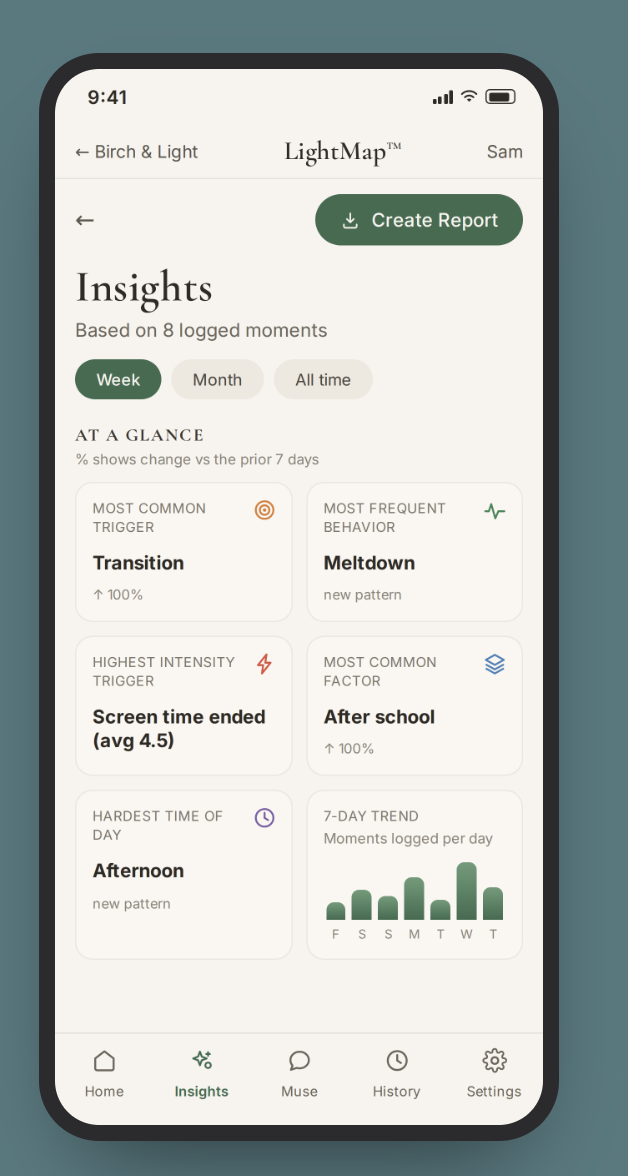

Part of the award-winning Birch & Light Method, honored with the Mom's Choice Gold Award for excellence in family resources.
A story to read together
Sometimes the easiest way in is a story you read side by side.
 June on the Blacktop
On a sunny gym day, June’s body sends a small alarm — and she learns that pausing for what she needs is not the same as quitting.
Read the story June and the Window That Took Time
When June receives special Valentine’s Day window clings from Grandma, she learns that some things take time, help, and persistence.
Read the story
If today was one of those days
A few more from the library, free to read.
Researched and drafted with AI assistance, reviewed before publication. Editorial standards