

Someone has handed you a meter, a box of supplies, and a folder, and told you that you are now responsible for a job a pancreas used to do without anyone thinking about it. You are probably not sleeping. You are probably checking her while she sleeps. And underneath it there is a fear you may not have said out loud yet, which is that you are not the kind of person who can do this.
You are. Not because you are stronger than you feel, but because this turns out to be a set of skills rather than a personality trait, and skills are learnable. Every parent reading this in six months' time was right where you are, convinced they were the exception.
The grief is real and it deserves room
People will tell you quickly how manageable Type 1 is, and they are right, and it will not help this week.
What you are grieving is not really the medical situation. It is the version of her childhood you had in your head, the one where sleepovers were simple and snacks were thoughtless and nothing had to be counted. That version was real to you, and it is gone, and being sad about that is not weakness or catastrophising. It is an accurate response to a loss.
Let it be a loss. Parents who make room for the grief early tend to steady faster than parents who go straight to competence and hold the feelings for a year until they arrive all at once on some ordinary Tuesday.
What the first year actually looks like
Nobody gives you the timeline, so here it is roughly.
The first weeks. Everything is conscious. Every number needs looking up, every meal is math, and you are terrified overnight. This is the hardest part and it is also the shortest.
Around a month. The mechanics start moving into your hands rather than your head. You stop having to think about the order of steps. You still check constantly, but you are no longer looking things up each time.
Two or three months. You start recognizing patterns rather than reacting to numbers. You know what a particular breakfast does. You get a stretch of hours where you do not think about it at all, and then feel strange for having forgotten.
Six months to a year. It becomes a background process. Not gone, not effortless, but folded into the day the way school runs and packed lunches are. Most families describe this as the point where they felt like themselves again.
You will also probably hit a stretch where things get easier for a while as her body still makes some insulin, and then get harder again as that fades. That is expected rather than a sign you have done something wrong, and it catches a lot of parents off guard emotionally.
The fear about other people
Handing her to a school, a grandparent, or a camp feels impossible right now, and the instinct is to solve it by trusting harder. That is not how it gets solved.
It gets solved with a written plan. Ask her endocrinology team for a Diabetes Medical Management Plan, and then ask the school to build a 504 plan from it. That converts her care from something people do kindly into something they are required to do, and it means more than one adult gets trained rather than everything resting on whether the nurse is in that day. Ask who covers lunch, field trips, and substitute days, because those are the gaps.
A continuous glucose monitor with remote sharing, once you have one, does more for a parent's nervous system than anything else available. Being able to glance at a number from your desk is the difference between a workday and eight hours of dread.
Things people will say that are not true
That she will grow out of it. She will not, and that is different from saying she will not thrive.
That it must be from sugar, or your genetics, or something you fed her. Type 1 is autoimmune. You did not cause it and you could not have prevented it, and the number of parents who quietly carry that guilt anyway is enormous.
That at least it is not something worse. Possibly true and completely useless, and you are allowed to find it irritating.
What she can still do
All of it. Sports, sleepovers, camp, travel, school trips, whatever she was going to do. Every one of those becomes a logistics problem rather than a closed door, and the logistics get solved by people who solve them every day.
The thing to guard against in the first year is not danger. It is the slow narrowing that happens when a frightened parent says no to things that felt manageable before. Each individual no is reasonable. Fifty of them add up to a childhood shaped by the diagnosis rather than by her.
What this builds
This part belongs late rather than early, because in week one it is useless and possibly infuriating. None of what follows makes the diagnosis worth it. It is not a gift. You do not have to feel grateful, and if anyone tells you to, you can ignore them.
But there are things these children reliably end up with, and they are worth knowing about while you cannot see past the next finger prick.
They understand their own bodies with a precision most adults never reach. They can tell you what is happening inside them and why, which is a form of self knowledge that transfers into everything else.
They become genuinely competent early. Not the fake competence of a child performing maturity, but real capability, because they are trusted with something that matters and they rise to it.
They learn to speak up. A child who has to tell a coach, a teacher, or a friend's parent what she needs has practiced self advocacy hundreds of times before her peers have done it once.
They are noticing, kind, and unsqueamish about other people's difficulties, because they know what it is to be the one with the thing.
And families often say, cautiously, that it drew them closer. Not because anyone would choose it, but because you end up paying a particular kind of attention to a child, and children can feel that.
But if there is one thing that genuinely changes what this is like to live with, it is none of the above. It is the people.

There's a story for this exact struggle
June on the Blacktop
On a sunny gym day, June’s body sends a small alarm — and she learns that pausing for what she needs is not the same as quitting.
Free to read. You'll also get five free articles a week. Unsubscribe anytime.
Before you go, grab the free guide
The 3 body-state triggers under most meltdowns, a script for the 30 seconds before it tips over, and a reset for after. Free.

You'll get the guide instantly, plus five free articles in your inbox every week. Real challenges (meltdowns, school mornings, picky eating, big feelings) and how to actually handle them. Unsubscribe anytime.
The community you have not met yet
Right now you are the only person you know doing this. That will not last, and the change when it goes is bigger than anything on the list above.
There will be another parent, probably one you meet in the worst week, who is a year or two ahead of you and treats all of this as ordinary. Watching someone be unafraid in front of you does more than any amount of being told not to worry. There will be a child around her age with the same diagnosis, and the first time your daughter meets a kid who also wears a device, something in her shoulders drops. There will be a nurse, a teacher, or a coach who turns out to be far better at this than you expected anyone to be.
There are camps built entirely for these children, where the whole cabin is doing the same routine at the same time and nobody is the odd one out for a single day. There are organizations pushing hard on better technology and on a cure, funded largely by families like yours who decided to do something with the anger. There are strangers who show up with unreasonable kindness on ordinary days.
None of that removes the diagnosis. What it does is turn it from something that happened to your family in isolation into something a very large number of people know how to carry. That shift is what most parents mean when they say it became liveable.
One year from now
Families in this world mark the anniversary of the diagnosis. They call it a diaversary, and to a parent in the first week it sounds absurd, because who celebrates the worst day of their life.
Here is what it turns out to be. It is not a celebration of the disease. It is a marker of a year survived, and of a child who turned out to be braver and more adaptable than anyone would have asked her to be. Most parents who write something on that day find that what comes out is not a description of what was hard. It is a list of names: the people who showed up, the school that got it right, the other family who went first, the friends who learned to do things nobody should have to learn.
You cannot see any of that from here. But a year from today, this date is going to mean something different than it does tonight, and what you will most likely be doing with it is thanking people.
She takes her cue from you, and you do not have to be calm
How she comes to feel about her body over the next few years is shaped considerably by how the adults around her handle it. Matter of fact and unbothered goes a long way.
That does not mean pretending. Children read performance instantly. It means letting her see you handle it steadily most of the time, and being honest on the days you are struggling, in a way that does not make her responsible for your fear. Crying in the kitchen is allowed. Crying while doing her injection is worth avoiding if you can, because that is the moment she is watching hardest for whether her body is something frightening.
Find the other parents
The single most reliable predictor of how quickly families steady is whether they found other Type 1 families. Not for medical advice, which belongs with her team, but because there is a particular loneliness in being the only person at the party doing carb math, and it lifts the moment someone else in the room knows.
You are days into this and already working the problem. That is not a parent who cannot handle it. That is what handling it looks like from the inside, before you have any evidence yet that you are doing it.
For her rather than for you, June on the Blacktop is a free illustrated story about a girl noticing her body go low during recess, written to help a newly diagnosed child feel proud of a body that talks to her rather than managed by it. Why diabetes makes every emotion feel bigger is worth reading once the first weeks have passed.
The patterns you are looking for now, what food did what, which days went sideways and why, are hard to hold in your head while you are this tired. LightMap gives you one place to log what you notice, including how she is doing emotionally, which is the part that gets missed when everyone is watching numbers.
This is general information for parents, not medical advice. All decisions about insulin, dosing, and care belong with your child's diabetes team.
For your child: June on the Blacktop is about a girl whose body signals a need mid game, and who has to speak up and step out instead of staying in the fun.
Sources: Breakthrough T1D (formerly JDRF), Beyond Type 1, peer-reviewed research on the type 1 diabetes partial remission ("honeymoon") phase.
For education and reflection, not medical advice. Our terms
See what's underneath
See the pattern behind the hard days
LightMap turns scattered hard days into a pattern you can see. Start by logging one moment tonight.
Log today's hard moment, no account needed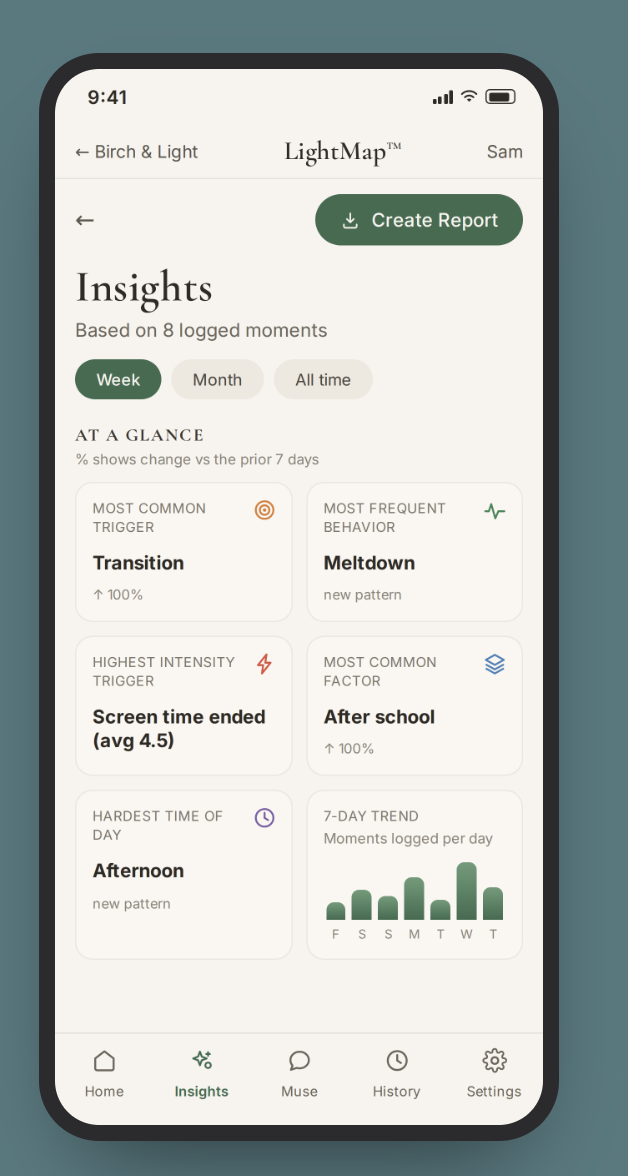

Part of the award-winning Birch & Light Method, honored with the Mom's Choice Gold Award for excellence in family resources.
A story to read together
Sometimes the easiest way in is a story you read side by side.
- June on the Blacktop
On a sunny gym day, June’s body sends a small alarm — and she learns that pausing for what she needs is not the same as quitting.
Read the story  June and the Window That Took Time
When June receives special Valentine’s Day window clings from Grandma, she learns that some things take time, help, and persistence.
Read the story
Researched and drafted with AI assistance, reviewed before publication. Editorial standards