
You signed them up for the thing they said they wanted. You bought the swimsuit, packed the bag, talked it up all week. And now you're standing in a parking lot with a child wrapped around your leg, crying like the world is ending, while other kids file past toward the picnic tables like it's nothing.
The counselors give you the look — the encouraging one that means just hand them over, they'll be fine the second you leave. And maybe that's true. But it doesn't make the moment any less awful, and it doesn't answer the question sitting in your chest: why is this so hard for my child when it's so easy for everyone else's?
The drop-off panic is not defiance, not manipulation, and not a sign you've raised a clingy kid. It is a nervous system doing exactly what it was built to do — and once you see the mechanism, both the moment and what helps look different.
What's Actually Happening at the Curb
Camp drop-off stacks several of the hardest things for an anxious nervous system into one compressed moment. It helps to see them separately, because each one is real.
Separation from the safe base. You are, to your child's nervous system, the anchor. Camp asks them to let go of that anchor and walk into uncertainty without it. For a child who reads the world as more threatening than most, that letting-go is not trivial — it is the removal of the one thing that makes unfamiliar territory survivable.
A pile of unknowns, all at once. New adults, new kids, a new place, a new set of rules they haven't learned yet, a day whose shape they can't predict. Each unknown is a small alarm. Together, at the curb, they arrive as a flood.
No exit and no timeline they can feel. "I'll pick you up later" is an abstraction to a child in alarm. In the moment, what their body registers is: I am being left here, in this unknown place, with no way out. The future pickup doesn't feel real. The being-left does.
The threshold itself. Like a child frozen at a birthday-party door, the hardest point is often the crossing — the actual handover. Once they're in and the day has a shape, the alarm frequently settles. But the curb is where the whole thing concentrates.
The panic isn't about whether camp is good. It's about a nervous system being asked to let go of its anchor and step into the unknown at the same moment.
Why "They're Fine the Second You Leave" Is Both True and Not the Point
Counselors are usually right that the crying stops soon after you go. And that is genuinely worth knowing — it can ease your guilt, and it tells you the day itself is probably okay. But it can quietly mislead, too.
That the alarm subsides once you're gone does not mean the alarm wasn't real, or that pushing through it costs nothing. For some children, the settling is real relief. For others, it's the start of masking — holding it together all day and falling apart at pickup or at home that evening. So "they stopped crying" is useful information, but it's not proof the whole thing was nothing. Watch what happens at pickup and at home to know which child you have.
What Tends to Make It Worse
The instinctive moves, the ones that feel like good parenting in the moment, often raise the alarm rather than lower it. Drawing out the goodbye, sneaking away while they're distracted, getting visibly anxious yourself, or pleading and bargaining all tend to backfire — the long goodbye prolongs the hardest moment, the sneak-away teaches them you can vanish without warning (which makes the next drop-off scarier), and your own visible worry confirms to their nervous system that there's something here to be worried about.
While you're here, take the guide
What's Underneath is free: the three body-state triggers under most meltdowns, what to say in the minute before it tips over, and how to reset afterward.

You'll get the guide instantly, plus five free articles in your inbox every week. Real challenges (meltdowns, school mornings, picky eating, big feelings) and how to actually handle them. Unsubscribe anytime.
What Tends to Help
Build familiarity before day one. Anything that converts unknowns into knowns lowers the alarm in advance. Visiting the site beforehand, meeting a counselor, seeing photos, walking through what the day will look like — each unknown you remove ahead of time is one less alarm firing at the curb.
Make the goodbye short, warm, and certain. A consistent, brief goodbye ritual — the same words, the same hug, the same confident exit — gives the nervous system a predictable edge to hold. Lingering doesn't reassure; it signals that the situation warrants hesitation. Your calm certainty is the thing they borrow.
Make the pickup concrete. Vague time is hard; concrete anchors help. "I'll be right here when swim time is over" attaches the return to something in their day they can actually feel arriving, rather than an abstract later.
Hand off to a person, not a void. Walking your child to a specific, warm counselor who takes it from there is far easier than releasing them into an undifferentiated crowd. A named adult to attach to bridges the gap your leaving creates.
Keep your own nervous system steady. Children read our regulation before they hear our words. A calm, confident drop-off — even when you don't fully feel it — tells their body this is safe more convincingly than any reassurance.
The Shift Worth Making
The question at the curb isn't "how do I get my child to stop making this hard." It's "what is making this so hard, and how do I lower it." The panic is a nervous system losing its anchor and facing a wall of unknowns at the same instant — which is a genuinely big thing to ask of a child who feels the world keenly.
You're not failing when your child melts down at drop-off, and you're not raising a child who can't cope. You're watching a hard moment that gets easier as the unknowns become known and the anchor proves it always comes back at pickup. Most of the time, it does get easier. And the way you handle the curb is part of how it gets there.
If the panic is severe, lasts well beyond the first week or two, or bleeds heavily into home life, that's worth taking seriously and, if it persists, exploring with someone who can look closely alongside you.
Every behavior is a clue.
If drop-off is a daily storm, LightMap can help you track what surrounds it — what eased it, what made it worse, how the week progressed — so the pattern beneath it becomes easier to see. Explore LightMap at birchandlight.com/lightmap.
For your child: Little Bird is about a bird who used to fly everywhere and suddenly will not leave her mother's side, and who rediscovers her wings one branch at a time.
Sources: Attachment research on the secure base and separation distress in early and middle childhood (PMC); peer-reviewed research on separation anxiety and graded separation approaches (Journal of Anxiety Disorders; PMC); American Academy of Pediatrics guidance on separation anxiety in children.
For education and reflection, not medical advice. Our terms
See what's underneath
Find the trigger instead of chasing the fear
LightMap reads your hard days together and gives you answers. Start with one moment today.
Start with 3 moments Not sure where to start? Ask me.Message Tara on WhatsApp. It really is me, I read everything and will personally respond.Click here to message Tara →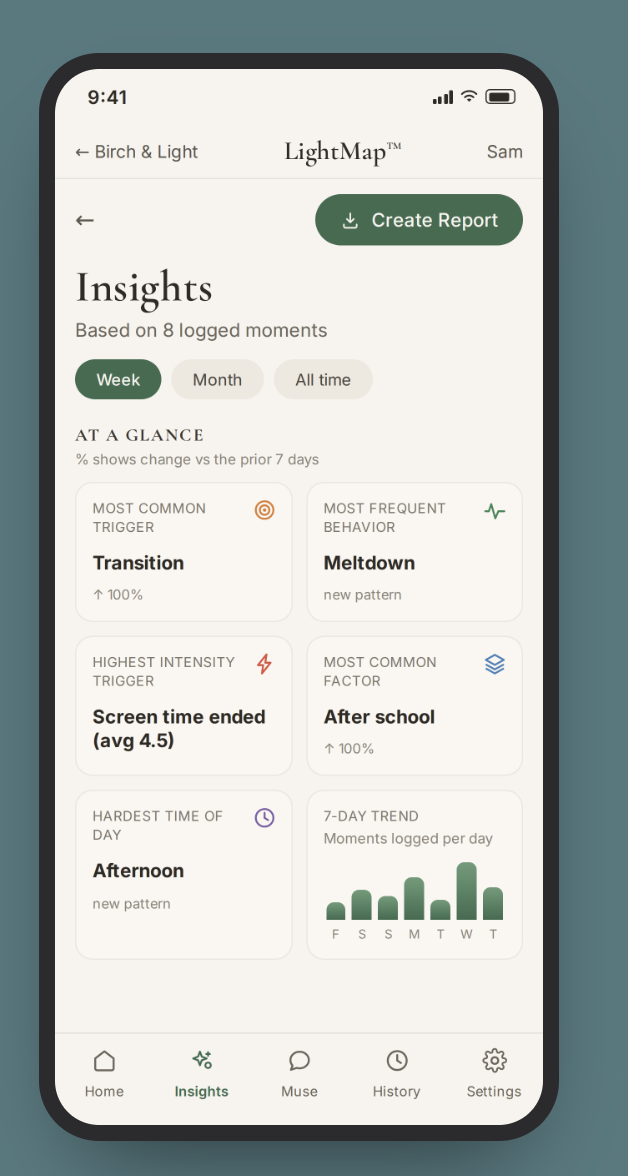

Part of the award-winning Birch & Light Method, honored with the Mom's Choice Gold Award for excellence in family resources.
A story to read together
Sometimes the easiest way in is a story you read side by side.
 HT the Hot Dog
A nervous hot dog learns that worrying about imagined disasters keeps stealing today’s joy.
Read the story The Mouse Who Heard Everything
Mina Mouse hears every creak the old house makes at night. The story gently shows that her brain isn’t broken — it’s working overtime to keep her safe — and what changes when someone sits beside her in the dark.
Read the story
If today was one of those days
A few more from the library, free to read.
Researched and drafted with AI assistance, reviewed before publication. Editorial standards