
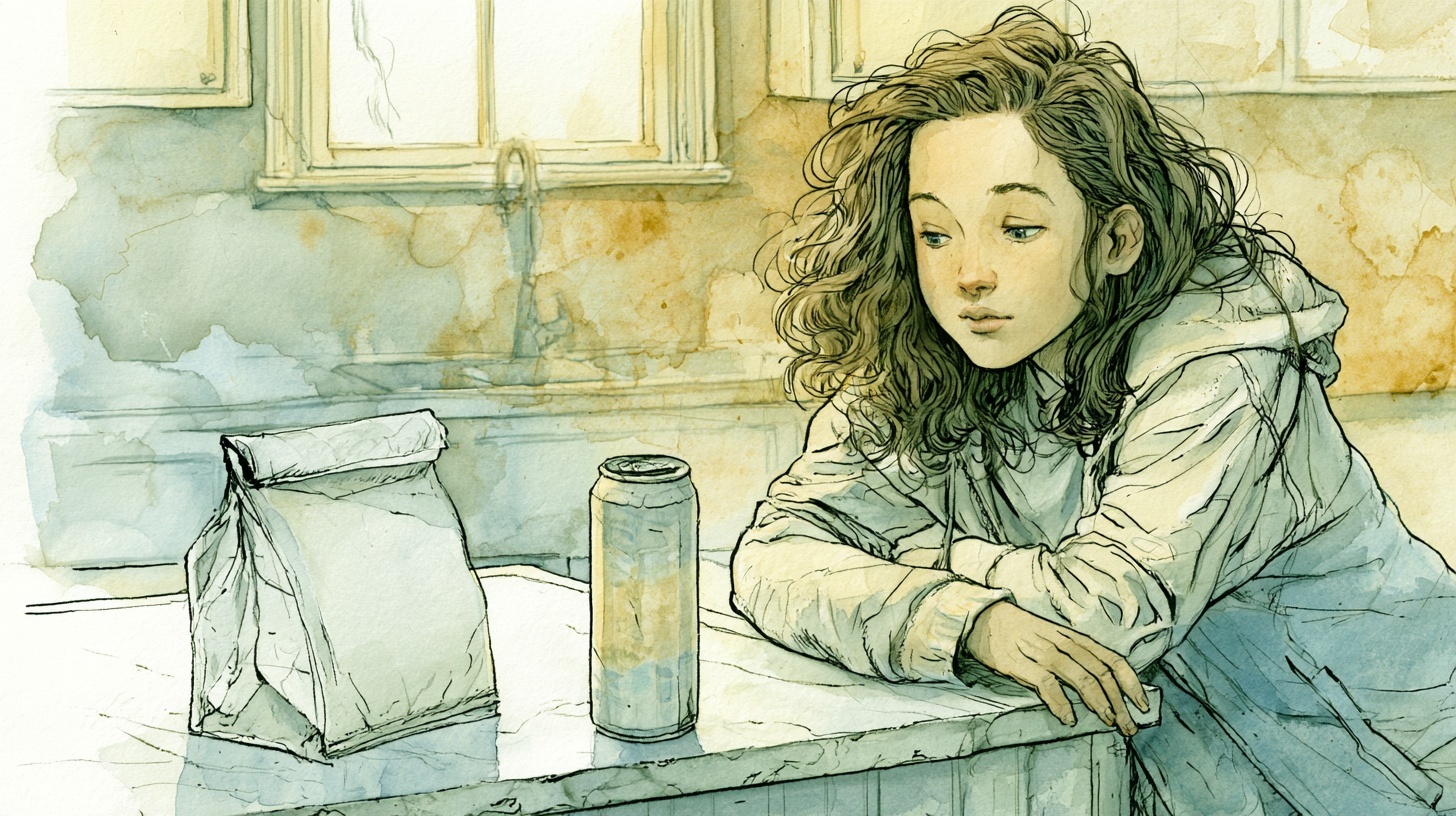
The prescription is filled. It is sitting on the counter in a white paper bag, and your teenager, who has been drinking a large energy drink most days for the past year, is supposed to start it Monday morning.
So you ask the reasonable question. She is already taking a stimulant. Does adding a prescription one matter? Do they cancel each other out, stack up, or have nothing to do with each other?
They are different drugs doing different jobs, and the answer changes what you do in the first two weeks more than at any other point in treatment.
This is a map, not medical advice. It reflects our best reading of the prescribing information and the research at the time of writing. Anything about your child's dose, timing or medical history belongs with the prescriber who wrote it.
What each one actually does
| Caffeine | Vyvanse (lisdexamfetamine) |
|---|---|
| What it does in the brain | |
| Blocks adenosine, the signal that builds up across a long day and registers as tiredness | A prodrug. The body converts it into dextroamphetamine, which raises dopamine and norepinephrine |
| What that feels like | |
| More awake, less foggy | Easier to pick a task, start it, stay with it, filter out what is not it, and pause before acting |
| What it is for | |
| Not a treatment. Consumed for alertness | Prescription treatment for ADHD in adults and children aged 6 and older, and for moderate to severe binge eating disorder in adults |
| How fast it arrives | |
| Felt within the hour | Peak dextroamphetamine levels around 3.5 hours after the dose in children aged 6 to 12 |
| How long it lasts | |
| Hours, and enough remains at bedtime that an afternoon drink costs sleep | Half-life around 12 hours. Dosed once in the morning, and afternoon doses are avoided because of insomnia |
| Controlled substance | |
| No | Yes. Schedule II, with a boxed warning covering abuse, misuse and dependence |
| What happens if it stops | |
| Withdrawal is real: headache, fatigue, irritability, poor concentration | Can produce dependence. Stopping is a prescriber conversation, not a weekend decision |
| Common side effects | |
| Jitteriness, anxiety, reflux, headache, disrupted sleep, racing heart | Appetite and weight loss, trouble sleeping, dry mouth, irritability, anxiety, higher heart rate and blood pressure |
Both are stimulants. That single word does most of the damage here, because it makes them sound interchangeable.
Caffeine removes tiredness. Vyvanse changes how attention works.
Caffeine blocks adenosine. Adenosine accumulates in the brain across a long day and is part of how the body registers being tired. Block it and the tiredness signal goes quiet. Nothing has been added. The debt is still there, waiting.
Lisdexamfetamine, the generic name for Vyvanse, is a prodrug. The capsule holds an inactive molecule that the body has to convert into dextroamphetamine before anything happens at all. That conversion is why it comes on slowly and lasts most of a day. Once converted, it raises dopamine and norepinephrine in the circuits that handle choosing a task, starting it, staying with it, filtering out everything that is not it, and putting a gap between an impulse and an action.
Which is why a teenager can drink caffeine every day for a year and still be unable to start her homework. Caffeine can make her feel more awake while she does not start it.
What is true of both
- Both can raise heart rate and blood pressure.
- Both can suppress appetite.
- Both can interfere with sleep.
- Both can produce jitteriness, anxiety and irritability.
- Regular use of either builds tolerance, and stopping either can produce withdrawal.
One myth to put down
You will hear that stimulants calm people with ADHD and excite everybody else. It is a tidy story and it is not accurate. A teenager on a dose that suits her may feel calmer because her thoughts and her behavior are better organized, not because the medication sedates her. The physical stimulant effects are still happening in her body. Which is precisely why whatever else is in her body matters.
Why stacking them ruins the first two weeks
Starting a stimulant is an experiment, and an experiment only produces an answer if one thing changes at a time.
Suppose she takes her first capsule and also drinks a 200 mg energy drink at 7:40 in the morning. By ten she is anxious, her heart feels fast, she has not touched lunch, and at nine that night she cannot fall asleep. You now have no idea what you are looking at. Wrong dose? Wrong medication? Or an ordinary response to two stimulants arriving together?
The likely outcome is the expensive one. Families conclude the medication does not agree with their child and abandon a drug that might have worked well at a dose nobody ever got to test.
What the research on energy drinks in teenagers shows
Start with the honest part. No trial has tested prescription stimulants and energy drinks together in teenagers. Anyone telling you the combination is proven dangerous, or proven fine, has gone past the evidence.
What does exist is a small set of randomized trials on energy drinks alone in healthy children and adolescents, and the detail in them is more useful than the headline.
In one randomized crossover trial, 27 healthy children and teenagers with a mean age of about 14 drank an energy drink dosed to their body weight at 3 mg of caffeine per kilogram, and a placebo, on consecutive days. Systolic blood pressure ran up to 5.23 mmHg higher after the energy drink and diastolic up to 3.29 mmHg higher, and more of them met criteria for elevated blood pressure and hypertension after the drink than after the placebo.
Two details matter. First, that is a smaller dose than many teenagers actually drink. A 50 kilogram teenager, roughly 110 pounds, received 150 mg in that study. One large energy drink can carry 200 mg or more.
Second, heart rate did not climb. It tended to run lower. A companion trial from the same group looked at heart rhythm and found more supraventricular extrasystoles, extra beats starting above the ventricles, after the energy drink than after placebo, with no dangerous rhythms and no change in the QT interval.
So the accurate picture is not that energy drinks make a teenage heart race. It is that blood pressure rises and the electrical timing of the heart is measurably disturbed, in healthy children, after a single drink. Set that beside a medication whose prescribing information lists increased blood pressure and heart rate among its warnings, and separating the two during the trial period stops being theoretical.
Where the pediatric guidance sits
The American Academy of Pediatrics has held for more than a decade that energy drinks are not appropriate for children and adolescents and should never be consumed by them, on the grounds of their stimulant content. The 2011 clinical report saying so was retired in 2021 under the AAP's standard five-year expiry policy, and the position has been restated since.
The FDA cites 400 mg a day as an amount not generally associated with dangerous effects in healthy adults, and names no safe amount for children at all. It notes that energy drinks range from 40 to 250 mg of caffeine per 8 fluid ounces, and it sends parents to their own clinician.
None of that was written for a teenager who is already drinking them daily. It is context for the conversation, not a script for it.
Do not cut the caffeine cold on day one
Caffeine withdrawal is a recognized syndrome and it looks like this: headache, fatigue, irritability, trouble concentrating, low mood. Read that list again with a new medication in mind.
If she has been drinking 200 mg a day and you take her to zero on the same morning she swallows her first capsule, you have introduced two changes instead of one, and the second produces the symptoms parents most often blame on the medication. Ask the prescriber whether to taper her down over several days before the first dose rather than after it.
Appetite, breakfast, and the part that goes wrong quietly
Appetite loss is the most reliable side effect in this class, and the prescribing information puts numbers on it. In a controlled trial in children aged 6 to 12, average weight change after four weeks was a loss of 0.9, 1.9 and 2.5 pounds at 30, 50 and 70 mg, against a one pound gain on placebo.
The medication itself does not require food. It can be taken with or without. But if your teenager already skips breakfast, and the medication takes her appetite by mid-morning, she can go until evening on nothing at all. And an energy drink cannot become the breakfast. Caffeine and a stimulant on an empty stomach is a direct route to nausea, shakiness and a miserable day that gets blamed on the wrong thing.
Aim small and specific instead of negotiating a real breakfast: half a peanut butter sandwich, a drinkable yogurt, a protein shake, milk, cheese and crackers, a bar she actually likes. Something with protein that she will reliably eat beats a proper meal she will reliably refuse.
For a child managing a condition where eating and timing interact with treatment, type 1 diabetes being the clearest case, this stops being a nutrition preference. Skipped meals, delayed meals and nausea all change the calculation, and the plan for that comes from the team who manages the condition, before the first dose rather than after it.
What to tell the prescriber before day one
- How much caffeine she actually drinks, in milligrams, and how often. Read the can rather than estimating.
- Whether she drinks it daily, which is what decides whether she needs a taper.
- Whether she skips breakfast.
- Any history of anxiety, panic, mood episodes, eating difficulties, fainting or palpitations, and any family history of sudden cardiac death or arrhythmia. The label directs prescribers to ask about these.
- Any other condition that meals and timing affect.
How to say it to a teenager who does not take instructions well
"You are not allowed" is an invitation to a fight you will lose in a school parking lot. The framing that tends to hold is the one that treats her as a participant rather than a subject.
Something close to: the doctor picked this starting dose on purpose, we have about two weeks to find out whether this medicine actually helps your brain, and the only way to know is to change one thing at a time. An energy drink adds a second thing, and then it is not the medicine we are testing anymore.
That is true, it makes no moral claim about her, and it has an end date, which matters enormously for a teenager who hears open-ended rules as control.
Say the end date out loud. Two weeks, and then we talk about what caffeine looks like from here. A restriction with a review date is a different object than a ban.
What to watch, and what to write down
Pick a start day when somebody can actually be around to observe. Then track, for the first two weeks:
- Dose and the time she took it
- Whether she ate, and what
- Any caffeine, with the amount
- Appetite through the day, and whether lunch happened
- Mood and irritability, and the time they shifted
- Sleep: the time she fell asleep, not the time she went to bed
- When the medication seemed to wear off, and what that looked like
Two weeks of that turns the follow-up appointment from a conversation about impressions into a conversation about a pattern. Prescribers can do a great deal with a pattern.
When to stop watching and make a call
Most first days are uneventful. If she does end up combining the two, it is not automatically an emergency. No further caffeine, keep her hydrated, stay near her.
Get urgent medical help for chest pain, fainting, severe shortness of breath, a heartbeat that stays very fast or irregular, extreme agitation, confusion, hallucinations, or behavior that is markedly unlike her. The prescribing information carries warnings about cardiovascular and psychiatric reactions, so those symptoms do not belong in a wait-until-morning category.
For anything troubling that is not an emergency, the pharmacist who filled the prescription can usually take a call the same day, and so can the prescriber's office.
The short version
Caffeine and Vyvanse are not the same drug, and one does not stand in for the other. Nothing rules out caffeine on this medication forever. But for the first two weeks, while you are trying to learn something specific about a specific dose in a specific kid, you want one variable, one person watching, and one honest answer. Then you can decide about the energy drinks with information instead of an argument.
Sources: Lisdexamfetamine as a prodrug of dextroamphetamine, indications for ADHD and for moderate to severe binge eating disorder, recommended starting dose, morning dosing and avoidance of afternoon doses, Schedule II status and boxed warning, cardiovascular and psychiatric warnings, and cardiac history screening before prescribing: Vyvanse (lisdexamfetamine dimesylate) prescribing information, Takeda Pharmaceuticals America, US Food and Drug Administration label reference 021977s050 and 208510s007, 2023. Time to peak dextroamphetamine concentration of approximately 3.5 hours in children aged 6 to 12: same prescribing information, clinical pharmacology section. Mean weight change of -0.9, -1.9 and -2.5 pounds at 30, 50 and 70 mg after four weeks against a one pound gain on placebo in children aged 6 to 12: same prescribing information, Study 1. Adult reference amount of 400 mg per day, the absence of any stated safe amount for children, and the range of 40 to 250 mg of caffeine per 8 fluid ounces in energy drinks: US Food and Drug Administration, "Spilling the Beans: How Much Caffeine is Too Much?", consumer update, updated 2024. Position that energy drinks are not appropriate for children and adolescents and should never be consumed by them: Schneider MB, Benjamin HJ; Committee on Nutrition and the Council on Sports Medicine and Fitness. "Sports Drinks and Energy Drinks for Children and Adolescents: Are They Appropriate?" Pediatrics, 2011;127(6):1182-1189. That clinical report was retired in July 2021 under the AAP's standard expiry policy, and the position was restated in American Academy of Pediatrics, "Children should avoid drinks with sugar, caffeine," AAP News, 2023. Blood pressure response to a weight-adjusted energy drink at 3 mg of caffeine per kilogram in 27 healthy children and teenagers of mean age 14.53 years: Oberhoffer FS, Li P, Jakob A, Dalla-Pozza R, Haas NA, Mandilaras G. "Energy Drinks: Effects on Blood Pressure and Heart Rate in Children and Teenagers. A Randomized Trial." Frontiers in Cardiovascular Medicine, 2022;9:862041. Increase in supraventricular extrasystoles with no malignant arrhythmias and no change in QTc: Mandilaras G, Li P, Dalla-Pozza R, Haas NA, Oberhoffer FS. "Energy Drinks and Their Acute Effects on Heart Rhythm and Electrocardiographic Time Intervals in Healthy Children and Teenagers: A Randomized Trial." Cells, 2022;11(3):498. Caffeine withdrawal as a recognized syndrome: Diagnostic and Statistical Manual of Mental Disorders, Fifth Edition, Text Revision, American Psychiatric Association, 2022.
For education and reflection, not medical advice. Our terms
See what's underneath
The pattern is already in your days. Start catching it.
LightMap turns scattered hard days into a pattern you can see. Start by logging one moment tonight.
Find out why it keeps happening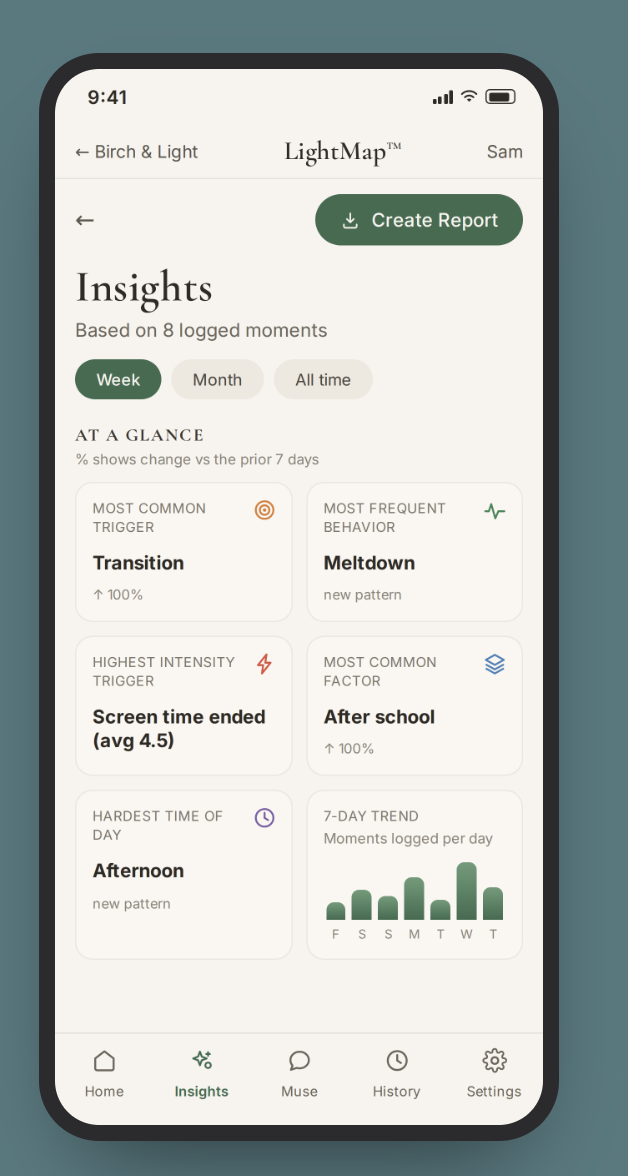

Part of the award-winning Birch & Light Method, honored with the Mom's Choice Gold Award for excellence in family resources.
Before you go, grab the free guide
The 3 body-state triggers under most meltdowns, a script for the 30 seconds before it tips over, and a reset for after. Free.

You'll get the guide instantly, plus five free articles in your inbox every week. Real challenges (meltdowns, school mornings, picky eating, big feelings) and how to actually handle them. Unsubscribe anytime.
Researched and drafted with AI assistance, reviewed before publication. Editorial standards