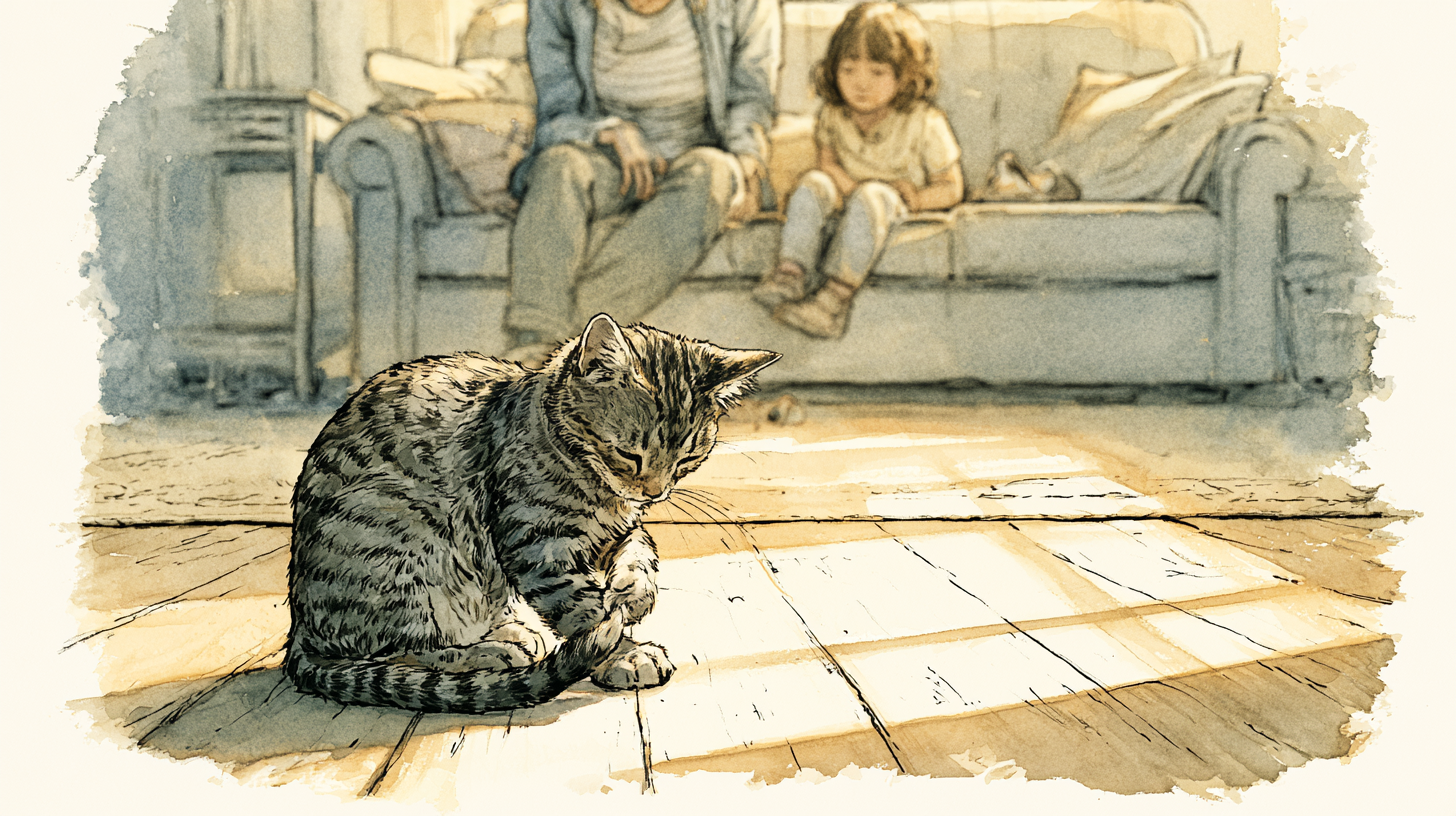
A cat scratch rarely leads to anything beyond a wipe and a plaster. When cat scratch disease does develop, a swollen lymph node appears one to three weeks later. Whether Bartonella drives PANS is unproven, with a handful of case reports and one small pilot study behind it. Flea control is the prevention that works.
A cat scratches your child. In most families that is a wipe, a plaster, and nothing else. In a family that has been through PANS, or is somewhere in the middle of trying to work out what happened to their child, it is a different moment entirely, because you have read the posts and you know the word Bartonella and now you are standing in the kitchen wondering whether you just watched something begin.
This piece is for that moment, and for the larger question sitting behind it. What is actually known about Bartonella, what is genuinely uncertain, and why parents get such wildly different answers depending on which doctor they happen to ask.
This is a map, not medical advice. It reflects our best reading of the published literature at the time of writing and is offered without guarantee. Nothing here should replace a conversation with your child's doctor.
Part one: the scratch itself
Start with the thing almost every parent gets wrong, including the reassurance people offer each other in comment threads.
Stray versus owned is close to irrelevant. Fleas are the variable.
Bartonella henselae does not live in the outdoors and cats do not pick it up from being neglected. Cats catch it from each other, and the vector is the cat flea, Ctenocephalides felis. The bacteria travels in flea feces, which ends up on a cat's claws and in its mouth during grooming. When the cat scratches or bites, that material is what gets pushed into the skin. Veterinary guidance on feline bartonellosis is explicit that fleas play the primary role in transmission between cats, and that prevalence is highest wherever conditions favor the flea.
Which means a beloved indoor cat with an untreated flea problem carries more risk than a stray with none. The scratch itself is only the delivery mechanism. The flea is the source.
Age matters more than temperament. Kittens and cats under a year old are considerably more likely to be carrying the bacteria in their bloodstream than adult cats, which is why so many cases trace back to a new kitten rather than the family cat of nine years. And bacteremia in cats can persist for weeks to months, with some evidence of intermittent bacteremia lasting two to three years.
There is no way to tell by looking. Infected cats are almost always completely well. As one state health department puts it plainly, because cats generally show no signs of illness, it is impossible to know which cats can spread it.
What happens after a cat scratch, and when should I call the doctor?
The great majority of cat scratches produce nothing at all. When cat scratch disease does develop, it follows a fairly predictable sequence, and knowing the sequence is the difference between catching it and having a mystifying fever three weeks later that nobody connects to the cat.
Days three to ten. A small reddish, often crusted bump appears at the scratch site. It is usually painless. On its own this is not the thing to worry about, and it can be easy to miss entirely.
One to three weeks after the scratch. This is the part that matters. A swollen, tender lymph node develops in the region that drains the scratch. Hand or arm means armpit or the inner elbow, leg means groin, face or scalp means neck. It is frequently accompanied by a low-grade fever, tiredness, headache, poor appetite. Most children with cat scratch disease are afebrile or run only a low fever with mild systemic symptoms.
In immunocompetent children this typically resolves on its own over two to four weeks. In about one in ten cases the node suppurates and needs draining.
The reason to write the date of the scratch down somewhere is that by the time the node appears, two weeks have passed, the scratch has healed and been forgotten, and the connection gets missed constantly. Highest incidence is in children aged five to nine, and children fourteen and under account for around a third of all reported cases.
Separately, and confusingly for parents: if the wound itself becomes red, hot, swollen and painful within a day or two, that is ordinary bacterial wound infection rather than this, and it also needs seeing. Fast and angry means one thing. Slow and glandular means another.
Part two: the question you are actually asking
The reason a scratch feels different in a PANS family is not cat scratch disease. It is the claim, widespread in parent communities, that Bartonella can cause or drive neuropsychiatric illness in children. Rage. Sudden OCD. Psychosis. Symptoms indistinguishable from PANS.
Here is the state of that evidence, stated as precisely as I can manage, because both the enthusiasm and the dismissal you will encounter are running ahead of what has actually been published.
The central case report. In 2019, a team led by Edward Breitschwerdt at North Carolina State University published a case in the Journal of Central Nervous System Disease. A fourteen-year-old boy developed neuropsychiatric symptoms and was diagnosed with rapid-onset schizophrenia. He failed multiple psychiatric drug combinations and an immunosuppressive agent given for presumed autoimmune encephalitis. The group then documented B. henselae bloodstream infection using newer culture and molecular methods.
On combination antimicrobial therapy he improved progressively, came off psychiatric medication, his skin lesions resolved, and he returned to all pre-illness activities.
That is a genuinely striking case and the authors were careful about what they claimed, writing that it suggests B. henselae bloodstream infection may contribute to progressive neuropsychiatric symptoms in a subset of patients.
What a case report can and cannot do. This is where families are most often misled, in both directions. A single case cannot establish that a treatment worked, because it cannot rule out that the child would have improved anyway, that something else in a long treatment course was responsible, or that the association was coincidental. What a case report does well is what this one did: demonstrate that something is possible, and make a case for looking harder. That is a real contribution. It is not the same as proof, and anyone telling you it is has misunderstood the format.
The follow-up work. A 2021 pilot case-control study examined the relationship between Bartonella species and schizophrenia or schizoaffective disorder. Seventeen cases, thirteen controls. Individuals with schizophrenia were more likely to test positive on a sensitive PCR assay than controls. A pilot study with thirty participants total is hypothesis-generating, which is what the authors called it, and a later review of this area summarized the position honestly: the research investigating a link between Bartonella infection and psychiatric symptoms remains limited to case studies and case series with small samples.
So the accurate summary is neither "Bartonella causes PANS" nor "this is nonsense." It is: a small number of researchers have documented Bartonella infection in patients with severe neuropsychiatric illness, some of whom improved on antimicrobials, and the total published evidence amounts to a handful of cases and one small pilot study.
The 2026 postmortem series. In July 2026 the same group published a case series in Parasites & Vectors, examining postmortem blood, tissue and urine from six chronically ill young people. Four died by suicide, one through medical assistance in dying, and one from a severe immune-activation disorder. DNA sequencing confirmed Babesia, Bartonella, or both in five of the six. It moved through parent communities within days, and if you have seen it shared with the claim that these infections cause suicide in young people, it is worth knowing what it actually establishes.
It establishes that the DNA was there. It does not establish that the infections caused the psychiatric symptoms or the deaths, and the authors do not claim that it does. Three limits sit on it.
There were six subjects and no control group, which makes it hypothesis-generating in the same way the 2021 pilot was. The families approached the researchers after learning about the lab's Bartonella work, so these were parents who already suspected this answer, which is close to the opposite of a representative sample. And most of the findings were Babesia, which is tick-borne, rather than the cat-associated B. henselae this article is about. The CDC's position remains that there is no evidence ticks transmit Bartonella to humans.
The same question about who produced the evidence applies here as to everything else from this group, for the reasons set out below. What has grown since 2021 is the volume of the signal rather than its strength. Researchers with no connection to the laboratory have said it deserves larger, carefully designed studies, which is the right conclusion, and also the one that was available five years ago.
Part three: the thing nobody tells parents
Stanford runs the Immune Behavioral Health Clinic at Lucile Packard Children's Hospital, founded in 2012 and, in its own description, the first multi-disciplinary PANS clinic in the world. Its director, Jennifer Frankovich, was co-first author on the 2013 consensus recommendations that set out how PANS is diagnosed, and is about as close to an authority as this field has.
Stanford publishes its full PANS bibliography publicly. It is long, and it is sorted into more than thirty categories: evaluation and treatment recommendations, autoantibodies, imaging, genetics, immunomodulation, animal models, differential diagnoses, and one headed specifically Infections and Antibiotics in PANS/PANDAS.
As of September 2026, there is not a single paper on Bartonella anywhere in it.
The infection work is strep, and more strep, plus sinusitis, COVID, and antibiotic trials of azithromycin and cefdinir. One paper from 2000 on mycoplasma and Tourette's sits under differential diagnoses. Search the whole list and Bartonella does not appear anywhere. Their published work on what else to consider covers lupus, Hashimoto's encephalopathy, rheumatic fever, Coxsackie virus and encephalitis lethargica. Not this.
The gap is specific to Bartonella, and it is worth being precise about that, because the field is not silent on tick-borne infection in general. The consensus guideline on infections in PANS, written by Cooperstock, Swedo, Pasternack and Murphy for the PANS PANDAS Consortium in 2017, carries a section headed Lyme borreliosis. It sets out a category called post-Lyme PANS and gives criteria for it: a child with diagnostic PANS symptoms following an illness compatible with clinical Lyme disease, who lives in a region where Lyme is established. New Jersey is on their list.
Those same authors are careful to add that they were unaware of an unequivocal case of PANS associated with Lyme disease, and that a positive Borrelia result from outside an endemic region is more likely to be a false positive than a finding. That was 2017, and it has not moved since. The American Academy of Pediatrics clinical report on PANS, published in Pediatrics in March 2025, says the same thing: Lyme has been suggested as a possible trigger, and to date no clear-cut cases of PANS have been associated with it.
There is a published case that families cite, and you should see it rather than hear about it secondhand. Cross, Bouboulis, Shimasaki and Jones described a girl whose neuropsychiatric symptoms began six months after a vacation in a tick endemic area, who had serological evidence of Lyme, who had also had three documented strep infections inside that same six-month window, and who recovered fully over thirty-one months of antimicrobials and three courses of IVIG. It is one child, she had both infections at once, and two of the four authors work for the laboratory whose antibody panel the case turns on. That combination is why the academic bodies still say no clear-cut case. It is also why a parent reading it recognizes her own child in it.
One disclosure, since I have spent this article telling you to check who funded what. One of the authors on that case report is my own child's doctor. I have left the limits of the paper standing exactly as they are, and you should still factor that connection in when you read how I have written about it.
So tick-borne infection has a place in the consensus. Bartonella has none. It appears in neither that guideline nor the Stanford bibliography.
One more thing belongs here, because leaving it out would be convenient and dishonest. Global Lyme Alliance is listed as a funder of the healthy controls in Stanford's own PANS cohort research. Their bibliography carries no Bartonella paper, and they are not sealed off from the tick-borne world either. Both things are true at once.
It matters that you understand what all of that does and does not mean.
It does not mean Bartonella is fake or that these children are imagining things. Absence of research is not evidence of absence, and this field is young enough that plenty of true things have not been studied yet.
It does mean the two bodies of work are almost entirely separate. The academic PANS establishment is investigating post-streptococcal autoimmunity, antibodies binding to striatal neurons, blood-brain barrier dysfunction, complement genetics. The Bartonella-neuropsychiatric literature comes overwhelmingly from one research group with a veterinary infectious disease background, publishing in different journals, with different collaborators. You should also know that two of that group's senior authors co-founded the laboratory that sells the enrichment culture and PCR testing their studies rely on. That does not make the findings wrong. It does mean the evidence and the test come from the same place, and you are entitled to weigh that.
Which explains the thing that drives families half mad: you can take the same child to two credentialed specialists and get two entirely different accounts of what is wrong. That is not one of them lying to you. It is two fields that have barely spoken to each other, and your child sitting in the gap.
While you're here, take the guide
What's Underneath is free: the three body-state triggers under most meltdowns, what to say in the minute before it tips over, and how to reset afterward.

You'll get the guide instantly, plus five free articles in your inbox every week. Real challenges (meltdowns, school mornings, picky eating, big feelings) and how to actually handle them. Unsubscribe anytime.
Part four: why is the testing so unsatisfying?
You will hear parents say they simply know their child has Bartonella. Usually what they mean is that a clinician assembled a symptom pattern, an exposure history, and a treatment response into a working diagnosis without a positive test. That is a legitimate way medicine operates when tests are poor. It is still a hypothesis, and the distinction gets lost in a comment thread.
The reason it comes to that is genuine. Detection is genuinely hard. The organism is described as notoriously good at hiding in the linings of blood vessels and possibly in the skin, and in cats bacteremia is intermittent and variable rather than continuous, so a single blood draw can land in a quiet window. The clearest signal of how poorly conventional testing performed is that the neuropsychiatric work only became possible with what its own authors describe as the advent of more sensitive culture and molecular diagnostic methods. Those newer techniques exist because the older ones were missing infections.
This is also why testing the cat itself is not something either the CDC or the veterinary guideline behind this article recommends for a family in your position. Their position, stated plainly: no benefit comes from testing a healthy cat, the one exception being a household with someone immunocompromised. Serology in cats has a strong negative predictive value but a weak positive one, meaning a positive result does not reliably mean the cat is currently shedding or making anyone sick, and a large share of cats in flea-heavy areas carry the bacteria without ever showing it. A test on the cat, in other words, is unlikely to move you closer to an answer either way.
Two consequences worth holding onto. A negative result does not rule it out. And, equally, no test at all does not rule it in. Both halves of that are true, and most conversations only carry one of them.
If your child is currently well and you are trying to work out retrospectively whether Bartonella was behind an episode years ago, be clear-eyed about what testing can deliver. It will tell you about now. It will not tell you about then, and a result either way will not close the question. That is a hard thing to accept when you badly want an answer, and it is better to know it before you spend money.
Part five: what to actually do
After a scratch, today. Wash it immediately with soap and water. That is the whole of the immediate response. Alcohol will not hurt and adds little once the wound is clean. Nobody gives preventive antibiotics after a routine scratch, so there is nothing to chase. Write the date down.
Over the next month. Watch for the sequence, not the wound. Papule at three to ten days is expected. A tender swollen node one to three weeks later, particularly with a low fever and a child who seems off, is the thing to take to a doctor, and say the word scratch and give the date, because that is what stops it being a three-week diagnostic detour.
Get help promptly if the eye is involved or the scratch was near the eye, if there is a severe headache with neck stiffness, if there are neurological changes, if there is prolonged unexplained fever, or if your child is immunocompromised, in which case the ordinary reassurance about self-limiting illness does not apply.
The prevention that actually works is flea control. Not keeping cats away from children, not rehoming a pet, not avoiding kittens. Year-round veterinary flea treatment on every animal in the house, because the flea is where this begins.
Trim claws. Discourage rough play with kittens specifically. Do not let a cat lick broken skin. For a family with a child who has an immune condition, that flea protocol is not fussiness, it is the single highest-yield thing available.
If your child is in a flare and you are asking about Bartonella. Test broadly and immediately rather than waiting to see whether it settles, because the window for catching what is driving a flare is narrow and it is the thing families most often regret missing. Ask which assay is being used and whether it is a standard serology or an enrichment culture and PCR method, since they are not equivalent. And ask any clinician recommending prolonged combination antimicrobial therapy the same questions you would ask about any long treatment: what would tell us this is working, what would tell us it is not, and at what point would we stop.
The thing to hold on to
The honest position on Bartonella and childhood neuropsychiatric illness is uncomfortable, because it is neither of the two comfortable positions available in a Facebook group.
It is possible. It has been documented in individual children by serious researchers publishing in peer-reviewed journals. The total evidence is thin, and the most prominent academic PANS program in the country has published nothing on it at all. Testing is unreliable in both directions. And a great many children in these communities are being treated for it on the strength of pattern recognition rather than proof.
Holding that whole picture at once is harder than picking a side. It is also the only position that will not eventually let your child down, because it keeps you asking questions in both directions: of the doctor who dismisses it, and of the doctor who is very certain.
Researched and written in 2026. This reflects our best reading of the published literature at that time and is offered without any guarantee of accuracy or outcome. It is not medical advice and it is not a diagnosis. Talk to your child's doctor.
Sources, tied to the claims they support. Transmission of Bartonella henselae between cats by the cat flea, the role of flea feces, higher prevalence where flea conditions favor it, persistence of bacteremia in cats, and the absence of clinical signs in most infected cats: European Advisory Board on Cat Diseases guideline for feline bartonellosis, and the review "Uncovering the truth about cat-scratch disease." Kittens being more likely than adult cats to be infected and to transmit, and the impossibility of identifying an infected cat by appearance: Minnesota Department of Health, cat scratch disease. Papule at the inoculation site within three to ten days, regional lymphadenopathy one to three weeks after inoculation, suppuration requiring drainage in approximately ten percent, and self-limited resolution in two to four weeks in immunocompetent patients: StatPearls, Cat Scratch Disease and Bartonellosis, and Merck Manual Professional Edition. Highest incidence in children aged five to nine, children fourteen and under accounting for roughly a third of reported cases, and most patients being afebrile or having only low-grade fever: Children's of Alabama antimicrobial reference on Bartonella henselae. The 2019 case of a fourteen-year-old boy diagnosed with rapid-onset schizophrenia, documented B. henselae bloodstream infection, and symptom resolution on antimicrobial therapy: Breitschwerdt EB, Greenberg R, Maggi RG, Mozayeni BR, Lewis A, Bradley JM, "Bartonella henselae Bloodstream Infection in a Boy With Pediatric Acute-Onset Neuropsychiatric Syndrome," Journal of Central Nervous System Disease, 2019. The pilot case-control study of seventeen cases and thirteen controls finding higher PCR positivity in schizophrenia and schizoaffective disorder: "Schizophrenia and Bartonella spp. Infection: A Pilot Case-Control Study," Vector-Borne and Zoonotic Diseases, 2021, lead author Erin Lashnits, with Breitschwerdt and Frohlich among the co-authors. The characterization of this literature as limited to case studies and case series with small samples: Stewart, Korsapathy and Frohlich, "Crowd-sourced investigation of a potential relationship between Bartonella-associated cutaneous lesions and neuropsychiatric symptoms," 2023. Difficulty of detection because the organism being described as hiding in the linings of blood vessels and potentially the skin, prompting development of more sensitive detection methods: North Carolina State University College of Veterinary Medicine research summaries on Bartonella. The advent of more sensitive culture and molecular diagnostic testing modalities as the precondition for documenting these infections: stated in the opening of the 2019 Breitschwerdt case report cited above. The absence of any Bartonella publication in the Stanford PANS program bibliography, and the composition of its infection and differential diagnosis categories: Stanford Medicine PANS program, Publications, accessed September 2026. The 2017 consensus guideline on infection, including its Lyme borreliosis section and the post-Lyme PANS criteria: Cooperstock, Swedo, Pasternack and Murphy, "Clinical Management of Pediatric Acute-Onset Neuropsychiatric Syndrome: Part III, Treatment and Prevention of Infections," Journal of Child and Adolescent Psychopharmacology 2017;27(7):594-606. Global Lyme Alliance as a funder of the healthy controls in Stanford's PANS cohort research: funding statement, Yin et al., interferon-lambda-neutralizing autoantibodies in pediatric acute-onset neuropsychiatric syndrome, medRxiv 2024. The laboratory selling the enrichment culture and PCR testing used in the Bartonella studies was co-founded by two of their senior authors: Galaxy Diagnostics company information. No clear-cut cases of PANS associated with Lyme disease to date: American Academy of Pediatrics, "Pediatric Acute-Onset Neuropsychiatric Syndrome (PANS): Clinical Report," Pediatrics 2025;155(3):e2024070334. The case report of concurrent PANDAS and persistent Lyme disease: Cross, Bouboulis, Shimasaki and Jones, Frontiers in Psychiatry 2021;12:505941, whose first and third authors are affiliated with Moleculera Labs. The recommendation against testing healthy cats, the exception for immunocompromised households, and the negative versus positive predictive value of feline Bartonella serology: European Advisory Board on Cat Diseases guideline for feline bartonellosis, and CDC, About Cat Scratch Disease, accessed September 2026.
For education and reflection, not medical advice. Our terms
Before the next flare
Bring your doctor a timeline, not a memory
LightMap reads your hard days together and gives you answers. Start with one moment today.
Start with 3 moments Not sure where to start? Ask me.Message Tara on WhatsApp. It really is me, I read everything and will personally respond.Click here to message Tara →
Part of the award-winning Birch & Light Method, honored with the Mom's Choice Gold Award for excellence in family resources.
If today was one of those days
A few more from the library, free to read.
Researched and drafted with AI assistance, reviewed before publication. Editorial standards