
The letter arrived in a window envelope. It uses the word truancy, or it uses the word chronic absenteeism, and somewhere in it is a sentence about court, or about a referral, or about child protective services.
Your child is not skipping school. Your child is having panic attacks in the car, or shutting down in the hallway, or being sent home by the same school that is now counting the absences.
Note before you read on: attendance law is state law and the thresholds, the terminology, and the agencies involved differ everywhere. What follows is the shape of the process and how to find your own state's numbers.
Two separate tracks, and they lead to different places
The single most useful thing to understand is that a school's attendance concern can travel down one of two roads, and families are rarely told which one they are on.
Truancy treats the absence as the student's conduct. It typically routes through the school, then a district attendance officer or review board, then in some states a juvenile or family court.
Educational neglect treats the absence as the parent's failure. It routes to child protective services.
Which road a school chooses is frequently discretionary, and it often depends on the age of the child and on how the school has characterized the absences internally.
So ask, in writing, early: is this being handled as truancy or as educational neglect, and what is the specific district policy being applied. That question alone changes how some cases are handled, because it makes clear that somebody is paying attention.
Excused, unexcused, and the word that matters
Most of these letters are counting unexcused absences, and most families do not know which of their absences got coded which way.
Ask for the attendance record. Not a summary. The coded record showing each date and how it was classified. Then check it against your own calendar, because errors are common and a single miscoded week can be the difference between under and over a threshold.
Then look at what your state and district accept as excused. Many accept documented illness including mental health, appointments, and in some places a parent note up to a set number of days. If your child has been out with anxiety and those days were coded unexcused, a letter from a clinician can sometimes reclassify them retroactively.
And count the days the school itself sent your child home. Those are frequently coded as absences, which means a district can create the attendance problem it is now writing to you about. Ask for those specifically.
The disability question changes the frame
This is the piece that reframes the whole thing, and it is the reason attendance letters and special education law belong in the same conversation.
If your child is missing school because of a disability, whether diagnosed or suspected, the absences are evidence that they are not receiving what they need to access their education. That is not a parenting failure and it is not delinquency. It is a school obligation that is not being met.
So the response to an attendance letter is very often a written request for an evaluation, or a request to reconvene the IEP or 504 team, sent the same week. A district that is simultaneously pursuing truancy and refusing to evaluate is in a much weaker position than one that is only doing the first.
Put both in writing, on the same day if you can, and keep the timestamps.
While you're here, take the guide
What's Underneath is free: the three body-state triggers under most meltdowns, what to say in the minute before it tips over, and how to reset afterward.

You'll get the guide instantly, plus five free articles in your inbox every week. Real challenges (meltdowns, school mornings, picky eating, big feelings) and how to actually handle them. Unsubscribe anytime.
If child protective services becomes involved
Take it seriously, and do not panic, and do not handle it by ignoring it.
Educational neglect referrals for a child with documented medical or psychiatric needs are frequently closed once the documentation is produced. What causes trouble is a family that stops responding.
Gather the record. Clinician letters describing why school attendance is affected, appointment history, every email you have sent the school asking for help, and any evaluation request you made and what came back.
That last one matters more than parents expect. A file showing you asked for help repeatedly and were refused reads very differently than a file showing absences and silence.
You are also allowed to have someone with you and to ask for everything in writing. If the referral involves a disability, your state's Protection and Advocacy agency and your Parent Training and Information Center are both free and both handle this.
Get the school on record
Ask for these in writing and keep the replies.
What is the attendance threshold that triggered this letter, and what is the policy number it comes from. What interventions has the district tried before referring. What accommodations has the school offered to address the reason for the absences. Who made the decision to refer, and to whom.
Most attendance systems are built to move automatically. A parent asking specific written questions frequently causes a human to look at the file for the first time.
Where to find your state's numbers
Search for compulsory attendance law with your state name to find the statute. Your district's attendance policy is usually in the student handbook or the board policy manual, both of which are normally public.
Your state's Parent Training and Information Center is federally funded and free, and knows how attendance and special education interact where you live. Your Protection and Advocacy agency handles the more serious cases. Legal aid handles court involvement.
What this actually is
A child who cannot get through the school door is telling you something, and a system responding to that with a letter about penalties has misread it entirely.
Your job is not to prove you are a good parent. It is to get the reason for the absences into the record, in writing, in front of people whose obligation it is to address it.
Our research says this is the general shape of the process. It is not legal advice, and this one varies more by state than almost anything else we write about, so nothing here substitutes for your own state's statute. Check it directly. Search your state name with compulsory attendance law, read your district's board policy, and call your state's Parent Training and Information Center, which is free.
Sources: state compulsory attendance statutes vary; consult your state's law and your district's board policy. Free help: your state Parent Training and Information Center and Protection and Advocacy agency.
For education and reflection, not medical advice. Our terms
See what's underneath
Put the reason in front of them, in writing
LightMap reads your hard days together and gives you answers. Start with one moment today.
Start with 3 moments Not sure where to start? Ask me.Message Tara on WhatsApp. It really is me, I read everything and will personally respond.Click here to message Tara →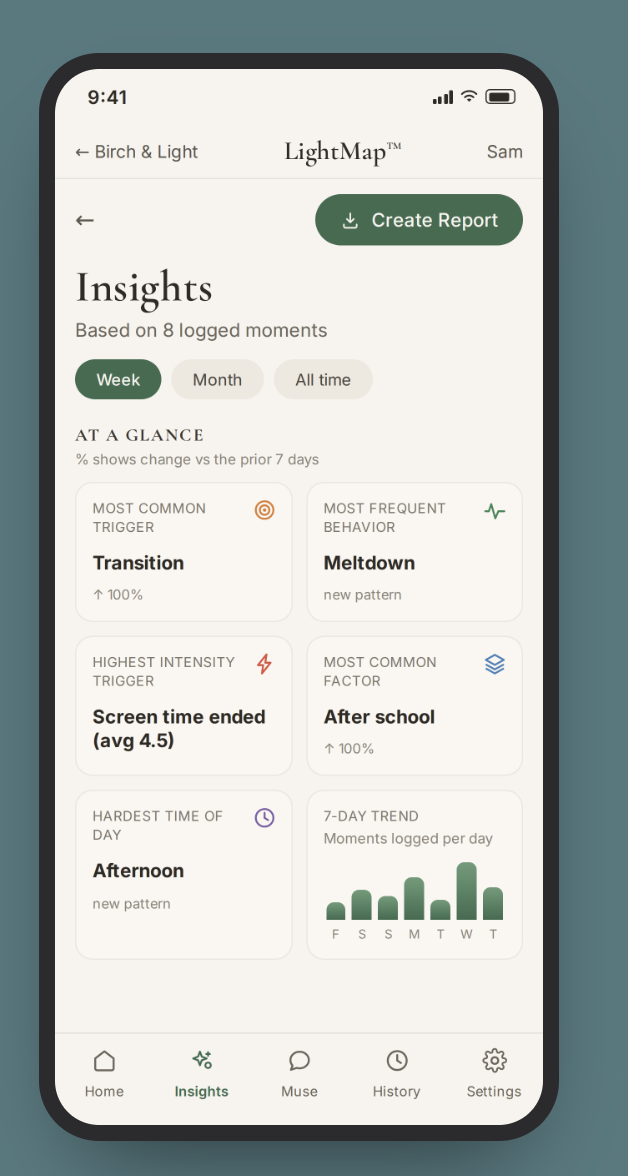

Part of the award-winning Birch & Light Method, honored with the Mom's Choice Gold Award for excellence in family resources.
If today was one of those days
A few more from the library, free to read.
Researched and drafted with AI assistance, reviewed before publication. Editorial standards