
The call came at eleven in the morning. There was an incident, he is in the office, and he is suspended. Maybe for three days. Maybe longer, and there is a word in the letter about a hearing.
If your child has an IEP, a set of federal protections may apply from the moment that decision was made, and the school is not required to explain them to you in a way you will understand while you are standing in a parking lot.
The ten day line
Everything in school discipline for a child with an IEP organizes around one number.
School personnel can remove a child with a disability for up to ten consecutive school days, the same as any other student. They can also make additional removals of not more than ten consecutive school days in the same school year for separate incidents of misconduct, so long as those removals do not add up to a change of placement.
That last clause is where families get caught. A district that suspends a child for three days in September, four in November, two in January, and five in March has passed ten days for the year. When a series of removals forms a pattern, that pattern can itself constitute a change of placement, which triggers the protections below.
So keep a running count from the first day of school. Not the school's count. Yours. Include partial days sent home early, because those are removals too, and they are frequently never written down as suspensions at all. A child who is collected at 10am four days a week is being removed, and if nobody is counting it, nobody is protecting him.
What has to happen once it becomes a change of placement
Within ten school days of any decision to change a child's placement because of a violation of the code of conduct, the district, the parent, and relevant members of the IEP team have to hold a manifestation determination.
You are part of that team. Not an observer. A member.
The meeting asks two questions and only two.
Was the conduct caused by, or did it have a direct and substantial relationship to, the child's disability?
Was the conduct the direct result of the district's failure to implement the IEP?
If the answer to either one is yes, the behavior is a manifestation of the disability, and the child generally goes back to the placement he came from.
The second question deserves more attention than it usually gets. If the IEP called for a one to one aide and there was no aide that week, if it called for movement breaks that had quietly stopped happening, if a behavior plan existed on paper and no staff member could describe it, then the conduct may be the direct result of a failure to implement. When the team reaches that conclusion, the district is required to take immediate steps to fix the deficiency.
Which means the question to walk in with is not was he provoked. It is: show me the service log. Was every service in this IEP actually delivered in the weeks before this incident.
What to bring
Bring the IEP itself, and read the services page before you go in.
Bring your own record of the last several months. Dates, incidents, what happened before each one, calls home, early pickups. Teams that are handed a pattern behave differently than teams that are handed a parent's recollection.
Bring any evaluation that describes the disability in terms that connect to what happened. If a report says he has significant difficulty with impulse control under stress and the incident was an impulsive act under stress, say the connection out loud and ask that it be recorded in the minutes.
And bring somebody with you if you can. Your state's Parent Training and Information Center is federally funded, free, and staffed by people who attend these meetings constantly.
While you're here, take the guide
What's Underneath is free: the three body-state triggers under most meltdowns, what to say in the minute before it tips over, and how to reset afterward.

You'll get the guide instantly, plus five free articles in your inbox every week. Real challenges (meltdowns, school mornings, picky eating, big feelings) and how to actually handle them. Unsubscribe anytime.
The exceptions nobody warns you about
There are three circumstances where a school can move a child to an interim alternative educational setting for up to forty five school days regardless of the manifestation determination. Weapons. Illegal drugs or the sale of a controlled substance. Serious bodily injury inflicted on another person.
In those cases the answer to the manifestation question does not change the removal. The IEP team still determines the setting, and services still have to continue.
Services do not stop
This is the piece most families never learn. Beyond ten cumulative school days of removal in a year, a child with an IEP has to keep receiving services that allow him to continue making progress toward his goals, even if he is not in his usual classroom, and even when the behavior is found not to be a manifestation.
A district that suspends your child for the rest of the semester and sends nothing home is not exercising discretion. Ask in writing what services are being provided and where.
If you disagree with the outcome
A manifestation determination can be appealed, and that appeal is expedited. Under the regulation a hearing occurs within twenty school days of the date the complaint is filed. A hearing officer can return the child to the placement he was removed from.
Before that, ask for prior written notice of the decision. A district that refuses to change a placement or a disciplinary outcome has to put in writing what it decided, why, what records it relied on, and what other options it considered and rejected. Decisions that were made on a general impression get much harder to defend once somebody has to write down the basis for them.
If your child does not have an IEP yet
These protections can still apply in some circumstances if the district knew, or should have known, that your child had a disability before the behavior occurred. A pending evaluation request, previous written concerns from you, or documented concerns raised by staff can all matter here. Raise it, in writing, immediately, and ask the district to address it directly.
What this is really about
Suspension does not teach a child with a disability to behave differently. It removes him from the place where the teaching happens, which for a child who is already behind is the opposite of what he needs.
The protections exist because Congress understood that. Using them is not making excuses for your child. It is insisting that a behavior which comes from a disability gets a plan rather than a punishment.
Our research says this is how the process works, based on our reading of the federal special education regulations as of August 2026. It is not legal advice. Rules get amended, states add their own layers on top, and your district may operate differently. Check it directly before you act on it. The regulations are public and free at ecfr.gov under Title 34, Part 300, and your state's Parent Training and Information Center will confirm how it works where you live at no cost.
Sources: 34 CFR 300.530, 300.532, 300.536, 300.503; US Department of Education Questions and Answers on Discipline Procedures.
For education and reflection, not medical advice. Our terms
See what's underneath
Walk into that meeting with answers
LightMap reads your hard days together and gives you answers. Start with one moment today.
Start with 3 moments Not sure where to start? Ask me.Message Tara on WhatsApp. It really is me, I read everything and will personally respond.Click here to message Tara →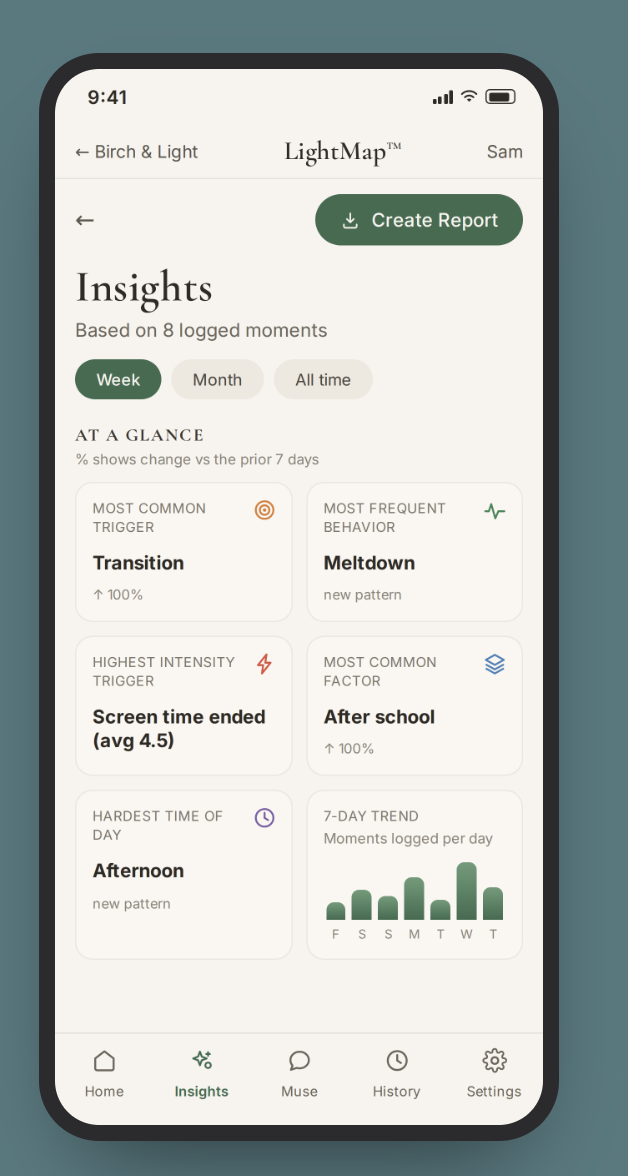

Part of the award-winning Birch & Light Method, honored with the Mom's Choice Gold Award for excellence in family resources.
If today was one of those days
A few more from the library, free to read.
Researched and drafted with AI assistance, reviewed before publication. Editorial standards