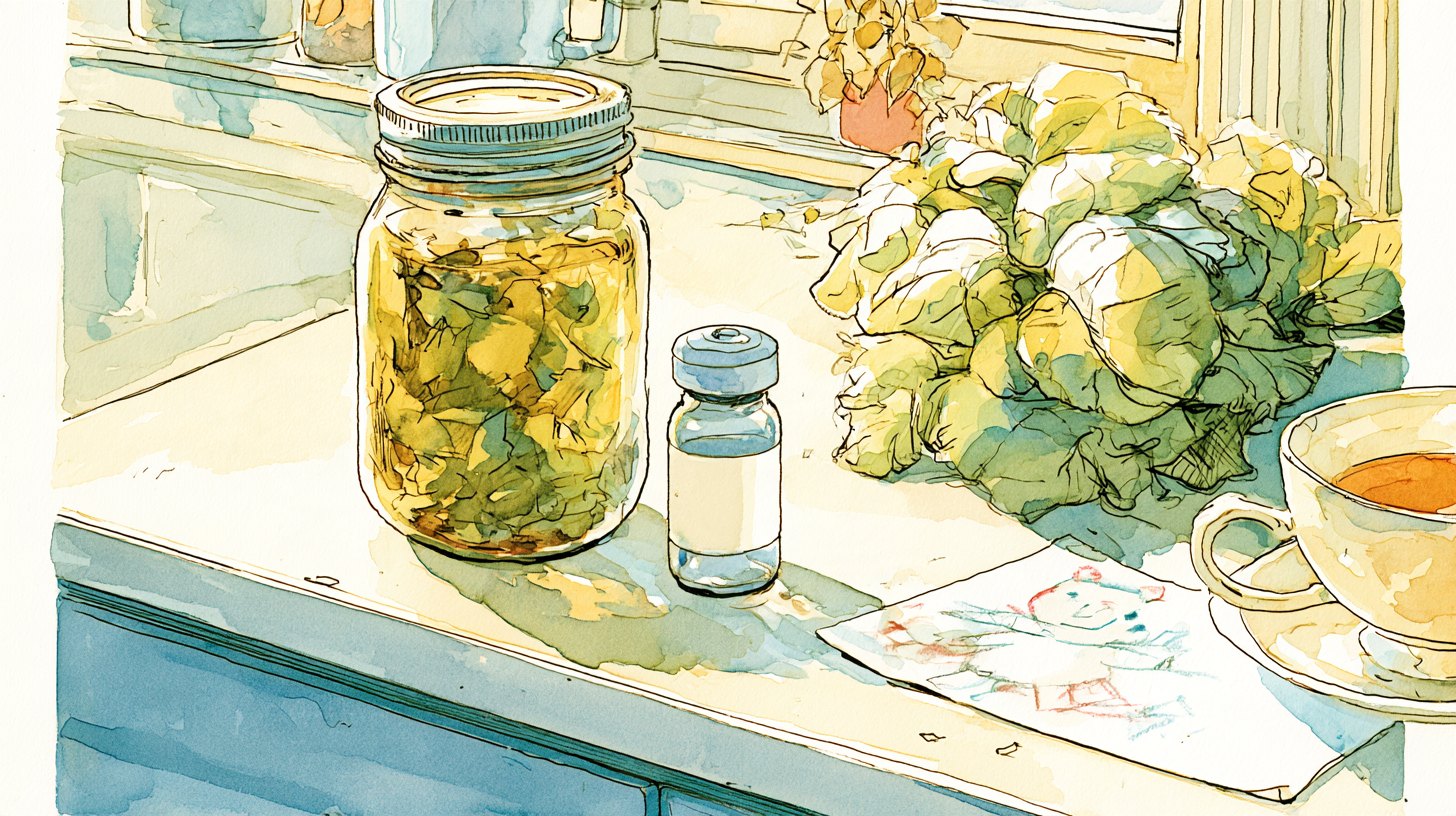
PS128 is a single probiotic strain, Lactobacillus plantarum PS128, sold for neurodevelopmental conditions. The research on it is real but small: a few short trials, mostly in autism, mostly funded or supplied by the company that owns the strain, and none built to test it for ADHD. It is a reasonable thing to try carefully. It is not a proven treatment.
You have probably seen it in a parent group. Someone's son was melting down every day, she started a probiotic, and within a week the house was different. She is not lying, and she is not selling anything. She is telling you what happened in her home. And you are sitting there with a child who is struggling, wondering whether you have missed the one thing that would have helped.
Here is what is actually known, so you can decide with clear eyes.
What PS128 is
PS128 is one strain of a common lactic acid bacterium. It was first isolated from fu-tsai, a traditional fermented mustard product from Taiwan (Chao et al., 2009). The company that owns it, Bened Life, sells it as Neuralli MP, which it markets as a medical food for the dietary management of autism and Parkinson's disease. A medical food is not a drug and does not go through drug approval. The company itself describes Neuralli as not a treatment.
It belongs to a group researchers call psychobiotics: bacteria studied for effects on the brain through the gut-brain axis, the two-way signaling between the gut, the immune system and the nervous system. That connection is a real and active area of science. What it can do for a specific child is still early.
What the trials found
The autism trial. The best-known study gave PS128 or a placebo to 80 Taiwanese boys with autism, aged 7 to 15, for four weeks, and 71 finished (Liu et al., 2019). On the main outcomes the trial was designed to test, there was no significant difference between the PS128 group and the placebo group. In a smaller group of boys aged 7 to 12, PS128 did better than placebo on an ADHD and oppositional behavior rating scale. The authors themselves noted that most of the benefits were exploratory, the sample was small, and the placebo effect was high. The study was funded by the company, which also supplied the product, and one author held stock in it.
The Tourette trial. A second trial gave PS128 or placebo to 58 children aged 5 to 18 with Tourette syndrome for two months (Wu et al., 2021). It found no difference in tics, the main outcome. On an attention test, the PS128 group improved on two measures, which led the authors to suggest it may help ADHD symptoms that often come with Tourette's and to call for more research. The company supplied the capsules.
The real-world report. A clinic in Italy looked back at 131 autistic children and teens who had taken probiotics, 105 of them PS128, and found improvements in overall clinical ratings after six months, larger in younger children, with few side effects (Mensi et al., 2021). Without a placebo group, a study like this cannot separate the probiotic from time, other treatments, growth, or a family's hope.
Put together: a few small, short studies with mixed results, mostly in autism, often tied to the manufacturer. That is enough to call PS128 promising. It is not enough to call it proven, and it is nowhere near the evidence behind standard ADHD treatment.
Claims you may hear in parent groups
"The gut-brain axis matters." True. It is a serious field of research.
"Neurodivergence is a sign of gut damage." Not supported. Some studies find differences in gut bacteria in autistic and ADHD children, but no research shows that gut problems cause neurodivergence or that every neurodivergent child has them.
"ADHD medication wipes out gut bacteria." Antibiotics are well known to change gut bacteria. We found no good evidence that ADHD stimulants do the same.
"It worked in a week." It may have, for that child. The trials ran four weeks and two months, and one family's experience cannot tell you what will happen for yours. That is the reason to run your own careful trial instead of borrowing someone else's result.
Is it safe?
For most healthy children, probiotics are low risk, and the PS128 trials did not report serious side effects. Probiotic bacteria have rarely caused bloodstream infections, mostly in people who are immunocompromised, seriously ill, premature, or have a central line (Doron and Snydman, 2015). Talk to your child's doctor first if your child has an immune condition, an autoimmune illness, a central line or port, a heart valve problem, or is on repeated antibiotics. Antibiotics can also kill probiotic bacteria, so if your child is on one, ask the doctor how to time doses.
How to try it fairly at home
If you and your child's doctor decide to try PS128 or any probiotic, the goal is to learn whether it helps your child, not whether it helped someone else's.
- Log two weeks of ordinary days first, so you have something real to compare against.
- Change one thing at a time. If you start a probiotic, a new diet and a new therapy the same week, you will never know which one did what.
- Give it as long as the studies did, up to about eight weeks, before you judge it.
- Decide in advance what you are watching: the number of hard moments, how long they last, sleep, stomach symptoms, how mornings go.
- Stop and call the doctor if anything new and worrying shows up.
Our guide on how to tell if a supplement is actually working walks through this step by step.
The part to hold onto
You are not behind because you have not tried the probiotic everyone in the group is talking about. Every child is different, and the only result that matters is the one you can see in your own child, over weeks, logged somewhere you can trust.
Log the start date of anything new as a change in LightMap, then keep logging the hard moments, sleep and good stretches as usual. After a few weeks you can see whether anything shifted, and bring that to your child's doctor.
This is general information for parents, not medical advice. Talk to your child's doctor before starting any supplement. Sources: Liu YW, Liong MT, Chung YCE, Huang HY, Peng WS, Cheng YF, Lin YS, Wu YY, Tsai YC, "Effects of Lactobacillus plantarum PS128 on children with autism spectrum disorder in Taiwan: a randomized, double-blind, placebo-controlled trial," Nutrients, 2019, 11(4), 820, doi 10.3390/nu11040820 (80 randomized, 71 completed, boys 7 to 15, four weeks, no significant between-group difference on primary outcomes, SNAP-IV improvement in ages 7 to 12 subgroup, funded by Bened Biomedical, one author held company stock). Wu CC, Wong LC, Hsu CJ, Yang CW, Tsai YC, Cheng FS, Hu HY, Lee WT, "Randomized controlled trial of probiotic PS128 in children with Tourette syndrome," Nutrients, 2021, 13(11), 3698, doi 10.3390/nu13113698 (58 children aged 5 to 18, two months, no difference in tic severity, improvement on two attention test measures, product supplied by Bened Biomedical). Mensi MM, Rogantini C, Marchesi M, Borgatti R, Chiappedi M, "Lactobacillus plantarum PS128 and other probiotics in children and adolescents with autism spectrum disorder: a real-world experience," Nutrients, 2021, 13(6), 2036, doi 10.3390/nu13062036 (131 children, 105 on PS128, retrospective, no placebo group). Doron S, Snydman DR, "Risk and safety of probiotics," Clinical Infectious Diseases, 2015, 60(Suppl 2), S129-S134, doi 10.1093/cid/civ085. Chao SH, Wu RJ, Watanabe K, Tsai YC, "Diversity of lactic acid bacteria in suan-tsai and fu-tsai, traditional fermented mustard products of Taiwan," International Journal of Food Microbiology, 2009, 135, 203-210 (original isolation of the PS128 strain). Bened Life, Neuralli MP product and healthcare provider materials, benedlife.com.
LightMap by Birch & Light
See whether it is helping your child
LightMap tracks the start date of anything new alongside hard moments, sleep and good stretches, so you can see what changed.
Get 7 days of LightMap free.
Enter your email and I'll send your link and a short guide to your first week. No card.
No card. No password yet.
7 days free. No card required.
Or get a free 15 minute LightMap Analysis with TaraFree. No card. 15 minutes.
“LightMap showed me patterns I wasn't connecting before. Things that looked random stopped feeling random.”
 Not sure where to start? Ask me.Message Tara on WhatsApp. It really is me, I read everything and will personally respond.Click here to message Tara →
Part of the award-winning Birch & Light Method, honored with the Mom's Choice Gold Award for excellence in family resources.
For education and reflection, not medical advice. Our terms
Take the guide for later
What's Underneath: the three body-state triggers under most meltdowns, what to say before it tips over, and how to reset afterward.
You'll get the guide instantly, plus five free articles in your inbox every week. Real challenges (meltdowns, school mornings, picky eating, big feelings) and how to actually handle them. Unsubscribe anytime.
More about ADHD
Related reading from the Birch & Light library.
Researched and drafted with AI assistance, reviewed before publication. Editorial standards