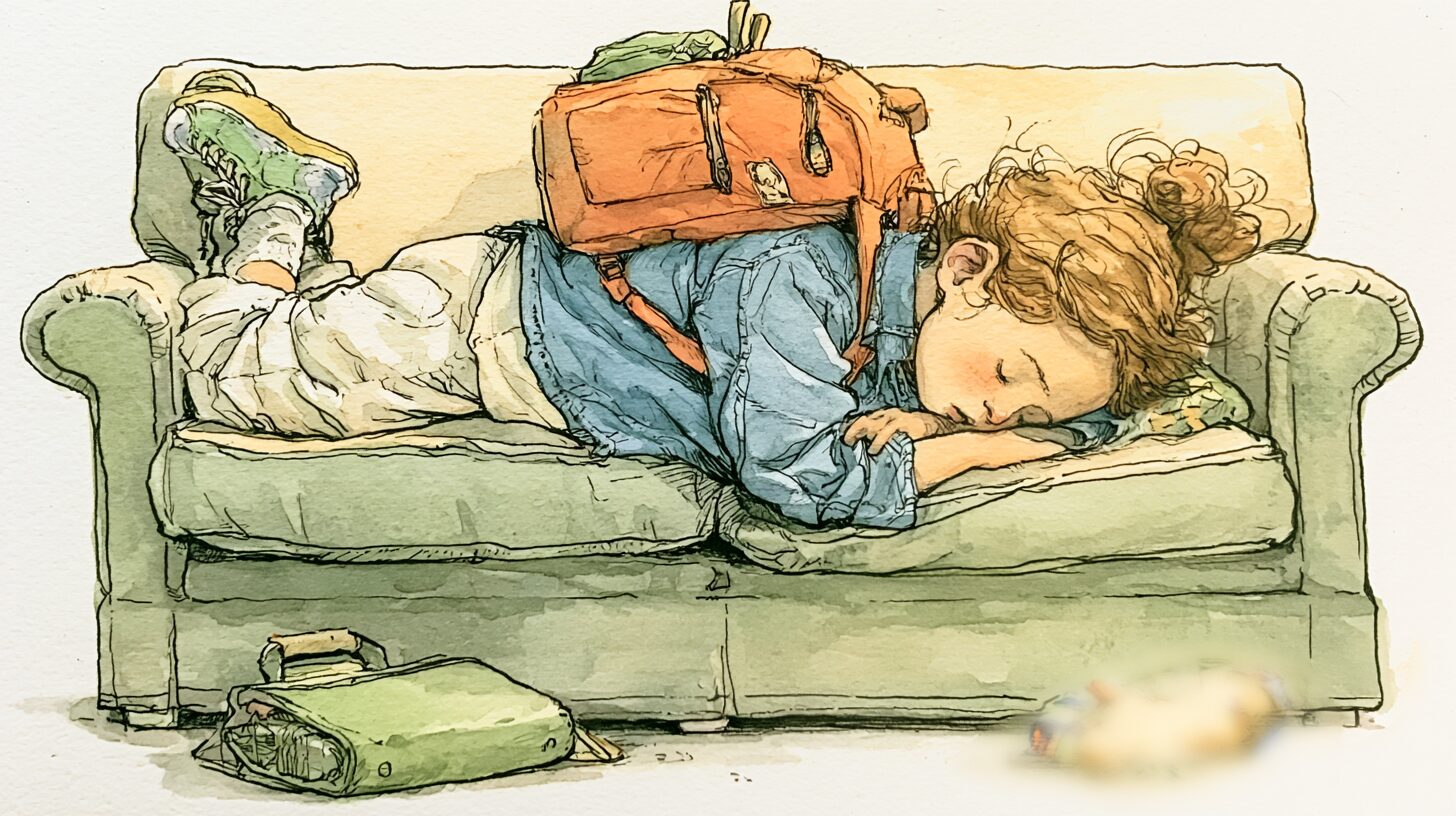
Your child walked out of the school building fine. Teacher says fine. Backpack, wave, maybe even a smile. Eleven minutes later they are on the kitchen floor screaming about the wrong cup.
This has a name. After school restraint collapse is the crash that comes when a child who has been holding themselves together all day finally stops holding. Parents often call it the 4pm crash. It is not defiance, it is not something you caused at pickup, and it is not a sign that home is the problem.
What is after school restraint collapse?
Restraint collapse describes what happens when the effort of self-restraint runs out. All day your child has been managing noise, transitions, other people's moods, unspoken rules, the fluorescent hum, the smell of the cafeteria, the friend who was weird at recess, and the constant low-grade work of appearing okay.
That effort is real work, and it is finite. When they reach you, the job is over. The collapse is not the beginning of the hard thing. It is the end of it.
The gap between school and home
There is a gap between how your child performs at school and how they fall apart at home, and it is the single most misunderstood thing about these kids.
School gets the regulated version. You get the honest one. Teachers describe a child who is quiet, agreeable, hardworking, "no concerns here." You describe a child who cannot get through a shoe removal without a full-body meltdown. Both of you are describing the same child on the same day.
The gap is not evidence that you are too soft. It is evidence that your child is holding a great deal in a place where holding it feels required, and releasing it in the one place that feels safe enough. That is a compliment you never wanted, but it is a compliment.
Why it hits sensitive and neurodivergent kids hardest
Masking costs more than it looks like it does. Many autistic, ADHD, anxious, and highly sensitive kids spend the school day running a background process: monitor the room, copy what other kids do, suppress the stim, delay the question, keep the face neutral. Nobody sees the process. Everybody sees the output.
Sensory input accumulates. One hallway is survivable. Seven hours of hallway, gym echo, chair scrape, and unpredictable touch is a slow fill, and there is no visible gauge showing how full they are.
Executive function is a battery, not a trait. Starting, switching, stopping, waiting, and inhibiting all draw from the same reserve. By dismissal it is spent, which is why the smallest transition at home is the one that breaks.
Interoception lags. Some kids genuinely do not notice hunger, thirst, needing the bathroom, or rising overwhelm until it is past the point of managing.
Safety triggers release. A nervous system that has been braced all day does not unbrace gently. It dumps.
What the crash usually looks like
It is not always a meltdown. Restraint collapse shows up as any of these, and often as different ones on different days:
Explosive. Rage over a snack, a sibling, a seam in a sock. Slammed doors, thrown backpack, words they do not mean.
Shutdown. Silence, screen, the floor, blank staring, refusal to speak about any part of the day.
Clingy and regressed. Baby voice, wanting to be carried, unable to be alone in a room for four minutes.
Wired. Loud, silly, bouncing off the walls, unable to land. This one is easy to misread as fine.
While you're here, take the guide
What's Underneath is free: the three body-state triggers under most meltdowns, what to say in the minute before it tips over, and how to reset afterward.

You'll get the guide instantly, plus five free articles in your inbox every week. Real challenges (meltdowns, school mornings, picky eating, big feelings) and how to actually handle them. Unsubscribe anytime.
A low-demand transition script
The window from pickup to about forty-five minutes later is a recovery period, not a conversation. Treat it the way you would treat someone coming out of surgery: warmth, low light, no questions, nothing required.
Before they reach you, drop the demands. Decide in the car or the doorway that nothing will be asked for the next half hour. No homework, no chores, no how was your day, no what happened with that friend. Anything you ask now costs more than it is worth and you will get a worse answer than you would at bedtime.
Lead with presence, not questions. Try: "Hey. I'm glad you're here." Then stop talking. Silence in the car is not awkward, it is medicine.
Offer input before words. Food and drink first, ideally something crunchy or chewy and a cold drink through a straw, because both organize a scattered system faster than talking does. Then movement or stillness, whichever their body is asking for.
Name it without demanding a response. "That was a long day. You don't have to talk about it." Or: "Your body worked hard today. You can be done now."
Make the landing predictable. Same snack spot, same blanket, same show, same thirty minutes. Predictability is what lets a braced system finally let go.
If the crash comes anyway, stay near and stay quiet. Do not teach during the collapse. There is no lesson available to a flooded brain, and trying to install one turns a fifteen-minute event into an hour.
Circle back later. Once they are fed, rested, and settled — often at bedtime, sideways, in the dark — you will get more truth in four minutes than an hour of after-school interrogation would ever produce.
What makes it worse
Not because you are doing it wrong. Because these are the reasonable things that happen to backfire.
Stacking questions in the car. Running errands on the way home. Homework immediately. Consequences for the collapse itself. An audience of siblings or another parent asking their own round of questions. And, most quietly damaging, expecting them to be grateful for pickup.
When to look closer
Restraint collapse is common and usually manageable with a softer landing. Worth a closer look if the crash is getting longer rather than shorter over the school year, if the mornings have started to fall apart too, if there is real school refusal building, if the collapse includes self-harm or talk of not wanting to be here, or if you are seeing the same intensity on weekends and school breaks — which usually points to something beyond the school day.
It is also worth looking closer if what happens at school is being described as "no concerns" while home is unlivable. That gap is information, and it is often the thing that unlocks support.
The reframe worth keeping
Your child is not worse for you. Your child is more honest with you.
The collapse is what safety looks like in a body that has been performing all day. You can make it shorter, softer, and less frequent by lowering the demands in the landing window — but you cannot make a child who has been holding it together all day walk in the door with nothing to put down.
Related reading: why after-school meltdowns happen and what helps, and why your neurodivergent child is wiped out after school.
For education and reflection, not medical advice. Our terms
See what's underneath
Next time, you will know what set it off
LightMap reads your hard days together and gives you answers. Start with one moment today.
Start with 3 moments Not sure where to start? Ask me.Message Tara on WhatsApp. It really is me, I read everything and will personally respond.Click here to message Tara →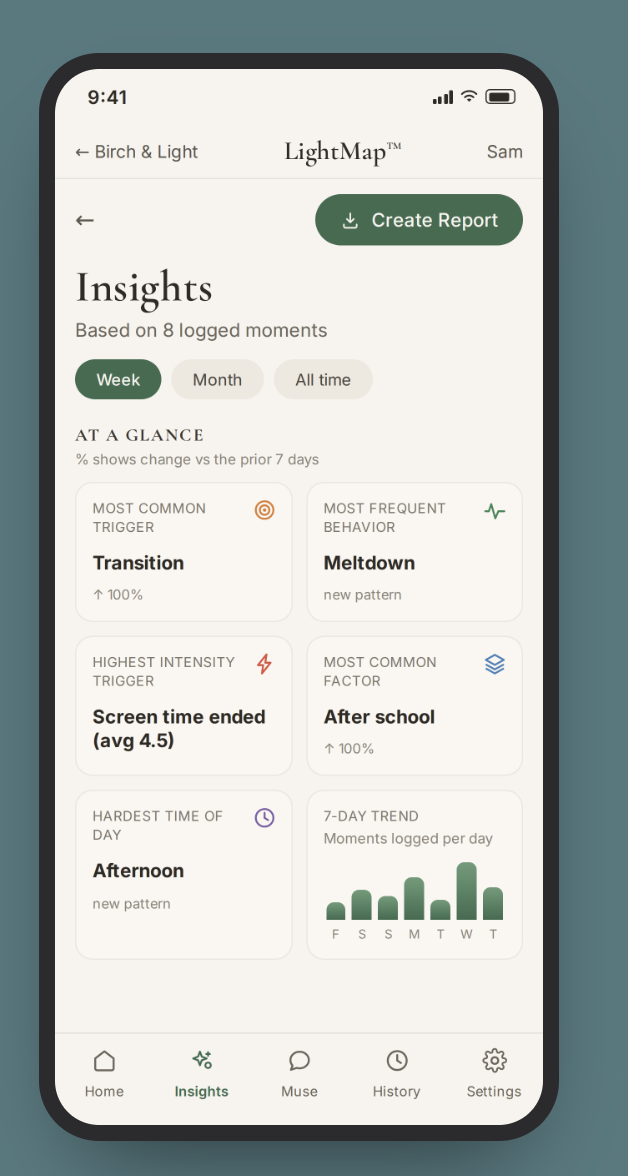

Part of the award-winning Birch & Light Method, honored with the Mom's Choice Gold Award for excellence in family resources.
A story to read together
Sometimes the easiest way in is a story you read side by side.
 The Tower That Looked Fine
A tower in a quiet clearing tries to stay steady through every small thing nobody else seems to notice — until one tiny breath of wind causes her to fall, and a gentle hand begins to gather the blocks back.
Read the story Until I Don't
Rosie shines at dance, at school, with neighbors. At home, the smallest thing can tip her over. One quiet hallway moment helps her family finally find language for the part of her nobody else sees.
Read the story
If today was one of those days
A few more from the library, free to read.
- Emotional RegulationBody-Based Tricks That Actually Interrupt a Meltdown (and the Science Behind Them)
- Emotional RegulationThe Difference Between Defiance and Overwhelm in Teens
- Emotional RegulationDMDD: What the Diagnosis Means and What It Leaves Out
- NeurodivergenceYour ADHD Child Just Got an Autism Diagnosis Too
Researched and drafted with AI assistance, reviewed before publication. Editorial standards