
Your child falls apart at home because she spends the school day holding herself together, and home is the one place it feels safe to stop. The collapse is a sign of trust and an empty tank, not a sign you did something wrong, and a quiet, low-demand arrival helps most.
The teacher says she had a great day. No incidents. No meltdowns. She ate her lunch, did her work, kept it together in the hallway, managed the noise of the cafeteria, navigated recess, sat through two transitions without a word.
And then she walked in your front door.
And everything fell apart.
She dropped her backpack on the floor and burst into tears over nothing — over the wrong cup, over her brother looking at her, over a snack that wasn't what she wanted. Or she came in silent and then erupted twenty minutes later at something so small you can't even remember what it was. Or she walked straight past you, went to her room, and you could hear her through the wall, finally releasing something she'd been holding for six hours.
You stand there in your own kitchen wondering what you did wrong. Wondering why school gets the good version of your child and you get this.
You didn't do anything wrong.
You are, in fact, the safest person in her world. And this is what that looks like.
What's Actually Happening
There's a name for this in parenting circles — the after-school restraint collapse — but the name matters less than understanding what's underneath it.
Your child spent the entire school day doing something extraordinarily demanding: regulating herself in an environment that required it.
School asks children to sit still, transition between subjects, manage noise and crowds and unpredictability, follow instructions from multiple adults, navigate social dynamics with peers, suppress impulses, tolerate frustration, and perform — academically, socially, behaviorally — for six or seven hours straight.
For children whose nervous systems work differently, this is not a normal day. It is an endurance event.
And here's the thing about endurance events: you can get through them. Many children do, every single day. But getting through them requires borrowing from somewhere. The nervous system holds itself together through sheer effort, and that effort has a cost.
No study measures this after-school pattern by name, but its pieces are documented. Emotion regulation difficulty is a recognized feature of autism and ADHD, and in one interview study of adolescent autistic girls, exhaustion from hiding their difficulties at school was the effect they described most often. Sleep matters too. In a school-week experiment with 34 children aged 7 to 11, those who slept about an hour less for five nights were rated by blinded teachers as more emotionally labile and more restless and impulsive (Gruber and colleagues, 2012).
By the time your child walks in your door, the tank is empty. The effort required to keep holding it together simply isn't available anymore.
And then there's you.
Why Does It Happen With You?
This is the part that tends to break parents' hearts a little, and then, once they really understand it, puts it back together.
Your child falls apart at home because home is safe. Because you are safe.
The nervous system is extraordinarily intelligent. It knows, without your child consciously deciding anything, where the consequences of falling apart are survivable. At school, falling apart has social costs. Peer perception costs. Sometimes academic costs. The nervous system calculates all of this and holds the line.
At home, with you, the calculation is different. Here, falling apart is allowed. Here, someone will still be there on the other side of it. Here, love is not conditional on composure.
What looks like your child saving her worst behavior for you is actually your child trusting you with the most unguarded version of herself.
That is not a small thing. That is everything.
What Makes It Harder
Some things tend to amplify the after-school collapse, and it's worth knowing what they are.
Transitions. The moment of crossing the threshold — car to home, school to front door — is itself a nervous system event. Some children who hold it together during the walk to the car will begin to unravel in the car, before they're even home. The transition signals: you can let go now.
Hunger. This one is almost embarrassingly straightforward, but it matters enormously. A child who has barely eaten lunch is running on empty in every sense. The nervous system has fewer resources to draw on when blood sugar is low.
The weight of specific things. Sometimes the meltdown isn't random. It's the release of something specific that happened — a moment of social rejection at recess, a test that felt hard, a conflict with a teacher — that your child couldn't process in the moment and is now processing now. The trigger at home is rarely the real thing. It's the door the real thing finally came out of.
Sensory accumulation. For children with sensory sensitivities, a school day is also a full day of managing input — fluorescent lights, noise, physical proximity to other bodies, scratchy uniforms, unpredictable smells. By afternoon, the sensory load alone is significant. Home is the first place that load can begin to come off.
While you're here, take the guide
What's Underneath is free: the three body-state triggers under most meltdowns, what to say in the minute before it tips over, and how to reset afterward.

You'll get the guide instantly, plus five free articles in your inbox every week. Real challenges (meltdowns, school mornings, picky eating, big feelings) and how to actually handle them. Unsubscribe anytime.
What Doesn't Help in That Moment
When a child comes home and immediately begins to fall apart, the instinct is often to problem-solve, redirect, or address the behavior directly.
"What's wrong? Tell me what happened."
"You need to calm down before we can talk."
"If you keep this up you're going to lose screen time."
These responses are completely understandable. They are also, in the moment, almost always ineffective.
A nervous system in collapse is not in a state to problem-solve, articulate, negotiate, or respond to consequences. The thinking part of the brain is genuinely less accessible when the body is in this state. Asking a child to use it before they've had a chance to come down is asking for something they literally cannot give you right now.
What Helps in That Doorway Moment?
Lower the demand of arrival. The transition home is its own moment. Some children do better when they don't have to talk, perform, or answer questions the moment they walk in. A snack waiting. Low lights. Quiet. Permission to decompress before anything is asked of them.
Don't take the bait. When the eruption comes over the wrong cup or the wrong snack, resist the urge to address the cup. The cup is not the point. Your child is not actually upset about the cup. Staying calm and present — not fixing, not explaining, just being steady — is often the most useful thing you can do.
Offer co-regulation before communication. Sit near her. Put a hand on her back if she'll allow it. Match her rhythm and then slowly, gradually, bring your own energy down. Children whose nervous systems are dysregulated can borrow regulation from a calm adult nearby. This is not a metaphor — it's how nervous systems work.
Create a decompression ritual. Some children do better when the transition home has a predictable shape. The same snack. The same quiet corner. The same ten minutes with no demands before the afternoon begins. Predictability helps the nervous system know what's coming and begin to settle before the collapse.
Ask later, not now. The conversation about what happened at school — if it needs to happen at all — almost always goes better after the nervous system has had time to settle. Twenty minutes, an hour, over dinner. Not at the door.
The Bigger Picture
If this is a daily pattern in your house, it is worth paying attention to — not because something is wrong with your child, but because the pattern itself is information.
A child who consistently comes home depleted is a child whose school environment may be asking more of her than her nervous system can sustain without a cost. That's useful to know. It might inform conversations with teachers, adjustments to the school day, accommodations worth asking about, or simply the way you structure the hours after school.
It might also just be a season. Some children grow into more capacity over time. The after-school collapses that were daily at seven become occasional at nine and rare at eleven. The nervous system, with support, builds resilience.
But right now, in this season, what your child needs most in that doorway moment is not correction.
It's you. Steady. Present. Not frightened by the size of what she's carrying.
She chose to put it down in front of you because you are the person she trusts most in the world.
Every behavior is a clue.
If the after-school hours feel like a mystery you can't solve, LightMap can help you start to see the pattern — what makes the collapse bigger, what helps it settle faster, and what your child's nervous system might be trying to tell you. Explore LightMap at birchandlight.com/lightmap.
Sources: Mazefsky CA and colleagues, "The role of emotion regulation in autism spectrum disorder," Journal of the American Academy of Child and Adolescent Psychiatry 2013;52(7):679-688. Shaw P, Stringaris A, Nigg J, Leibenluft E, "Emotion dysregulation in attention deficit hyperactivity disorder," American Journal of Psychiatry 2014;171(3):276-293. Halsall J, Clarke C, Crane L, "Camouflaging by adolescent autistic girls who attend both mainstream and specialist resource classes," Autism 2021;25(7):2074-2086. Morris AS and colleagues, "The role of the family context in the development of emotion regulation," Social Development 2007;16(2):361-388. Gruber R and colleagues, "Impact of sleep extension and restriction on children's emotional lability and impulsivity," Pediatrics 2012;130(5):e1155-e1161.
For your child: Until I Don't is about a girl who shines at school, at dance, and with the neighbors, and comes apart over small things at her own kitchen table.
For education and reflection, not medical advice. Our terms
See what's underneath
Next time, you will know what set it off
LightMap reads your hard days together and gives you answers. Start with one moment today.
Start with 3 moments Not sure where to start? Ask me.Message Tara on WhatsApp. It really is me, I read everything and will personally respond.Click here to message Tara →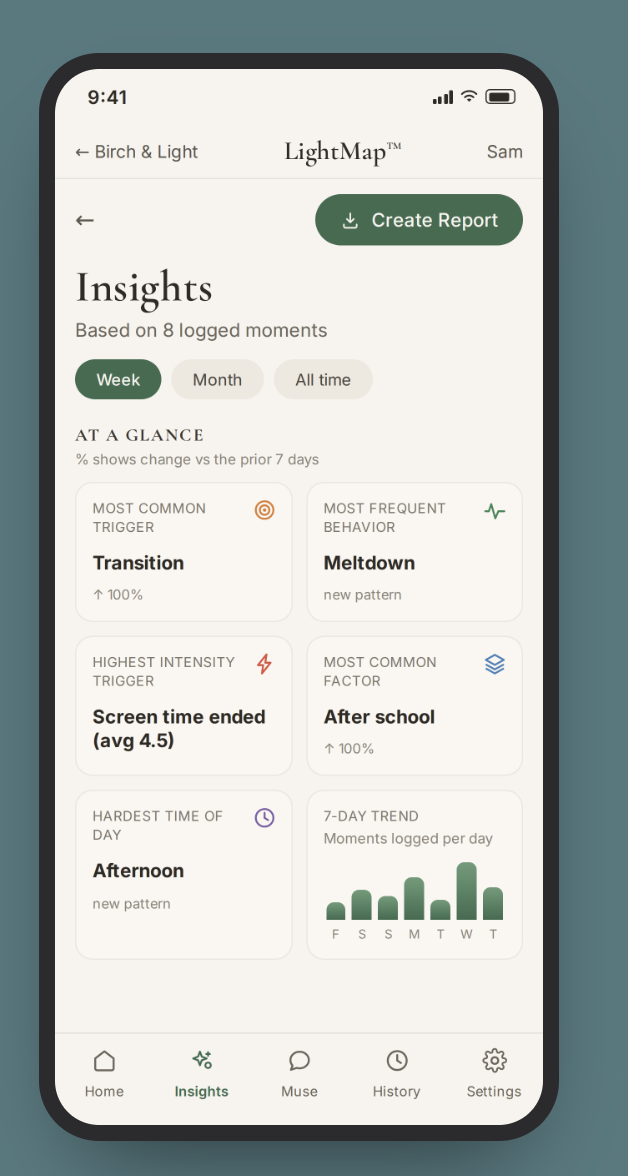

Part of the award-winning Birch & Light Method, honored with the Mom's Choice Gold Award for excellence in family resources.
A story to read together
Sometimes the easiest way in is a story you read side by side.
 The Tower That Looked Fine
A tower in a quiet clearing tries to stay steady through every small thing nobody else seems to notice — until one tiny breath of wind causes her to fall, and a gentle hand begins to gather the blocks back.
Read the story The Princess and the Witch Inside
Esme is loved, but a fast protective part keeps rushing in before she gets a turn. A quiet visitor helps her meet the witch inside — not as an enemy, but as a worried protector — and find her way back to the people she wanted to be with all along.
Read the story
If today was one of those days
A few more from the library, free to read.
- Emotional RegulationWhy Does My Child Melt Down After School? (And What Helps)
- Emotional RegulationAfter School Restraint Collapse: Why the 4pm Crash Happens
- Emotional RegulationBody-Based Tricks That Actually Interrupt a Meltdown (and the Science Behind Them)
- NeurodivergenceYour ADHD Child Just Got an Autism Diagnosis Too
Researched and drafted with AI assistance, reviewed before publication. Editorial standards