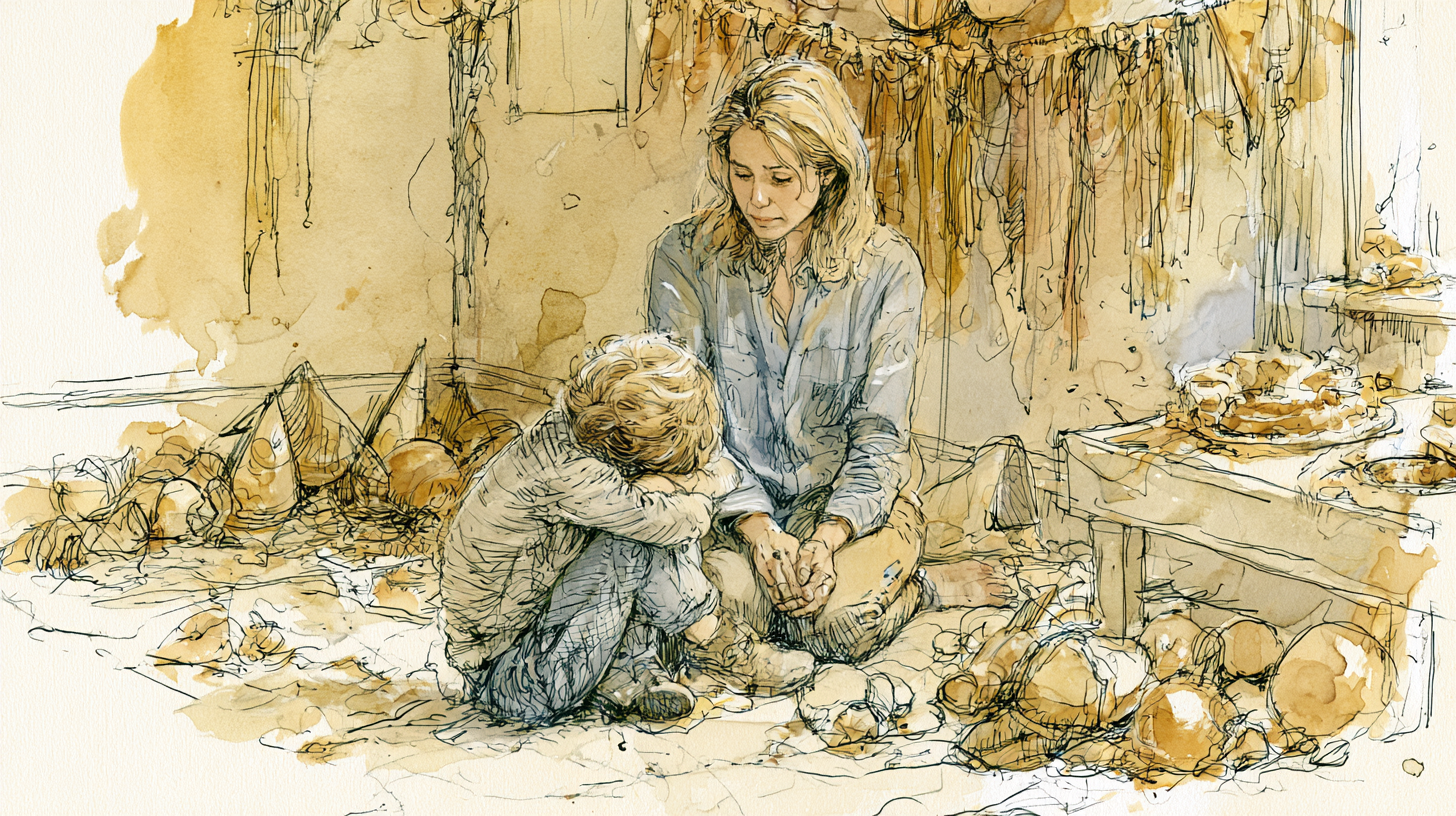
Tuesday was good. He made his bed without being asked. He got dressed the first time you said it. There was a moment in the car where he told you something funny and you both laughed, and you thought, quietly, so as not to jinx it, that maybe something had turned.
Wednesday he threw a chair.
If you have lived this, you have probably also lived the interpretation that follows it, which is that he can do it when he wants to, and Wednesday was a choice. That reading is wrong, and it is the single most damaging conclusion a parent can draw about a child like this.
A good day is not free
For a lot of neurodivergent children, holding it together is effortful in a way it is not for other kids. Sitting still, tracking instructions, keeping the volume down, waiting a turn, tolerating the tag in the shirt, reading the room, staying pleasant when something felt unfair. None of it runs on its own. All of it draws down.
On a good day, your child spends more, not less. The cooperation you saw was purchased. The bed got made because he had enough in reserve that morning to override the pull of everything else, and overriding costs something.
So Wednesday is not a reversal. Wednesday is the bill.
This is the same mechanism behind the four o'clock crash after school, stretched across two days instead of one afternoon. The child who holds it together for six hours at school and falls apart in the kitchen is doing on a daily cycle what this child is doing on a slightly longer one.
Why the good day makes the next one harder
There is a second thing happening, and it is entirely accidental.
When a child has a good day, the adults around them respond to it. Not with anything unkind, quite the opposite. We are pleased. We say so. We add. Since he is doing so well, let us also stop at the store. Since he is in a good mood, let us invite the cousins. Since he managed the morning, let us try the birthday party after all.
Every one of those is reasonable, and together they turn a good day into a longer day with more demands in it. The reward for capacity is more to do with it. By the following morning the reserve is gone, and the same requests that were fine on Tuesday now land on a child who has nothing left to meet them with.
Schools do this too, often formally. A run of good days becomes a reason to reduce support, drop the break, try the mainstream classroom for another period. The improvement gets read as new baseline rather than as peak output, and the supports that produced it get withdrawn precisely when they were working.
What to do with a good day instead
The counterintuitive move is to ask for less on the day that is going well, not more.
Protect the shape of it. Keep the good day roughly the same length and density as an ordinary one. Resist the urge to add the errand, the extra outing, the second social thing. The goal is a Tuesday that does not create a Wednesday.
Guard the evening especially. Whatever went well during the day, the last two hours are where the deficit shows first. Fewer demands after dinner, an earlier landing, less asked of them at bedtime than you would ask on a neutral day.
Say nothing performative about it. Some children hear you noticed how well you did today as pressure to repeat it, which adds a new demand on top of a day that already cost them. A quiet ordinary comment lands better than praise that raises the stakes.
Let the good day be evidence of what supports are doing, rather than evidence they can be removed. If Tuesday went well, the useful question is what was in place on Tuesday, not what can now be taken away.
While you're here, take the guide
What's Underneath is free: the three body-state triggers under most meltdowns, what to say in the minute before it tips over, and how to reset afterward.

You'll get the guide instantly, plus five free articles in your inbox every week. Real challenges (meltdowns, school mornings, picky eating, big feelings) and how to actually handle them. Unsubscribe anytime.
What to do with the day after
Lower the bar and say so. Wednesday is a maintenance day. Food, rest, minimum required output, nothing optional. You are not rewarding the chair throwing by reducing demands. You are responding to a nervous system that has run out, which is a different thing entirely.
Do not relitigate Tuesday. Any version of you were fine yesterday, so I know you can do this lands as an accusation, and it teaches the child that a good day will be used against them later. Some children start suppressing their good days for precisely this reason, because the visible capacity gets converted into an expectation they cannot sustain.
Hold the essential boundaries and drop everything else. Safety stays. Kindness gets addressed later, when the tank is not empty. The homework and the shower and the tidy room can wait a day, and the world does not end.
Do the teaching afterward. Not during, not the same evening, and never in the form of a comparison to yesterday.
Tracking it, if the pattern is unclear
Sometimes the rhythm is obvious and sometimes it takes a few weeks to surface. If you are not sure whether you are seeing a real pattern or just a hard stretch, note down two things a day for a month: roughly how the day went, and what was in it. Not a detailed log, two lines.
What most parents find is that the crashes are not random and they are not caused by the thing that happened just before them. They follow load. A good day, a full weekend, a birthday party, a school trip, a stretch of holding it together for company. The trigger everyone points to is the last thing on top of a stack that was already too tall.
Once you can see the stack, you can move things off it in advance, which is the only intervention that reliably works. Everything else is management after the fact.
Some children run this cycle across weeks rather than days, with long good stretches followed by long crashes. The mechanism is the same and the timescale is different.
The reframe that matters
He can do it when he wants to is technically true and completely useless, because it treats capacity as motivation. He can do it when he has the resources to do it. On Tuesday he did. On Wednesday he did not, and no amount of wanting closes that gap.
The child in this pattern is usually the last person who needs convincing that Wednesday was bad. He was there. He knows he threw the chair and he knows Tuesday was better and he cannot explain the difference either, which is its own kind of frightening when you are seven.
What helps him most is an adult who does not treat the good day as proof and the bad day as betrayal, but treats both as information about how much he had that morning.
Sources: Raymaker et al., research on autistic burnout and the cost of sustained masking (Autism in Adulthood, 2020); Pearson and Rose, conceptual analysis of masking and camouflaging in autistic people (Autism in Adulthood, 2021); peer-reviewed research on camouflaging and its association with exhaustion and mental health outcomes (PMC). The good-day rebound described here is a pattern widely reported by parents and clinicians rather than a formally studied phenomenon, and it is presented as an observed pattern, not a research finding.
For education and reflection, not medical advice. Our terms
See what's underneath
Next time, you will know what set it off
LightMap reads your hard days together and gives you answers. Start with one moment today.
Start with 3 moments Not sure where to start? Ask me.Message Tara on WhatsApp. It really is me, I read everything and will personally respond.Click here to message Tara →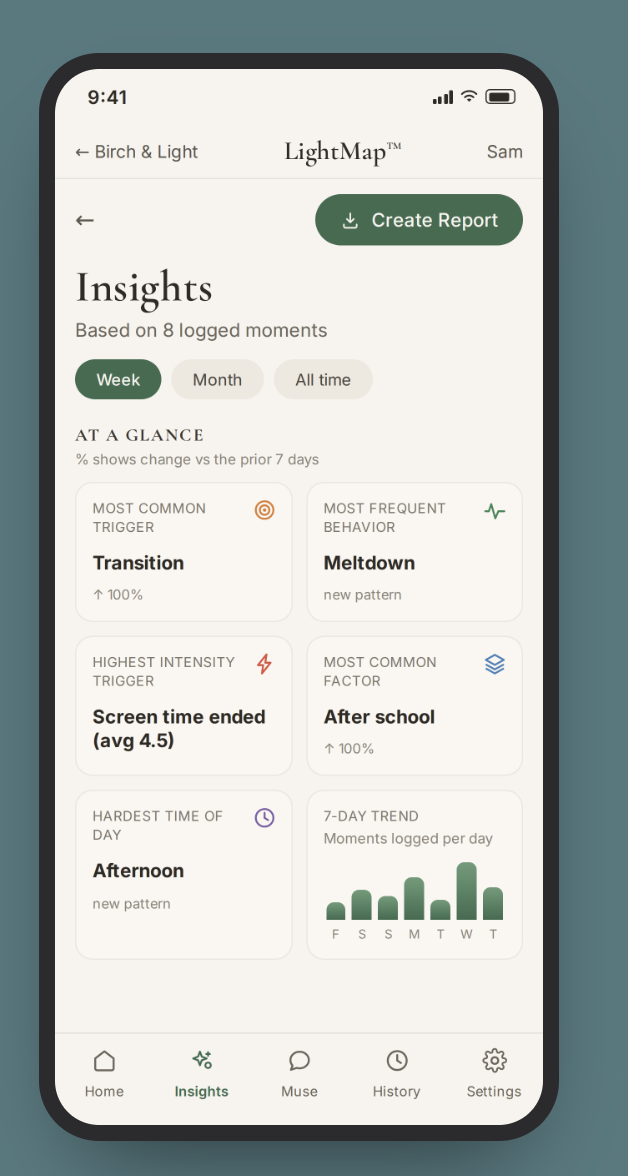

Part of the award-winning Birch & Light Method, honored with the Mom's Choice Gold Award for excellence in family resources.
A story to read together
Sometimes the easiest way in is a story you read side by side.
 The Tower That Looked Fine
A tower in a quiet clearing tries to stay steady through every small thing nobody else seems to notice — until one tiny breath of wind causes her to fall, and a gentle hand begins to gather the blocks back.
Read the story Until I Don't
Rosie shines at dance, at school, with neighbors. At home, the smallest thing can tip her over. One quiet hallway moment helps her family finally find language for the part of her nobody else sees.
Read the story
If today was one of those days
A few more from the library, free to read.
Researched and drafted with AI assistance, reviewed before publication. Editorial standards