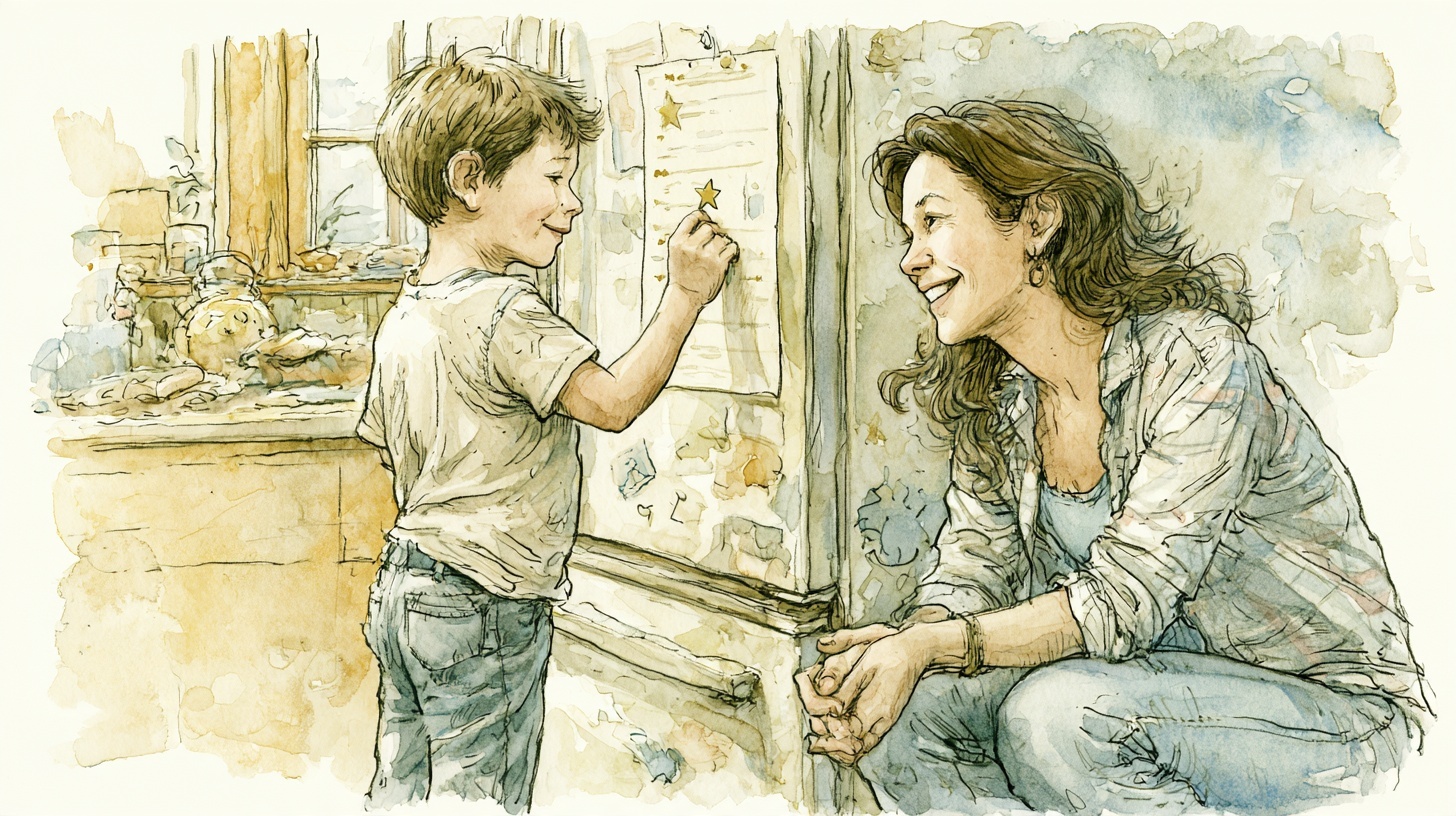
You set it up on a Sunday night. A chart on the fridge, a sticker for every morning he gets dressed without a fight, and ice cream on Saturday if he fills the row. Monday goes well. Tuesday goes fine. By Thursday he has stopped looking at the chart, and on Saturday you are deciding whether to go for ice cream anyway, because he has one sticker and a very sad face.
It is easy to take from a week like that that rewards do not work for your kid. The research says something more useful. Rewards do work for children with ADHD, but only when they arrive fast enough to count, and most home reward systems are built for a brain that can feel Saturday from Tuesday.
A reward that is far away counts for less
Researchers call it delay discounting: how much a reward loses its pull the longer you have to wait for it. Everyone does it. Children and adults with ADHD do it more. When a 2016 meta-analysis pooled 21 studies covering nearly 4,000 people, the difference between people with and without ADHD was consistent and medium in size, and it showed up the same way in children as in adults.
In everyday terms, Saturday's ice cream is a smaller prize to your son on Tuesday morning than it is to his sister, even if they love ice cream the same. He is not choosing to care less. By the time the reward shows up, the thing he did to earn it is long gone from view.
Russell Barkley builds two chapters of 12 Principles for Raising a Child with ADHD around this: "Touch More, Reward More, and Talk Less" and "Make Time Real." The thread through both is that a child with ADHD needs the consequence close to the behavior and the passage of time made visible, not more reminders about a prize at the end of the week.
What a reward system built for ADHD looks like
- Now, not later. The reward or a token toward it lands within seconds of the behavior, not at bedtime. If the big prize is on Saturday, he needs something he can see or hold in the moment that counts toward it.
- Small and often beats big and rare. Several small wins a day keep the system alive. One big win a week lets it die by Wednesday.
- Visible. Tokens in a jar, marbles moving from one cup to another, a tally on the whiteboard he walks past. The system has to be in front of him, not in your head.
- Named praise with it. "You got your shoes on before I asked" tells him what earned it. "Good job" does not.
- One behavior at a time. Pick the thing that causes the most friction and start there. A chart with eight rows asks for eight kinds of self-control at once.
- Start where he can win. Set the first target at something he manages on a decent day, so the system pays out in the first week and he believes in it.
- Change it before it goes stale. Most reward systems lose their pull after a couple of weeks. Rotating the prize or the token keeps it from turning into wallpaper.
Will rewards ruin his motivation?
This is the worry that stops a lot of parents, and it comes from real research. A 1999 meta-analysis of 128 experiments found that expected, tangible rewards reduced how much people chose to keep doing an activity on their own afterward, and that tangible rewards tended to do more of this damage in children than in college students.
The detail that gets lost is what kind of activity those experiments were about. The authors were clear that the undermining effect applies to tasks people already find interesting. When a task holds little interest to begin with, there is little motivation there to undermine. So do not pay him to build Lego or draw, which he already loves. Getting dressed, brushing teeth and starting homework are not in that category for most kids, and those are where a reward system belongs.
The same analysis found that positive feedback held up far better than tangible rewards, though its boost was smaller for children than for adults. That is one more reason to pair every token with a sentence that tells him what he did.
While you're here, take the guide
What's Underneath is free: the three body-state triggers under most meltdowns, what to say in the minute before it tips over, and how to reset afterward.

You'll get the guide instantly, plus five free articles in your inbox every week. Real challenges (meltdowns, school mornings, picky eating, big feelings) and how to actually handle them. Unsubscribe anytime.
What the evidence says, including the limits
Reward systems are the core of behavioral parent training, which reviews of the research rate as a well-established treatment for ADHD. The American Academy of Pediatrics recommends it as the first treatment for preschoolers with ADHD, and alongside medication for school-age children.
It is not a cure, and a fair account says so. A 2020 review found that behavioral parent training is moderately effective at reducing oppositional behavior and improving parenting, but it does not reduce ADHD symptoms when they are rated by observers who do not know which families got the training, and the gains fade after the training stops. A reward system is scaffolding you keep up, not a fix you install once and take down.
When a reward is the wrong tool
Some hard moments are not about motivation at all. If your child is melting down because he is anxious, overwhelmed, flooded or pushing back against demands, a sticker cannot compete with what is happening in his body, and a reward system can add pressure to a moment that already has too much. Why behavior charts sometimes fail goes into that side in depth.
The hard part is telling the two apart in your own house. The morning fight that looks like he will not get dressed might be about time, about the itchy shirt, or about the spelling test at nine. The quickest way to know is to look at a week of them side by side: what happened right before, what time it was, what helped. LightMap is built for that. Log the hard moments as they happen and the pattern starts to show you which ones a reward can reach and which ones need something else.
If it turns out to be the kind a reward can reach, you now know how to build one that pays off on Tuesday instead of Saturday.
Sources, tied to the claims they support. The finding that people with ADHD discount delayed rewards more steeply than controls, pooled across 21 studies and 25 case-control comparisons (N=3,913) with a medium effect size (d=0.43) and no significant difference between child and adult samples: Jackson JNS, MacKillop J, "Attention-Deficit/Hyperactivity Disorder and Monetary Delay Discounting: A Meta-Analysis of Case-Control Studies," Biological Psychiatry: Cognitive Neuroscience and Neuroimaging, 2016;1(4):316-325. The chapter titles and the emphasis on immediate reinforcement and making time visible: Barkley RA, 12 Principles for Raising a Child with ADHD, Guilford Press, 2020. The finding across 128 experiments that expected tangible rewards undermined free-choice intrinsic motivation, more so in children than college students, that positive feedback enhanced it, and the authors' statement that the theory concerns tasks that are initially interesting rather than boring ones: Deci EL, Koestner R, Ryan RM, "A Meta-Analytic Review of Experiments Examining the Effects of Extrinsic Rewards on Intrinsic Motivation," Psychological Bulletin, 1999;125(6):627-668. Behavioral parent training rated a well-established treatment: Evans SW, Owens JS, Bunford N, "Evidence-Based Psychosocial Treatments for Children and Adolescents With Attention-Deficit/Hyperactivity Disorder," Journal of Clinical Child and Adolescent Psychology, 2014;43(4):527-551. Behavioral treatment as first line for preschoolers and alongside medication for school-age children: Wolraich ML et al., "Clinical Practice Guideline for the Diagnosis, Evaluation, and Treatment of Attention-Deficit/Hyperactivity Disorder in Children and Adolescents," Pediatrics, 2019;144(4):e20192528. The limits of behavioral parent training (moderate effects on oppositional behavior and parenting, no reduction in blinded ADHD symptom ratings, effects dissipating after training): van der Oord S, Tripp G, "How to Improve Behavioral Parent and Teacher Training for Children with ADHD: Integrating Empirical Research on Learning and Motivation into Treatment," Clinical Child and Family Psychology Review, 2020;23(4):577-604.
For education and reflection, not medical advice. Our terms
See what's underneath
Find what your hard moments have in common
LightMap turns a week of rough mornings into a pattern you can plan around.
Start with 3 moments Not sure where to start? Ask me.Message Tara on WhatsApp. It really is me, I read everything and will personally respond.Click here to message Tara →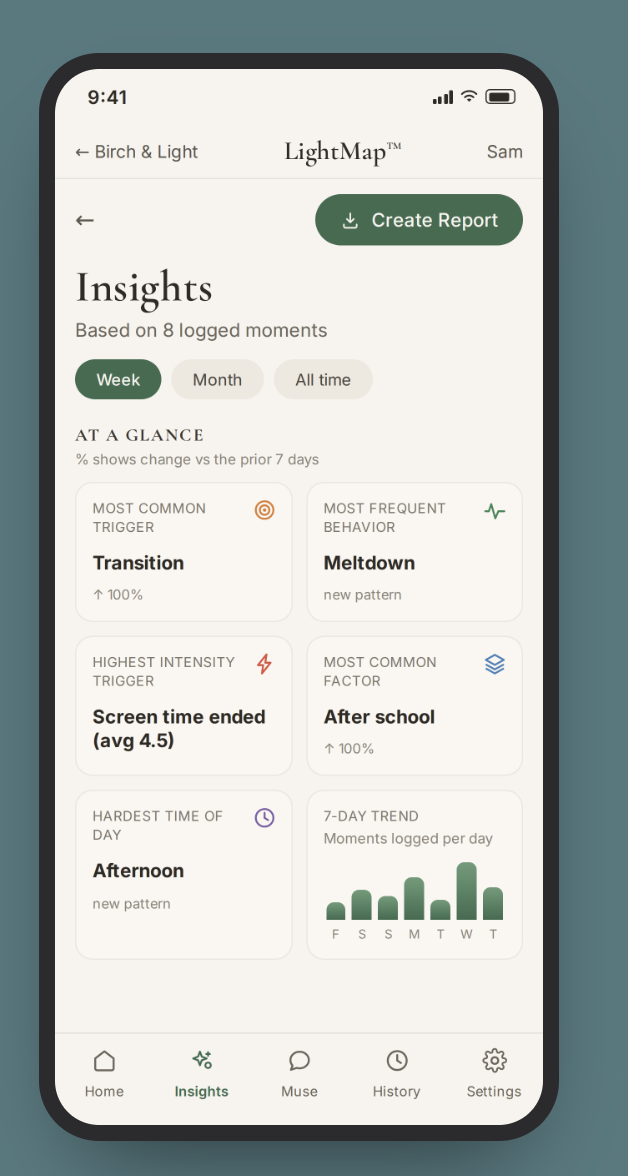

Part of the award-winning Birch & Light Method, honored with the Mom's Choice Gold Award for excellence in family resources.
Researched and drafted with AI assistance, reviewed before publication. Editorial standards