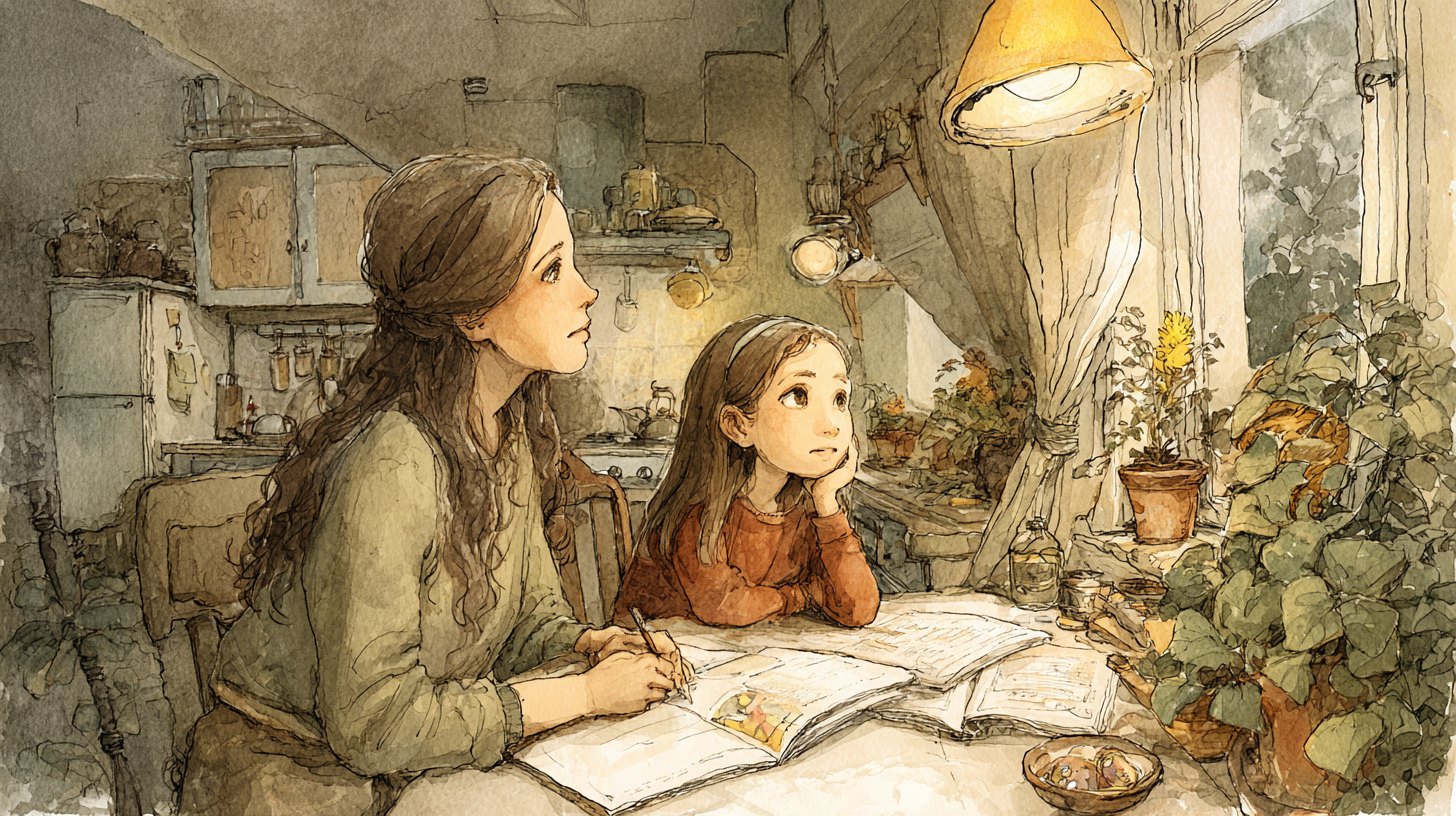
Inattentive ADHD in girls is often missed because it is quiet. Instead of bouncing off the walls, many girls drift, daydream, lose things, work twice as hard to keep up and hold it together at school. The struggle often becomes visible around puberty, when schoolwork gets harder and hormones start to shift, and it tends to show up as anxiety, low mood or falling apart at home.
Maybe it looks like this in your house. Her teachers say she is a pleasure to have in class. She is polite, quiet, never a problem. Then she gets home and melts down over a worksheet that should have taken ten minutes. She forgets the permission slip, the gym clothes, the project due tomorrow. She says she is stupid. She says she is lazy. And somewhere around twelve or thirteen, the girl who was managing starts to unravel, and nobody outside your house seems to see it.
If that sounds familiar, you are not imagining it, and you did not miss something obvious. Here is why this happens and what helps.
Why girls get missed
Most people still picture ADHD as a boy who cannot sit still. Girls with ADHD are more likely to have the inattentive presentation, and inattention is easy to overlook. A child staring out the window does not disrupt the class. A child who quietly does not finish her work can look like she simply is not trying.
Research has backed this up for years. A 2002 meta-analysis found that compared with boys with ADHD, girls with ADHD showed fewer hyperactive and externalizing behaviors and more internalizing problems, like anxiety and low mood. A review of ADHD in women and girls described it as a "hidden diagnosis" and pointed to the same reasons: inattentive rather than hyperactive symptoms, internalizing rather than acting out, and coexisting anxiety and depression. That review also made a point every parent of a bright, struggling girl should hear: good grades do not rule out ADHD.
A large Swedish twin study found that girls with high ADHD traits were more likely to be missed in the diagnostic process unless they also had more obvious behavior problems. A related study from the same research group found that emotional problems were what most often separated the girls who got diagnosed from the girls with just as many symptoms who did not. In other words, many girls are not noticed until they are visibly hurting.
What it can look like
Every child is different, but these are some of the patterns parents describe most often:
- Daydreaming and drifting: she misses instructions, then copies what everyone else is doing so no one notices.
- Disorganization: lost papers, a backpack full of crumpled sheets, a room that looks like a storm went through it.
- Working harder than anyone sees: homework that takes hours, staying up late to finish, perfectionism to make up for what slips.
- Holding it together at school, falling apart at home: the effort of masking all day has to go somewhere.
- Friendship trouble: missing parts of conversations, feeling left out, not knowing why.
- Harsh self-talk: "I'm stupid," "I'm lazy," "What's wrong with me?"
- Anxiety and low mood: these are often what finally bring a girl to a doctor, and ADHD can be missed underneath them.
Why puberty is often the turning point
Two things change around the same time. School demands climb. There are more teachers, more assignments, more deadlines and less hand-holding, and the strategies that got her through elementary school stop working. At the same time, her hormones begin to shift.
Researchers are only starting to study how hormones interact with ADHD, but early work points in a clear direction. A 2023 review in Hormones and Behavior noted that ADHD symptoms and impairment tend to increase in girls during adolescence, and cited longitudinal research linking pubertal development in girls with greater impairment and more depressive symptoms. A 2018 study that tracked hormones and daily ADHD symptoms in young women found that symptoms rose at certain points in the menstrual cycle, early in the cycle around the start of a period and again after ovulation.
Most of this research is in young adult women, not teens, so it is still early. But it matches what many mothers notice: some weeks are fine, and some weeks everything falls apart, and the hard weeks may line up with her cycle. If you see that pattern, it is real information to bring to her doctor.
What helps
Name what you see, without blame. Many girls with inattentive ADHD have spent years believing they are lazy or not smart enough. Hearing that their brain works differently, and that the struggle has a reason, can be a huge relief.
Ask for a full evaluation, and tell the evaluator the whole story. Describe what happens at home, not only at school. Mention the anxiety, the mood, the hours of homework, and any pattern you have noticed around her cycle. If she was evaluated for anxiety or depression and ADHD was never considered, ask about it directly.
Build supports outside her head. Planners she chooses herself, phone alarms, a launch pad by the door for everything she needs in the morning, and big assignments broken into small steps work better than reminders and lectures. Check in on the plan, not just the grades.
Talk to the school. A girl who is quietly drowning may qualify for support under a 504 plan or an IEP even if her grades look fine. Teachers often do not see the cost because she is working so hard to hide it.
Watch her mood closely. Anxiety and depression are common alongside ADHD in girls. If she seems hopeless, withdrawn or talks about not wanting to be here, get help right away from her doctor or a mental health professional.
Help her quiet the harsh voice. Our story Theo's Invisible Backpack is about a little bear whose backpack fills with heavy stones from the hard things people say, including some he adds himself. It is written for younger children, but many families use it to start the conversation about the stones we pick up from our own self-talk.
Seeing the pattern
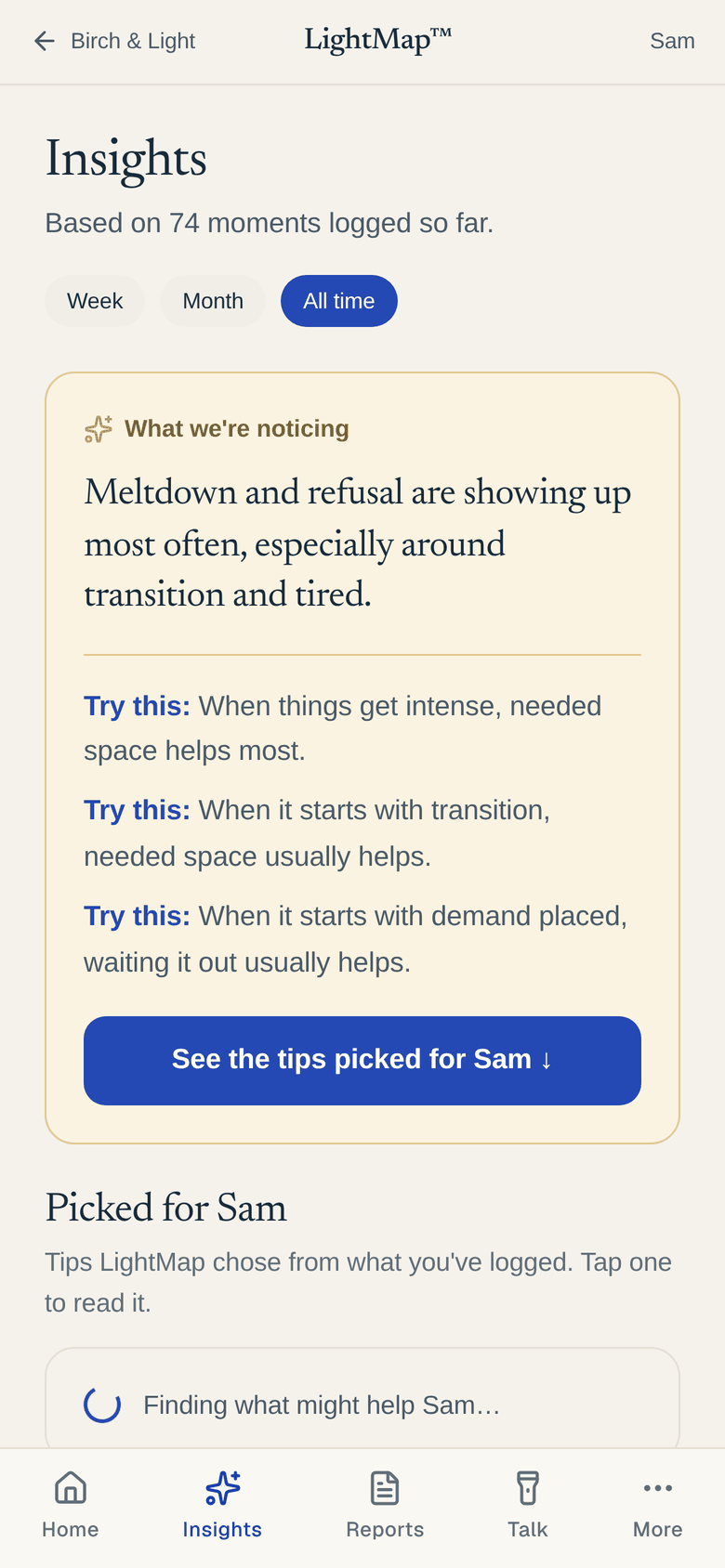
Inattentive ADHD in girls is hard to see from the outside, which is why your view from home matters so much. In LightMap you can log the hard moments and the good ones in a few taps, along with sleep, medication and her menstrual cycle, and upload any evaluations or school reports you already have. Over a few weeks, the patterns start to show, and you get a report to bring to her doctor and an IEP or 504 Report for her school, so the people helping her see what you see.
This is general information for parents, not medical or clinical advice. Talk with your child's pediatrician, psychiatrist or psychologist about evaluation and treatment. If your child is in crisis, call or text 988 in the US. Sources: Gershon J, "A meta-analytic review of gender differences in ADHD," Journal of Attention Disorders, 2002, 5(3), 143-154, doi 10.1177/108705470200500302. Quinn PO, Madhoo M, "A review of attention-deficit/hyperactivity disorder in women and girls: uncovering this hidden diagnosis," Primary Care Companion for CNS Disorders, 2014, 16(3), PCC.13r01596, doi 10.4088/PCC.13r01596. Mowlem FD, Rosenqvist MA, Martin J, Lichtenstein P, Asherson P, Larsson H, "Sex differences in predicting ADHD clinical diagnosis and pharmacological treatment," European Child and Adolescent Psychiatry, 2019, 28(4), 481-489, doi 10.1007/s00787-018-1211-3. Mowlem F, Agnew-Blais J, Taylor E, Asherson P, "Do different factors influence whether girls versus boys meet ADHD diagnostic criteria? Sex differences among children with high ADHD symptoms," Psychiatry Research, 2019, 272, 765-773, doi 10.1016/j.psychres.2018.12.128. Roberts B, Eisenlohr-Moul T, Martel MM, "Reproductive steroids and ADHD symptoms across the menstrual cycle," Psychoneuroendocrinology, 2018, 88, 105-114, doi 10.1016/j.psyneuen.2017.11.015. Eng AG, Nirjar U, Elkins AR, et al., "Attention-deficit/hyperactivity disorder and the menstrual cycle: Theory and evidence," Hormones and Behavior, 2023, 158, 105466, doi 10.1016/j.yhbeh.2023.105466.
LightMap by Birch & Light
You just found what you've been searching for
Log the hard moments. LightMap turns them into answers: the reason underneath, what helps, and how to explain it to the school and the care team so they finally understand too. Easy, calm, and a little bit magic.
Get 7 days of LightMap free.
Enter your email and I'll send your link and a short guide to your first week. No card.
Start my free weekNo card. No password yet.
7 days free. No card required.
Or get a free 15 minute LightMap Analysis with TaraFree. No card. 15 minutes.
“LightMap showed me patterns I wasn't connecting before. Things that looked random stopped feeling random.”
 Not sure where to start? Ask me.Message Tara on WhatsApp. It really is me, I read everything and will personally respond.Click here to message Tara →

Part of the award-winning Birch & Light Method, honored with the Mom's Choice Gold Award for excellence in family resources.
For education and reflection, not medical advice. Our terms
Take the guide for later
What's Underneath: the three body-state triggers under most meltdowns, what to say before it tips over, and how to reset afterward.

You'll get the guide instantly, plus five free articles in your inbox every week. Real challenges (meltdowns, school mornings, picky eating, big feelings) and how to actually handle them. Unsubscribe anytime.
Researched and drafted with AI assistance, reviewed before publication. Editorial standards