If your child repeats words, phrases or lines from shows, that is called echolalia, and it is speech. A child who echoes is using verbal language, so echolalia alone does not make a child nonverbal. Research going back more than 40 years shows that echoed words often hold real meaning, like a request, a protest or a comment, so the most helpful thing you can do is listen for what your child is trying to say.
Maybe it happened like this. You finally got the evaluation, the diagnosis was what you expected, and then you hit a line in the report that stopped you: "deficits in nonverbal communication." You read it three times. Does that mean your child is nonverbal? He talks. He repeats everything. He can recite a whole episode of his favorite show. So what does it mean?
This is one of the most confusing parts of an autism report, and it is not your fault that it reads like a contradiction. Here is what the words mean and what you can do with them.
What echolalia is
Echolalia is the repetition of words or phrases a child has heard from someone else. Researchers describe a few kinds:
- Immediate echolalia: repeating something right after hearing it. You ask, "Do you want juice?" and your child says, "Want juice?"
- Delayed echolalia: repeating something heard earlier, sometimes much earlier, like a line from a movie, a song or something a teacher said last week.
- Mitigated echolalia: repeating a phrase with small changes, such as switching the pronoun or adding a word, which can be a sign the child is starting to build language of their own.
Echolalia is very common in autistic children who use speech.
Is it communication?
For a long time, echolalia was treated as meaningless repetition, something to be reduced or stopped. That view began to change in 1981, when speech researchers Barry Prizant and Judith Duchan videotaped four echolalic boys at home and at school and analyzed more than 1,000 of their utterances. They found that immediate echolalia was far more than meaningless behavior. The children used it to take turns, to answer, to request and to keep a conversation going, and the authors warned that programs aimed only at stopping echolalia could overlook what it was doing for the child (Prizant and Duchan, 1981).
Later work added nuance. A 1988 study of 18 autistic children found that how often children echoed was linked to their expressive language level, not their age. It also found that the functions researchers had described were hard to pin down reliably (McEvoy, Loveland and Landry, 1988). A 2022 review for educators pulled the research together and concluded that echolalia can serve many of the same purposes as other speech, including requesting, commenting, taking turns and sharing information, and urged adults to interpret it rather than suppress it (Cohn, McVilly, Harrison and Stiegler, 2022).
So the honest summary is this: echoed words often mean something, the meaning is not always obvious, and the people who know the child best are usually the ones who can crack the code.
What "deficits in nonverbal communication" means
This phrase comes from the diagnostic criteria for autism. The DSM-5 lists "deficits in nonverbal communicative behaviors used for social interaction" as one of three social communication areas that must be present for an autism diagnosis. It covers things like eye contact, gestures such as pointing or waving, facial expressions, body language, and how well a child pairs words with those signals (American Psychiatric Association, 2013).
In other words, it is about the communication that happens without words. It says nothing about whether your child talks. A child can have a lot of speech and still meet this criterion, and because it is part of the diagnostic criteria, most autism reports include some version of this line.
Nonverbal, minimally verbal and verbal
"Nonverbal" is not a diagnosis and is not one of the diagnostic criteria. It is an informal description, usually used for children who do not use spoken words to communicate. Many clinicians and researchers now prefer "minimally verbal" or "minimally speaking," because many children described as nonverbal understand language and communicate in other ways. A child who repeats words and phrases is using spoken language, even if most of it is echoed for now. If your report does not use the word nonverbal, ask the evaluator before assuming it applies.
What about autism levels?
The DSM-5 severity levels (Level 1, 2 and 3) describe how much support a child needs in social communication and in restricted or repetitive behaviors at the time of the evaluation. Some evaluators assign a level to toddlers and some prefer to wait, because young children change quickly. Both approaches happen in practice, and a level given at three is a snapshot, not a forecast. If you were told a level would come later, it is reasonable to ask when the evaluator plans to revisit it.
You may hear about gestalt language processing
If you spend time in parent groups, you will likely hear that your child is a "gestalt language processor." This idea, closely tied to a therapy approach called Natural Language Acquisition, says some children learn language in whole chunks, like scripts, before breaking them into single words. It has become very popular with parents and speech therapists, partly because it treats echolalia with respect.
The research picture is more mixed than social media suggests. A 2024 critical review in the journal Autism and Developmental Language Impairments concluded that the term is conceptually troubled and that evidence is lacking that gestalt language processing is a distinct clinical category, and recommended individualized, evidence-based supports instead (Hutchins, Knox and Fletcher, 2024). Supporters of the approach have responded, and the debate is ongoing in the speech therapy field.
What both sides largely agree on is the part that matters most at home: echoed words can be meaningful, and they deserve a response rather than correction.
What helps at home
- Respond to the meaning, not the words. If your child says "Do you want a cookie?" while reaching for the pantry, treat it as "I want a cookie" and answer that.
- Get curious about the source. Delayed echoes often come from a specific scene or moment. Knowing where a phrase came from can tell you what feeling or situation it stands for.
- Model short, useful language. Say what your child might want to say, from their point of view, in a few words: "Open, please" or "All done."
- Do not try to stop it. Echolalia is often how a child is getting language in. Building on it tends to help more than shutting it down.
- Ask about every way to communicate. A speech-language pathologist can assess your child's language and talk with you about supports, including picture systems or a speech device, which research suggests do not hold speech back.
Keeping the full picture
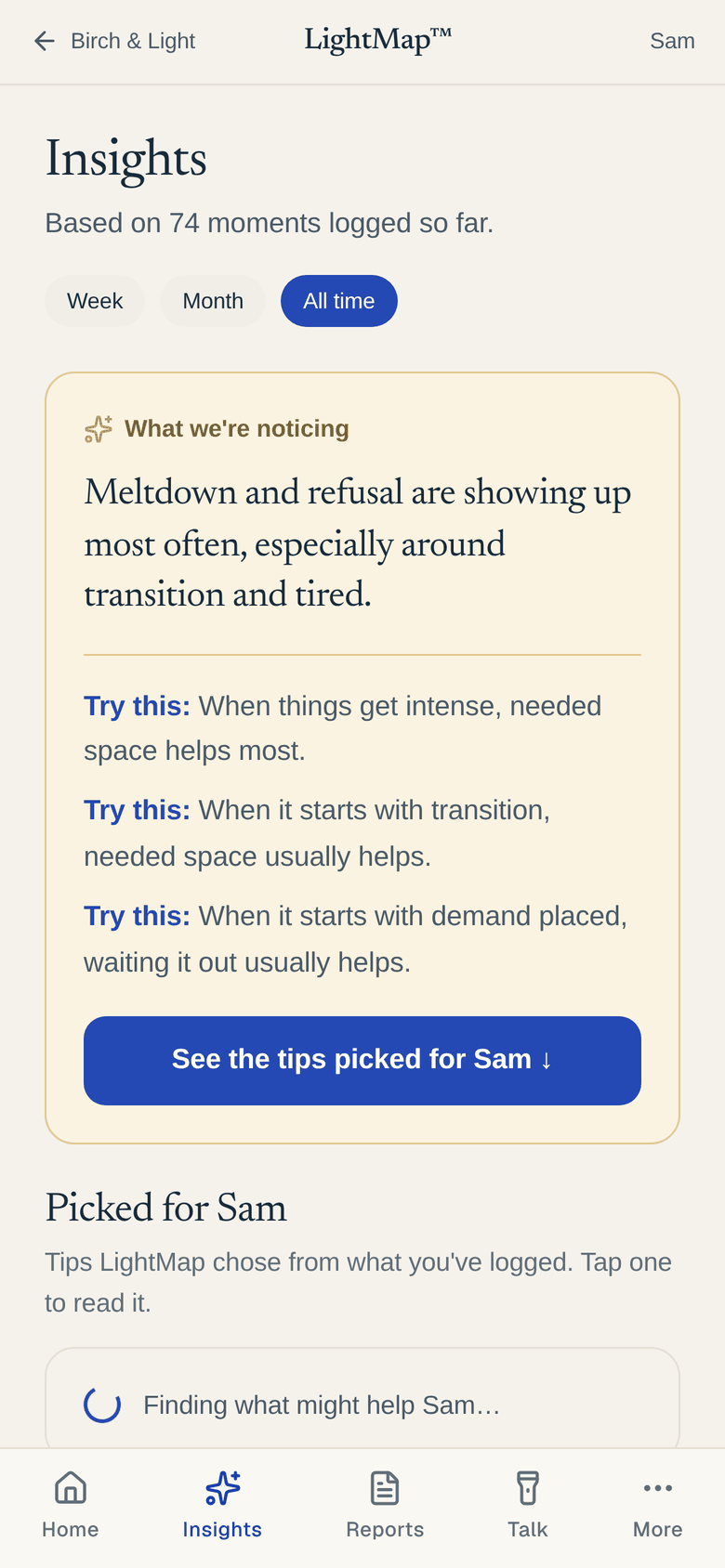
Echolalia makes the most sense when you can see the pattern: which phrases show up, when, and what happened right before. That is hard to hold in your head on top of everything else. In LightMap you can upload your child's evaluation and log the phrases they repeat along with what was happening at the time, and over a few weeks the meanings often start to show. When you meet with the evaluator or speech therapist, you bring real examples instead of trying to remember them on the spot.
This is general information for parents, not medical or clinical advice. Talk with your child's evaluator, pediatrician or speech-language pathologist about your child's communication. Sources: Prizant BM, Duchan JF, "The functions of immediate echolalia in autistic children," Journal of Speech and Hearing Disorders, 1981, 46(3), 241-249, doi 10.1044/jshd.4603.241 (four children, more than 1,000 utterances, school and home). McEvoy RE, Loveland KA, Landry SH, "The functions of immediate echolalia in autistic children: a developmental perspective," Journal of Autism and Developmental Disorders, 1988, 18(4), 657-668, doi 10.1007/BF02211883 (18 children aged 4 to 12, echolalia frequency varied with expressive language level, validity of functional categories not strongly supported). Cohn EG, McVilly KR, Harrison MJ, Stiegler LN, "Repeating purposefully: Empowering educators with functional communication models of echolalia in Autism," Autism and Developmental Language Impairments, 2022, 7, doi 10.1177/23969415221091928. Hutchins TL, Knox SE, Fletcher EC, "Natural language acquisition and gestalt language processing: A critical analysis of their application to autism and speech language therapy," Autism and Developmental Language Impairments, 2024, 9, doi 10.1177/23969415241249944. American Psychiatric Association, Diagnostic and Statistical Manual of Mental Disorders, Fifth Edition (DSM-5), 2013, autism spectrum disorder criteria A2 and severity levels.
LightMap by Birch & Light
You just found what you've been searching for
Log the hard moments. LightMap turns them into answers: the reason underneath, what helps, and how to explain it to the school and the care team so they finally understand too. Easy, calm, and a little bit magic.
Get 7 days of LightMap free.
Enter your email and I'll send your link and a short guide to your first week. No card.
No card. No password yet.
7 days free. No card required.
Or get a free 15 minute LightMap Analysis with TaraFree. No card. 15 minutes.
“LightMap showed me patterns I wasn't connecting before. Things that looked random stopped feeling random.”
 Not sure where to start? Ask me.Message Tara on WhatsApp. It really is me, I read everything and will personally respond.Click here to message Tara →
Part of the award-winning Birch & Light Method, honored with the Mom's Choice Gold Award for excellence in family resources.
For education and reflection, not medical advice. Our terms
Take the guide for later
What's Underneath: the three body-state triggers under most meltdowns, what to say before it tips over, and how to reset afterward.
You'll get the guide instantly, plus five free articles in your inbox every week. Real challenges (meltdowns, school mornings, picky eating, big feelings) and how to actually handle them. Unsubscribe anytime.
Researched and drafted with AI assistance, reviewed before publication. Editorial standards